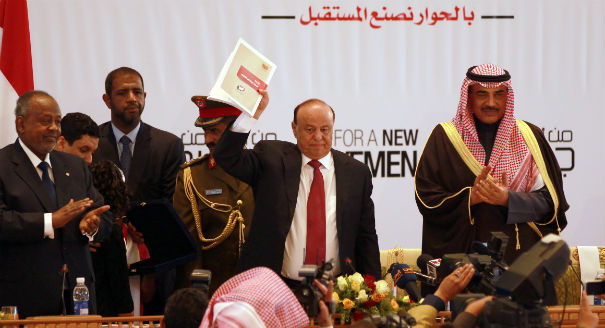
On March 8, interim Yemeni President Abd Rabu Mansour Hadi announced the formation of the Constitution Drafting Committee (CDC), which has been highly controversial within the Yemeni political scene. Several political groups, including the Socialist Party, independent youth organizations, and members of the Islah Party are protesting their lack of representation in the CDC, while others object to the committee’s overall composition, arguing that its members have virtually no expertise in the federalist system model that Yemen aspires to adopt.
In his announcement, Hadi specified that the CDC would have seventeen members; this contradicts the agreement reached by the nation-building team at the National Dialogue Conference, which recommended that the CDC be comprised of 30 members selected according to their area of expertise. However, the National Dialogue Conference Consensus Committee, which represented all the factions in the dialogue, reduced the number of CDC members without any explanation. Currently, only one of these members has experience in constitutional law, but lacks the requisite ten years in the field. The other members have assorted specializations, some of which are unrelated to the constitution. Yet Hadi’s decision was not only heavily criticized for not having the CDC meet standards of legal expertise, but also for not representing the same spectrum of movements as the National Dialogue Conference did. The one group that is better represented in the CDC is women, of which there are four on the seventeen-member committee.
Youth groups, meanwhile, feel marginalized after having proposed specific representatives as specified in the National Dialogue Memorandum that was signed by Hadi on November 21. They were unpleasantly surprised when none of these nominees were selected for the CDC—as they noted in their statement following the announcement of its formation. Seeing as the composition of the CDC combines technocratic and partisan aspects, there are concerns that the members will remain loyal to the parties they represent—particularly Islah and General People’s Congress. Other parties, not well represented on the CDC, are also concerned. The Socialist Party, with only one representative, and the southern secessionist faction headed by Ali Salem al-Beidh argue that the CDC’s formulation is a move to bypass their proposals altogether.
A key feature of the Yemeni state envisioned by the National Dialogue Conference is the presidential federalist system. Building a presidential system would require curbing the president’s powers by removing financial powers from his control, making it a prerogative of the federal legislative branch. The CDC would also need to formulate constitutional articles outlining the federal state and the relationship between the center and the regions in several areas, most importantly the judiciary, public revenue and its redistribution, and concession contracts for mineral extraction. This question has been of concern for many in Yemen’s political elite, who have cautioned the CDC to choose its wording carefully. With insufficient expertise in constitutional law among CDC members—and the relative lack of input from key groups and parties—these necessary articles may not curb presidential authority enough to allow for the federalist system in Yemen.
President Hadi granted the CDC one year to finish its job, with the possibility of further extensions if need be, whereas the original National Dialogue Conference proposal had limited this period to only six months. This move is widely interpreted as a way for Hadi to extend Yemen’s interim period and remain in power longer than originally envisioned. Giving credence to this interpretation is the fact that Hadi has given the CDC the power to supervise a constitutional referendum and organize campaigns to educate Yemenis about the constitution. The CDC will present a draft of the constitution for review and discussion to the National Oversight Agency, a body that is mandated to implement the outputs of the National Dialogue Conference and whose members are scheduled to be announced in the near future. The chair of the constitutional committee in parliament, Ali Abu Haliqa, has said that given the enormity of the CDC’s task, there is no chance that it will not have its timeframe extended—especially after the CDC was assigned further tasks, including preparing laws on the federal regions. However, a prolonged constitutional drafting process could plunge Yemen into a legislative void, generating uncertainty about a range of issues.
The naming of CDC members has clearly taken on considerations unrelated to the constitutional drafting process. This could have been avoided by restricting membership to constitutional experts and politicians in the National Oversight Agency. Yemenis hope that the new constitution will meet their aspirations and put a decisive end to the uncertainty that has paralyzed the country politically and economically. The CDC will need to preserve a fragile unity between the diverse components of the Yemeni population, which it cannot do without ensuring that all voices have a say in Yemen’s next constitution.
Ashraf al-Falahi is a Sana’a-based Yemeni journalist.
This article was translated from Arabic.