Social and economic grievances among Palestinian residents and the contentious politics of the Israeli right underlie East Jerusalem’s turmoil.
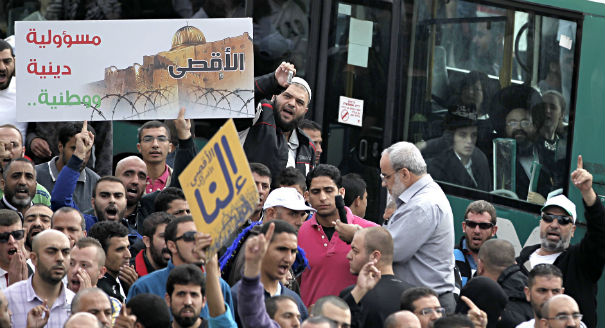
In the past few weeks, escalating clashes between Palestinian demonstrators and the Israeli police have become routine in East Jerusalem, prompting observers to note that perhaps the third Palestinian intifada has finally arrived. Like the intifada that broke out in October 2000, the al-Aqsa Mosque and its surrounding area, known as al-Haram al-Sharif to Palestinians and the Temple Mount to Jews, is again the mobilizing symbol for the violence. But the underlying grievances that have mobilized East Jerusalem Palestinian residents are about deteriorating economic and political conditions, increased isolation, settler encroachment, and the absence of any prospects for effective negotiations. On the Israeli side, while the question of the right of Jews to pray at the contested site has dominated public discourse, internal party politics and the government’s coalition conflicts animate recent developments.
The latest protests—as well as three separate attacks in October and early November by lone militants from East Jerusalem targeting Israeli civilians and military personnel—are ostensibly a response to Israel’s intention to change the status quo at the holy site. The existing arrangement, which has been in place since 1967, stipulates that the religious control of the site belongs to the Islamic Waqf and that prayer is permitted to Muslims only, while Israel maintains security control. However, in the last ten years right-wing Jewish groups, which government officials have allowed to operate largely unimpeded, have increasingly encouraged a Jewish presence at the site. Meanwhile the Israeli security establishment has repeatedly warned against the possible harmful consequences of these activists’ efforts.
Indeed, clashes around the al-Aqsa Mosque have erupted sporadically in the past years over the presence of right-wing Jewish groups at the site. But the increased visits by such groups in recent months have convinced many Palestinians that Israel’s plan is to gradually allow Jewish prayer at the site, and to divide it spatially and temporally between Muslims and Jews as was done in Hebron with the Ibrahimi Mosque/Tomb of the Patriarchs, a holy site of importance to both faiths. As tensions grew over the issue, an East Jerusalem Palestinian resident ran over passengers waiting for the city’s light rail train on October 22, killing a young woman and an infant. On October 29, a Palestinian shot Rabbi Yehuda Glick, a prominent activist for Jewish access to the site, and Israel moved to close off the premises of al-Haram al-Sharif to Muslim worshipers for a day. In response, another East Jerusalem resident ran over Israeli soldiers with his car on November 5, killing a border police officer.
Although on the surface the issue of al-Aqsa evokes strong religious sentiments, the roots of the current violence are to be found in the transformation of economic and political conditions in East Jerusalem. The city, which was once a hub of Palestinian economic and political activity for the entire West Bank, has been increasingly isolated since the second Palestinian intifada. The separation wall has made it difficult for West Bank Palestinians to travel to the city, and Israel has closed Palestinian Authority (PA) and Palestine Liberation Organization (PLO) institutions and offices in the city, weakening East Jerusalem’s formerly vibrant civil society. In addition, the right-wing Israeli leadership of the Jerusalem municipality has deliberately neglected East Jerusalem neighborhoods in hopes of driving Palestinian residents out, investing in these quarters only a fraction of what it spends on education, social, and municipal services in the Jewish neighborhoods. The Israeli government has also facilitated the move of growing numbers of settlers into Palestinian neighborhoods in an attempt to further undermine any possibility the city could be divided in the future to make East Jerusalem the capital of a Palestinian state.
The Israeli government is aware that tension around al-Aqsa could ignite local violence and reverberate elsewhere in the region. Jordan has called back its ambassador from Israel for consultation and has canceled celebrations marking the twentieth anniversary of its peace treaty with Israel. It even threatened to revise this treaty over the situation in al-Haram al-Sharif. Egypt has also condemned Israel’s handling of the issue. The Israeli security establishment similarly warned of the escalating situation and advised the government that the use of excessive force to assert Israel’s control over the site will be counterproductive. Yet instead of working to soothe tempers, several members of the Israeli government have been using fiery rhetoric and visiting the holy site themselves to assert Israeli sovereignty on the Temple Mount.
Members of Netanyahu’s Likud party, including Miri Regev, Moshe Feiglin and Tzipi Hotovely, have publicized their visits in defiance of Netanyahu’s request that they avoid such provocations. Their moves are a part of the attempt by Likud’s right-wing core to challenge Netanyahu’s control of the party. Each one of these parliamentarians seeks to signal to a party base that is veering further to the right that they could undermine Netanyahu’s dominance in the party’s upcoming primaries or in subsequent contestations. Uri Ariel and Shuli Mualem, members of the Jewish Home party, also made highly publicized visits to the Mount. The party’s leader, Economy Minister Naftali Bennett, denounced what he described as Netanyahu’s impotence in responding to the protests and terror attacks in Jerusalem, trying to use his brand of right-wing militancy to replace Netanyahu in future elections. This leaves Netanyahu in a difficult position. On the one hand, he understands that changes to the status quo and the rising tensions cause Israel an international headache not only with the Arab and Muslim world in general, but also with close allies like Jordan and Egypt. On the other hand, Netanyahu’s own political brand rests on security and being tough on terror, and he does not want to appear to be an appeaser, as his hawkish partners have accused.
Conditions now seem to mirror the circumstances that led to the Al-Aqsa Intifada in 2000. That October, Ariel Sharon, at the time the Likud opposition leader, visited the holy site, instigating clashes between Israeli police and Palestinian protesters that spread to the rest of the West Bank. The failure of the Camp David talks just prior to the visit indicated to Palestinians that violence may be the only way to move forward. This time, John Kerry’s latest negotiation initiative has failed resoundingly, Palestinians in Jerusalem and in the West Bank are ripe for a change in strategy, and the threat to al-Aqsa—which the PA, Hamas, and other Palestinian factions are using as a rallying cry—seems increasingly palpable in light of actions by Israeli government members. In a recent national survey, half of Palestinian respondents predicted that the current tensions around al-Aqsa would lead to a widespread outbreak of violence.
Yet some Palestinian analysts argue that this coming “intifada” is likely to remain confined to Jerusalem and not turn into a popular uprising across the occupied territories. The paralyzing territorial and political fragmentation of the Palestinian territories, they argue, means instances of violence occur in isolation. The devastating war in Gaza, for example, failed to generate a popular uprising in the West Bank. The separation that Israeli policy has imposed between different parts of the occupied territories—separating Jerusalem from the West Bank, different parts of the West Bank from each other, and Gaza from the rest of the territories—has fragmented Palestinian society to such an extent that coordinating a popular unified response is incredibly difficult. What is more likely to happen is an increase in lone, uncoordinated, sporadic attacks by Palestinians across different regions. But even if mass mobilization and clashes do not spread to the West Bank, what is happening in Jerusalem since this last summer already merits the name “intifada” in its own right.
Lihi Ben Shitrit is an Assistant Professor at the School of Public and International Affairs, University of Georgia, Athens. Mahmoud Jaraba is a Researcher at the Erlangen Centre for Islam and Law in Europe, Germany. He is the author of Hamas: Tentative March toward Peace (Ramallah: Palestinian Center for Policy and Survey Research, 2010). Both are regular contributors to Sada.