Claims of Iran’s influence over the Houthis have been overblown. While the Houthis do receive some support from Iran, it is mostly political, with minimal financial and military assistance. However, since the Houthis took control of Sanaa, the group has increasingly been portrayed as “Iran-backed” or “Shia,” often suggesting a sectarian relationship with the Islamic Republic. Yet until after the 2011 upheavals, the term “Shia” was not used in the Yemeni public to refer to any Yemeni groups or individuals. The Houthis do not follow the Twelver Shia tradition predominant in Iran, but adhere to the Zaidiya, which in practice is closer to Sunni Islam, and had expressed no solidarity with other Shia communities.
Although Iran sees cooperation with non-state actors as an integral part of its foreign policy to protect and expand its influence in the region, its support for the Houthis has been marginal. The military support Iran has provided to the Houthis since at least 2011 has largely been limited to training and mostly channeled through Lebanese Hezbollah. According to Hezbollah sources, hundreds of Lebanese and Iranian advisors have provided training to Houthi fighters in Yemen. It is not clear, however, whether and how this training translates into military strength on the ground. A Hezbollah commander acknowledged that the Houthis were already experienced fighters due to the six-year war the group waged with the central government between 2004 and 2010 in the mountainous terrain of northern Yemen.
Consistent with Iran’s history of transporting weapons to the horn of Africa, reports have noted a flow of weapons for a while from Iran in the direction of Yemen and Somalia, but it remains unclear if those were intended specifically for the Houthis. Others allegations of specific arms transfers to the Houthis have been difficult to verify. The near-complete sea blockade Saudi Arabia has upheld since the beginning of the military intervention in March 2015 has made smuggling weapons into the country quite difficult. Reports that Iran is smuggling weapons to the Houthis through Oman have been denied by the Sultanate and appear implausible given the long distance the weapons would have to be transported overland through territory the Houthis do not control.
The most effective support the Houthis have received is in the field of media. Al-Masirah, the Houthis’ television channel, is broadcast from Beirut with Hezbollah assistance. The media outlet’s discourse of oppressed groups resisting an illegitimate government, used particularly in the months preceding the group’s advance on Sanaa in September 2014, were strikingly similar to Hezbollah narratives. The parallels in the Hezbollah takeover of West Beirut in 2008 and the Houthi grab of power in 2014 also suggest some exchange on military strategy.
What is clear is that whatever support the Houthis received from Iran, it was not decisive for the Houthi’s power grab in the Yemeni capital in September 2014. American diplomatic sources, backed by credible Iranian analysts, have also claimed that the Iranians tried to discourage the Houthis from taking over Sanaa; advice the Houthis chose not to follow. Rather, the Houthis’ decision was driven by local factors. The transitional government under President Abd Rabu Mansour Hadi was facing a severe legitimacy crisis. It did not create a truly inclusive political process, nor did it improve Yemenis’ living conditions. For instance, after the government announced in July 2014 that subsidies on fuel would be lifted and fuel prices would increase by 90 percent, frustration ran high. Corruption within the government was perceived by Yemenis to have reached unprecedented levels. Constant power cuts in the capital, continued unemployment, and economic deterioration added to the anger. The Houthis exploited this frustration to mobilize against the government. As they were perceived to be the only political group not involved in corruption, the Houthis had already gained support in the previous months among the wider population, particularly in the capital. The Houthis’ empowerment was also seen as a way Yemen could potentially achieve more political inclusivity.
Another important factor that enabled the Houthis to mobilize was Saudi Arabia’s March 2014 decision to declare the Muslim Brotherhood a terrorist organization in the wake of the coup against Mohamed Morsi in Egypt in 2013. With that, the Yemeni Islah Party—a large part of which is made up of members of the Yemeni Muslim Brotherhood—lost its main supporter. Islah had become the Houthis’ strongest antagonist and the only bulwark between them and the capital. Because of the Saudi policy shift, an important flow of cash, which Islah used to buy the loyalty of tribal fighters, was cut off. In combination with the Islah leadership’s involvement in the corrupt transitional government, this cost the party its armed support base in the tribal region between the capital and the Houthi homeland in Saada.
Former President Ali Abdullah Saleh indirectly supported the Houthi takeover of the capital by instructing his loyalists within the military and tribes not to resist. Although Saleh was pushed out of office in November 2011, he used his influence to sabotage the political process to regain power. This alliance has driven the Houthis’ expansion and attempts at governance to a much larger degree than Iran ever could. Troops—which had received substantial American military assistance in the past—remained loyal to the former president and now fought side by side with the Houthis. Not only did this alliance give the Houthis access to the army’s weapons stockpiles, including those provided by the United States, but these well-trained troops were also responsible for attacks such as the one on Emirati and U.S. vessels in October 2016.
Once the Houthis took control over Sanaa in September 2014, Iran used the opportunity to expand its relationship with the group. With Western states increasingly isolating the Houthis, the latter welcomed Iranian offers to cooperate in severely needed infrastructure projects, including restarting regular flights between Tehran and Sanaa and sending humanitarian aid to Yemen—initiatives that did not materialize due to the military intervention. Nevertheless, Iran undeniably wants to make political gains from its relationship with the Houthis, as is clear from the bold statements coming from Tehran. After the Houthis took control of Sanaa in September 2014, Iranian Parliamentarian Alireza Zakani publically stated that after Beirut, Baghdad, and Damascus, Sanaa is now the fourth Arab city to have joined the Islamic Revolution. In November 2016, the chief-of-staff of the Iranian armed forces suggested that Iran may seek a naval base in Yemen. Generally, statements of this sort are exaggerated and reveal more about Iranian self-perception than about the realities on the ground.
The conflict in Yemen is first and foremost a conflict between the Saleh-Houthi alliance and the Saudi-backed Hadi government. While Iran’s financial investment in the Houthis remains limited, its regional antagonist Saudi Arabia is engulfed in a war it cannot win, with devastating financial losses. Iran can merely point to the humanitarian crisis the war has caused in Yemen and insist on a diplomatic solution to make political profits from the war.
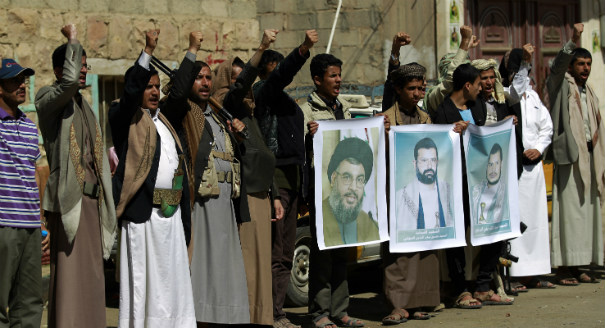
The Saudi coalition’s continued war on Sanaa, the frequent failures of UN-led peace negotiations, and the involvement of Western states in the bombardment of the country increasingly isolate the Houthi-Saleh alliance from the West. While Sanaa was in early 2015 not part of a regional Iranian axis, Saleh and Houthi supporters have increasingly portrayed themselves as supporters of Iranian allies Bashar al-Assad and Hezbollah leader Hassan Nasrallah—and Saleh has even offered to cooperate with Russia in fighting terrorism. Because support from the West is so unlikely, the Houthi-Saleh alliance is also looking to Iran to receive the kind of assistance it gives to other actors—namely Hezbollah and the Assad regime. But for now, Yemen is not a priority on Iran’s foreign policy agenda, and what the Iranians do provide has not bought the Houthis’ unconditional loyalty. But as the United States increases its involvement in Yemen and the White House inflames its rhetoric against Iran, Yemen may develop into a battleground for the escalating tension between Washington and Tehran and push the Houthis into Iran’s corner.
Mareike Transfeld is a PhD candidate at the Berlin Graduate School of Muslim Cultures and Societies at the Freie Universität Berlin, Germany. Follow her on Twitter @projectyemen.
* Correction: and earlier version of this article stated that Hezbollah had taken over southern Beirut in 2006.