The December 4 Houthi ambush that killed their recent ally, former Yemeni president Ali Abdullah Saleh, has shaken up perceptions but done little to alter the fundamentals of the conflict in Yemen. This includes Saudi and Emirati policies for the country, which prior to Saleh’s death were beginning to converge on tactics but lacked a coherent strategy and objectives. The UAE had argued Saleh was the only person able to hold some version of the Yemeni state together. Without him the Saudis and the Emiratis will struggle all the more to reduce the territorial dominance of the Houthis in northern Yemen, and to do so swiftly and without further security, economic, and political costs.
For the Saudis, this means achieving peace, or at least relative calm, while setting back Iran’s gains sufficiently enough to save face. However, this will likely take some time, given that the Houthis control Sanaa, territory bordering Saudi Arabia, and the Red Sea port city of Hodeida—a vital access point for humanitarian relief and other essential supplies, even though the Saudi-led aerial and naval coalition periodically seals it off.
The Saudis had begrudgingly accepted the UAE’s argument that there was little choice but to embrace Ali Abdullah Saleh, their former ally and more recent nemesis. This prompted the Saleh and Houthi forces, formerly aligned tactically, to fight for control of Sanaa and signed Saleh’s own death warrant. Saleh’s son Ahmed Ali, a man able to draw on his own supporters and his father’s within what remains of the state’s military apparatus, may be able to wreak revenge on the Houthis and affect the course of the war. The former president’s death seems to have given some impetus to the UAE-backed Yemeni ground forces who remain loyal to Ali Abdullah Saleh and, for the time being at least, to Ahmed Ali. These forces are seeking to take territory on the coastal route north from Aden to Hodeida and, following Ali Abdullah Saleh’s death, they seem to have air and naval support from the UAE to do so.
While the Emiratis see few other choices for Yemeni allies, the Saudis are willing to consider a greater range of actors. Islah, the Yemeni version of the Muslim Brotherhood, has the allegiance of capable fighters in the north and can draw on tribal support as the Saleh clan does. While the Emiratis maintain their neuralgic opposition to Islah and to any manifestation of political Islam, the Saudis do not share this sentiment. Crown Prince Mohammed bin Salman, the de facto Saudi leader, met Islah’s leader, Mohammed al-Yidoumi, in Riyadh on December 14—after which Yidoumi praised what the Saudi-led coalition is doing in Yemen. This was the second time in a month Mohammed bin Salman had publicly met with the Islah leader, who had spent two years trying to re-establish Islah’s formerly good relationship with the kingdom.
Current Saudi policy toward it, and Yemen in general, is in a state of flux, so much so that a Saudi ground invasion of the bordering Yemeni province of Saada, the Houthis’ heartland, cannot be ruled out.1 The Saudi Arabian National Guard (SANG) is scheduled to mobilize close to the Yemeni border by the end of the year. While SANG is, on balance, more likely to confine itself to limited incursions to secure the border, it is possible that Mohammed bin Salman, frustrated by an ongoing war, might eventually sidestep the perpetual Saudi quest for a reliable and capable Yemeni ally and use SANG to try to subdue the Houthis, which the Saudi army so disastrously failed to accomplish in 2009–10. However, in the short term, the Saudis will continue to hope that Yemenis can do the job for them.
In addition to Ahmed Ali Saleh, Saudi Arabia is also still working with General Ali Mohsen al-Ahmar, Ali Abdullah Saleh’s former close military ally and currently Vice President to Abed Rabbo Mansour Hadi—whom Saudi Arabia officially backs as president and the Emiratis despair of. Ali Mohsen has long worked with Islah-allied as well as Salafi fighters. Saudi Arabia has for years considered Ali Mohsen a possible alternative Yemeni leader.
The Saudis are therefore backing two rivals in the Yemeni fight: Ahmed Ali and Ali Mohsen. The UAE is also divided, for while it backs Ahmed Ali’s forces in the north, it supports different Yemeni fighters in the south, from where it wants to expand northward to the province of Taiz, according to Yemeni media reports.2 Despite Emiratis’ aversion to political Islam, they seem to accept that some of these southern forces are Salafi—as long as they follow the “right” Salafism, the kind that is deeply entrenched in Emirati social mores. The Saudis are wary that Emirati backing for some southern secessionists will encroach on its own northern spheres of influence, but seem willing to double down on the UAE’s current enthusiasm for Ahmed Ali even though they judge Ali Mohsen more capable of commanding the powerful Yemeni nexus of Islamism and tribe. It is hard to imagine these two men aligning on much, although they could form a tactical alliance against the Houthis, a common enemy.
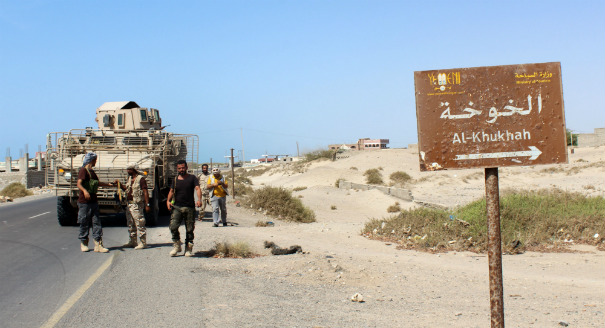
Yet even if they formed a temporary pact and joined forces, neither Ahmed Ali nor Ali Mohsen has the means to take Sanaa yet. In the meantime, the UAE might provide their forces aerial and naval support to retake Hodeida, as they reportedly did when pro-Saleh forces retook the Red Sea city of al-Khoukha on December 7. By contrast, the Emiratis will likely not back attempts to retake the oil-rich northern inland province of Marib. To do so, the UAE would need significant military support and deal with unfavorable local politics. The Emiratis will work with seemingly pliable local elements, including some Salafis, but the territory’s tribal leadership has Islah connections.3
In short, both Saudi and Emirati policies in Yemen remain self-contradictory, and the two countries also continue to diverge over means and objectives. For as long as a single Yemen is viable, however, the Saudis seem committed to it, while the UAE remains ambivalent. How Yemen will be “liberated,” by whom, and who will subsequently have authority are questions to which the two ostensible Gulf allies have seemingly not yet worked out the answers—for themselves let alone their declared alliance.
Neil Partrick is the editor and lead contributor to Saudi Arabian Foreign Policy: Conflict and Cooperation (IB Tauris, second edition forthcoming in February 2018). Follow him on Twitter @neilpartrick.
1. Interview with a Saudi writer, December 14, 2017.
2. “Yemen president tries to stop UAE-led force seizing Aden base,” BBC Monitoring, October 29, 2017.
3. Interview with Saudi analyst Jamal Khashoggi, December 12, 2017.