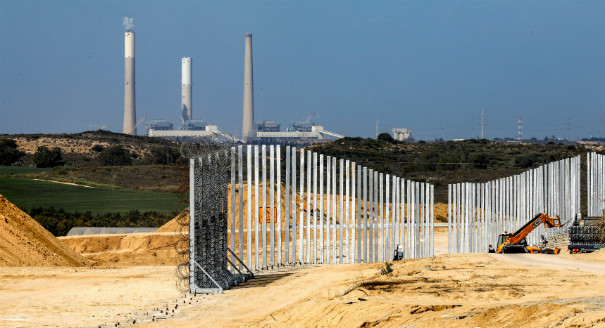
On February 3, Israel began construction on the third and last phase of a large barrier along its land and sea borders with Gaza. As Prime Minister Benjamin Netanyahu tweeted, Israel aims to “prevent terrorists from Gaza from penetrating into our territory on the ground,” adding, "If the quiet is not maintained in Gaza, we will not hesitate to act." Aside from Netanyahu’s plan to surround Israel with a fence to “protect ourselves from wild beasts”—referring to the Palestinian factions—this move is part of a larger strategy to remove any security-based pressure on Israel to reach a two-state solution.
Once completed, the aboveground barrier, constructed of galvanized steel, will be 65 kilometers (40 miles) long, covering the area from Zikim on Gaza’s northern border—where a new three layer, 200-meter (656 foot) sea barrier extends off the coast—to the Kerem Shalom crossing in the south. The entire aboveground length has a corresponding underground section with advanced sensors and monitoring devices. The sea barrier is not only made of heavy concrete slabs and metal rods, it also includes a “smart fence” with sensors and an alarm system. It surrounds the breakwater as a “final security measure,” in response to a Hamas operation in the 2014 war in which a team of militants entered Israel through the sea.
The new barrier has significant implications not just for Israeli security but the future of the peace process. Historically, armed struggle has served as a key tool for the Palestinians to force Israel to make concessions concerning negotiations. The 1993 Oslo Accords, for instance, agreed “to establish a Palestinian Interim Self-Government Authority” in the West Bank and Gaza Strip in return for ending “decades of confrontation and conflict.” Certainly, Palestinians had combined the paramilitary operations with political and diplomatic steps such as calling on Arab and international states to collectively adopt anti-Israeli positions or arranging large-scale protests, widely known as the Intifada. However, their gains in the peace process gradually started to diminish as—following the death of Yasser Arafat in 2005—Fatah party leader Mahmoud Abbas called for an end to the Palestinian Intifada and denounced paramilitary operations. He even later encouraged the rival Islamist group Hamas to follow the same path.
As armed struggle reached its lowest levels in years—due to both intra-Palestinian divisions and the Israeli siege of Gaza—Palestinians still made some progress in terms of gaining international recognition to their statehood rights. For example, in 2012 the UN General Assembly voted to upgrade the Palestinian Authority’s (PA) observer status from “entity” to “non-member status,” following UNESCO’s decision to grant it full membership in 2011. However, even though months-long Palestinian protests and clashes with Israeli forces along the Gaza-Israel border would suggest the reemergence of some of the conditions that led to Oslo, measures such as the wall have lessened the pressure these protests put on Israel to make concessions. This suggests that Palestinian diplomacy cannot make further gains in negotiations unless it is backed by active, armed resistance.
During the past decade, Netanyahu’s successive coalitions have expanded settlement building and the extent of control over Palestinian territories to an unprecedented degree, also showing no interest in addressing the issue of the return of Palestinian refugees. These developments coincided with a decline in the number of terrorist attacks, mainly due to the presence of the West Bank barrier that former prime minister Ariel Sharon built in 2002 in response to Israeli public pressure. Since then, according to Israeli official figures, the West Bank saw 87 “terror events” in 2018 as opposed to 97 in 2017, 169 in 2016, and 219 in 2015. In Gaza, Israel wants a similar outcome. Hamas is the only major Palestinian faction that continues to use a confrontational strategy against Israel, regularly launching rockets toward Israel and digging tunnels to smuggle military equipment into Gaza from Israel and target Israeli security personnel in cross-border raids.
The completion of the barrier leaves Hamas with few options. One is to escalate its paramilitary activities, potentially leading to the outbreak of a new war. Although Hamas has emphasized that it will still be able to pose a threat to Israel after the barrier is completed, it is unclear how it can do so, especially if the barrier cuts off the smuggling routes it relies on for access to military equipment. Based on the example of the West Bank barrier, Israel will likely succeed in making it harder for groups such as Hamas and Islamic Jihad to attack its territories while maintaining the ability to launch an offensive against Hamas whenever it deems it necessary. If the barrier proves effective, there will be no security-based motive for Netanyahu's cabinet to worry about Palestinian calls for negotiations. Hamas might instead consider new asymmetrical tactics, such as the car-ramming attacks used in the West Bank or hijacking the large-scale protests along the Gaza–Israel border.
Alternatively, Hamas could acknowledge that its militants are no longer capable of fighting Israel, potentially leading to a dramatic shift in its political and ideological beliefs. Based on this logic, it will aim to avoid incurring new Israeli offensives that it will find difficult to counter, especially if asymmetrical tactics appear to have no effect. Halting violent operations could make it possible for Hamas to negotiate a long-lasting ceasefire with Israel that could ease restrictions on the entrance of food, reconstruction materials, and medical supplies. So long as these demands do not include Palestinian calls for territorial concessions, Israel may be inclined to accept them, especially if Hamas agrees to end its paramilitary activities. Yet not only would this cause significant divisions within Hamas’s ranks, especially between its military wing and political bureau, it is no guarantee of further concessions from Israel, which continuously insists on excluding Hamas from any rounds of peace talks. Hamas has indirectly indicated in the past that it could accept a two-state solution if the majority of Palestinians approved a deal. However, with a secure border, Israel has little reason to give Hamas anything else.
Basem Aly is a journalist and a PhD researcher in political science at Cairo University. Follow him on Twitter @BaBasem.