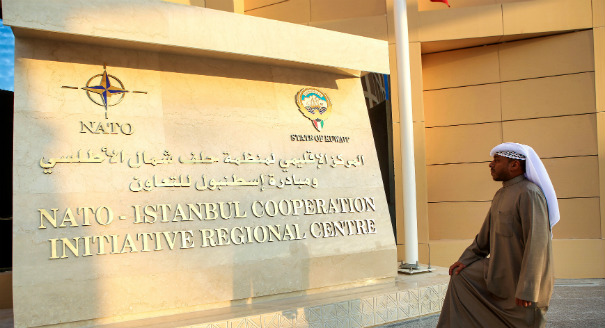
In the last decade, new war colleges have burgeoned in Gulf countries. In May 2013, Qatar opened its Joint Command and Staff College, and a few months later, the United Arab Emirates (UAE) and Oman announced the creation of their own National Defense Colleges. Bahrain followed in 2014 with the Royal Command, Staff, and National Defense College. In 2017, Kuwait inaugurated a regional training center for the North Atlantic Treaty Organization (NATO) that now brings officers from the region together with their counterparts from the alliance. Meanwhile, Saudi Arabia has launched an ambitious reform project to create a defense university, inspired by the U.S. National Defense University and similarly comprised of several military colleges.
War colleges of this nature are new to the countries of the Gulf Cooperation Council (GCC). Military education in these schools differs from the tactical training that had been taught in the military academies of GCC countries to provide basic combat skills to soldiers. By contrast, the new war colleges aim to turn officers into strategists able to connect their operational missions with their geopolitical environment and political authorities’ higher objectives.
This ongoing momentum of military education within the GCC reflects a new step in the maturity of Gulf armed forces and the ways political leaders envision using them to support their national security strategies. It sheds light on the new international ambitions of Gulf countries and in particular their desire for greater strategic autonomy from their traditional Western allies. To that end, reforms of procurement policies have aimed to strengthen GCC countries’ indigenous capabilities through building up local military-industrial complexes such as the Emirates Defense Industry Company. Similarly, the Gulf’s new war colleges are meant to enhance strategic autonomy by preparing the local elite for national security responsibilities.
Implementing these goals nonetheless faces several challenges. The first relates to the desired type of military education. Whether in Riyadh, Doha, or Abu Dhabi, military colleges have followed a Western model, meaning that Gulf officers study policy analysis and Western writings on strategy, including the classical theories of Carl von Clausewitz, Niccolo Machiavelli, or Thucydides. But building courses in strategic affairs requires expertise that remains limited in the Gulf. The region’s current generation of mid-career officers has been well trained in tactical matters but taught little of grand strategy and national security. To address this, some of the programs have relied extensively on bringing in foreign advisors. This dependency conflicts with the ultimate goal of strengthening indigenous capabilities. Moreover, foreign advisors at times fail to tailor their expertise to local needs. For instance, an American instructor reported that the materials for his courses on defense planning at one of these war colleges referred to the chain of command structure of the U.S. military, which differs from the local one.1
The difficulty of importing a military education that derives largely from the Western tradition and experience, particularly the United States and United Kingdom, is not only about the Gulf’s dependency on outside human capital. It also has implications for civil–military relations and national security decisionmaking. War colleges in the West prepare future military commanders by encouraging them to develop proper strategic debate, prioritize threats, formulate doctrines, and anticipate future innovations (whether technological, organizational, or doctrinal). Effective military education also implies an ability to contribute to relevant policymaking in ways congruent with civilian control. In the GCC, where the militaries have long been a mere tool—rather than an actor—of national security strategies, this would entail changing how policy on strategic affairs is made and how military leadership interacts with civilian populations.
This challenge explains why Gulf experiences have so far produced mixed results. The Qatari Joint Command and Staff College was based on the British model of the Defense Academy of the United Kingdom in Shrivenham. The Qatari authorities initially relied on a small faculty dispatched from King’s College London to deliver the courses, but this partnership was not renewed past the original three-year contract. There has been speculation that Qatari authorities wanted to take full ownership of the program, which King’s College felt might compromise its academic credentials.2
Taking a different tack, the Omani government chose not to look for a Western partner and instead relied on its own resources to create an indigenous military education system. Oman has a more established military tradition compared to its neighbors. Sultan Qaboos bin Said Al Said, himself a U.K. military college graduate, invested in local defense education much earlier. So although British officers have traditionally acted as academic advisors, Omani officers take pride in claiming ownership of their own military education.3
These Gulf countries are also struggling to meet their ambitions of building on this momentum of national war colleges to strengthen regional cooperation at the GCC level. In 2015, GCC leaders announced plans for a joint GCC Defense College to be hosted by the UAE. Indeed, they had discussed the idea as early as 1984, seeking to emulate the NATO Defense College, which engenders a collective military identity among officers of the Atlantic alliance. Past proposals to build joint GCC forces have stumbled over concerns that this would encroach on member states’ national sovereignty. The recent and ongoing Qatar boycott and the rift it created within the GCC further diminish prospects for collective defense education. But officials claim that working-level meetings involving all GCC members (including Qatar) continue, with the aim of inaugurating the joint defense college by 2021.4 The project’s future hinges on the settlement of the regional crisis, but the fact that it has not been publicly cancelled reveals how important the regionalization of defense education remains for GCC countries.
Ultimately, reaching the goals of these military education initiatives involves shifting these states’ strategic cultures, which requires years—if not generations—of deliberate and sustained effort. But because the new defense colleges have been hastily built, they might perpetuate the gap between official objectives and reality. In this sense, the next decade will require creating and sustaining the necessary ecosystems to foster this culture. As Gulf officers look at the Western experience, they may contemplate how U.S. war colleges have contributed to the policy debates over counterinsurgency campaigns in Iraq and Afghanistan. Likewise, war colleges in the GCC will achieve their goals when they start being part of their own policy circles by producing their own knowledge for decisionmakers—for instance on the military lessons of the Yemen war or the regional standoff with Iran.
Jean-Loup Samaan is Associate Professor in Strategic Studies attached to the UAE National Defense College. The views expressed in this article do not reflect those of the UAE National Defense College, the Near East South Asia Center for Strategic Studies, nor any government.
1. Author’s interview.
2. Author’s interviews.
3. Author’s interviews with Omani officers.
4. Author’s interview with Emirati and Kuwaiti officials involved in the project.