• Research
  • Emissary
  • About
  • Experts
Carnegie Global logoCarnegie lettermark logo
Democracy
  • Donate
{
  "authors": [
    "Mohammed Ali Thamer"
  ],
  "type": "commentary",
  "blog": "Sada",
  "centerAffiliationAll": "",
  "centers": [
    "Carnegie Endowment for International Peace",
    "Malcolm H. Kerr Carnegie Middle East Center"
  ],
  "englishNewsletterAll": "",
  "nonEnglishNewsletterAll": "",
  "primaryCenter": "Carnegie Endowment for International Peace",
  "programAffiliation": "",
  "programs": [
    "Middle East"
  ],
  "projects": [],
  "regions": [
    "Middle East",
    "Yemen"
  ],
  "topics": [
    "Economy"
  ]
}
Attribution logo
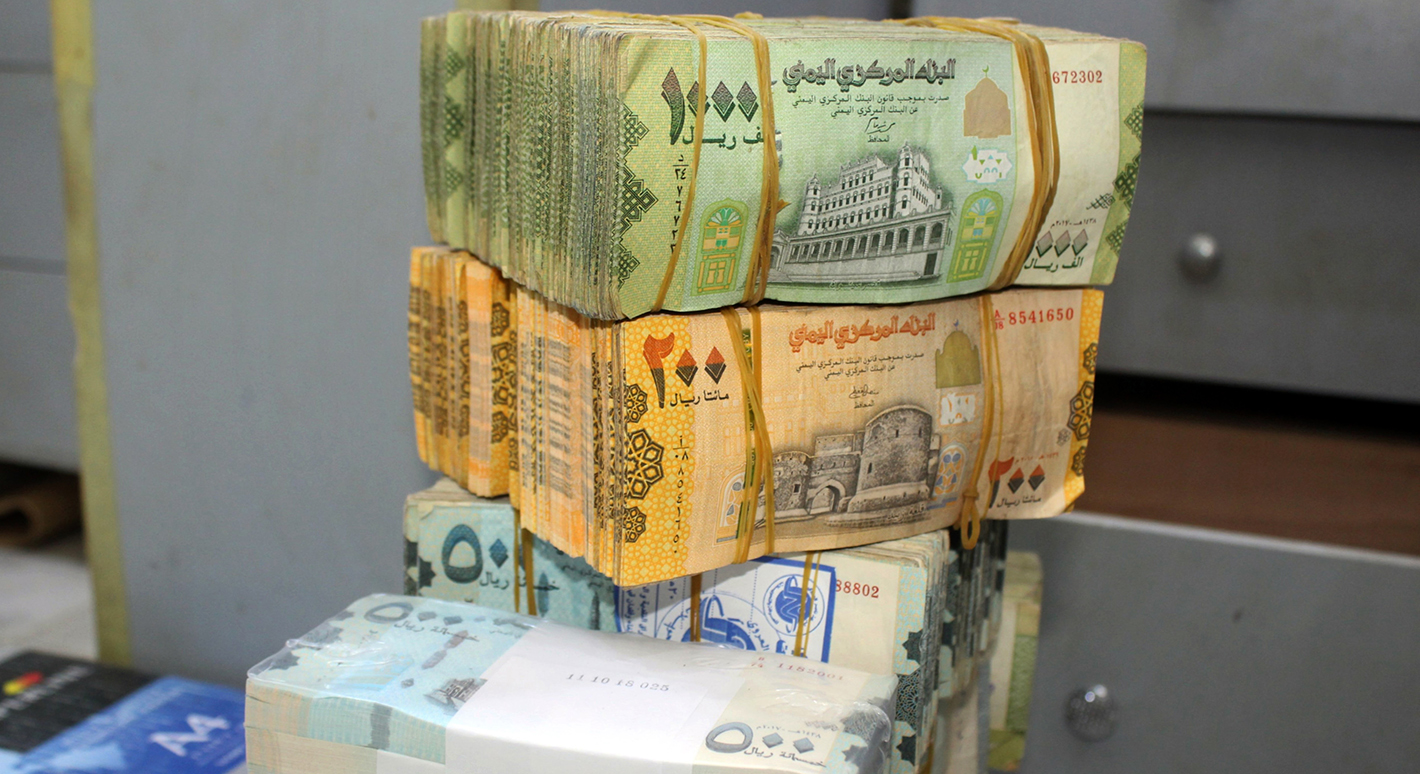
Old and new Yemeni bank notes are pictured at a money exchange office in the southern port city of Aden on January 23, 2020

Source: Getty

Commentary
Sada

Coin Rollout Sparks a New War in Yemen

A new hundred-riyal coin has ignited a financial war between Yemen’s rivaling central banks in Sana’a and Aden, drawing international condemnation and exacerbating the country’s economic turmoil.

Link Copied
By Mohammed Ali Thamer
Published on May 21, 2024
Sada

Blog

Sada

Sada is an online journal rooted in Carnegie’s Middle East Program that seeks to foster and enrich debate about key political, economic, and social issues in the Arab world and provides a venue for new and established voices to deliver reflective analysis on these issues.

Learn More
Program mobile hero image

Program

Middle East

The Middle East Program in Washington combines in-depth regional knowledge with incisive comparative analysis to provide deeply informed recommendations. With expertise in the Gulf, North Africa, Iran, and Israel/Palestine, we examine crosscutting themes of political, economic, and social change in both English and Arabic.

Learn More

 In a press conference on March 30, the Houthi-controlled Central Bank of Yemen in Sana'a (CBY-Sana’a) announced its plan to circulate a new hundred-riyal coin. The bank assured the public that the new coin will not affect exchange rates or the Yemeni economy, as it is solely intended to address the problem of the damaged banknotes. The announcement was swiftly rejected by the government-controlled Central Bank of Yemen in Aden (CBY-Aden) who, in an announcement on April 2, decided to relocate all the major banking centers, including commercial banks, Islamic banks, and microfinance banks, from Sana'a to Aden. Shortly before, CBY-Aden had issued a directive prohibiting dealings with specified directive commercial banks in Sana'a, to which the CBY- Sana'a responded by issuing its own prohibiting all dealings with newly established banks in Aden.

 Thus began the battle of Yemen’s banks. Financial and economic experts in Yemen, and international organizations alike, have condemned these reckless decisions, that could  increase inflation rates, heighten the risk of the country’s economic collapse, and lead Yemen towards an uncertain future.

Local and international condemnation

 The rollout of the new coin sparked widespread controversy among Yemenis on social media. Beyond the complexity that the new coin will generate, many described it as a nail in the coffin of the Yemeni economy. Critics noted that the bank in Sana'a has neither the ability nor the tools to print banknotes according to the international specifications and standards. In Aden, the central bank issued a strongly worded statement that described the Houthis’ coin launch as “unlawful” and denounced the new currency as a “counterfeit” designed to loot the assets of financial, banking, and commercial institutions and Yemeni citizens.

 Internationally, the European Union expressed its deep concerns that the new coin would risk undermining the integrity of the banking sector, and could compromise Yemen’s adherence to international protocols aimed at combating money laundering and terrorist financing. Similarly, the US embassy issued a statement denouncing the issuance of counterfeit coins to replace Yemen’s legitimate currency, stressing that unilateral decisions of this nature will harm the wellbeing of the Yemeni people.

 In turn, France condemned the issuance of counterfeit currency and expressed its firm opposition to an unlawful decision issued by an unrecognized party, noting the importance of unity at this critical moment in Yemen’s history. Britain followed suit, stating that "this measure threatens to destabilize the banking sector." The Sana’a government not only disregarded all these condemnations, but considered them part of an international war waged on Yemen.

Years of War, Years of Collapse

 In 2016, the transfer of the Central Bank of Yemen to Aden marked the beginning of a series of decisions that proved catastrophic to the Yemeni economy. The bank ordered the printing of various currency denominations which remained in circulation nationwide until the end of 2019. However, the Houthis prevented the use of this currency within the territories they controlled, branding it as counterfeit and illegal and confiscating it accordingly. Yemenis were left torn between an old and a new riyal, and financial transfers between the Yemeni regions under different governments were severely complicated.

 To make matters worse, the CBY-Aden decided to relocate the headquarters of all banks from Sana’a to Aden, and  gave only 60 days for the banks to comply with the threat of severe punitive measures—including potential exclusion from the SWIFT network and international money transfer services. This decision drew sharp criticism from many researchers and academics, who denounced it as hasty and likely to aggravate existing complications and deepen Yemen’s economic division. They cautioned against the adverse repercussions that could extend beyond the financial sector, impacting shareholders' rights and ultimately destabilizing the Yemeni economy. 

The Yemeni Economy

 The future of the Yemeni currency and economy appears extremely grim. Many experts are concerned that the Houthi decision to issue a new currency is just a test to gauge reactions of the Aden government and the Yemeni people. They fear that this move could pave the way for further measures, such as legalizing electronic currency, printing banknotes, minting more coins, or a combination of these actions, which could result in a shift towards creating an alternative, independent economy— and potentially full economic separation within the same fragmented country.

 If these fears materialize, internal tensions and conflicts could spiral out of control and lead Yemen into complete economic collapse.  Unless a strong international intervention compels all conflicting parties to pursue peace, Yemen and its people will be doomed to a bleak economic future.

Mohammed Ali Thamer

Mohammed Ali Thamer is a Yemeni writer, researcher, and journalist whose articles are published in Yemeni, Arab, and international periodicals. He was the manager of the Culture and the Yemenia magazines, and has authored several books.

EconomyMiddle EastYemen

Carnegie does not take institutional positions on public policy issues; the views represented herein are those of the author(s) and do not necessarily reflect the views of Carnegie, its staff, or its trustees.

More Work from Sada

  • Commentary
    Sada
    Sub-Saharan African Migrants in Morocco: Security Concerns and the Test of Human Rights

    Is Morocco’s migration policy protecting Sub-Saharan African migrants or managing them for political and security ends? This article unpacks the gaps, the risks, and the paths toward real rights-based integration.

      Soufiane Elgoumri

  • Commentary
    Sada
    A House Divided: How Internal Power Struggles Shape Iraq’s Foreign Policy

    Iraq’s foreign policy is being shaped by its own internal battles—fractured elites, competing militias, and a state struggling to speak with one voice. The article asks: How do these divisions affect Iraq’s ability to balance between the U.S. and Iran? Can Baghdad use its “good neighbor” approach to reduce regional tensions? And what will it take for Iraq to turn regional investments into real stability at home? It explores potential solutions, including strengthening state institutions, curbing rogue militias, improving governance, and using regional partnerships to address core economic and security weaknesses so Iraq can finally build a unified and sustainable foreign policy.

      Mike Fleet

  • Commentary
    Sada
    The Role of E-commerce in Empowering Women in Saudi Arabia: Assessing the Policy Potential

    How can Saudi Arabia turn its booming e-commerce sector into a real engine of economic empowerment for women amid persistent gaps in capital access, digital training, and workplace inclusion? This piece explores the policy fixes, from data-center integration to gender-responsive regulation, that could unlock women’s full potential in the kingdom’s digital economy.

      Hannan Hussain

  • Commentary
    Sada
    A War Fueled by Hate Speech: Sudan’s Fall into Fragmentation

    Hate speech has spread across Sudan and become a key factor in worsening the war between the army and the Rapid Support Forces. The article provides expert analysis and historical background to show how hateful rhetoric has fueled violence, justified atrocities, and weakened national unity, while also suggesting ways to counter it through justice, education, and promoting a culture of peace.

      Samar Sulaiman

  • Commentary
    Sada
    Disarming Palestinian Factions in Lebanon: Can a Security Experiment Evolve into Sovereign Policy?

    The August 2025 government decision to restrict weapons to the Lebanese state, starting with Palestinian arms in the camps, marked a major test of Lebanon’s ability to turn a long-standing slogan into practical policy. Yet the experiment quickly exposed political hesitation, social gaps, and factional divisions, raising the question of whether it can become a model for addressing more sensitive files such as Hezbollah’s weapons.

      Souhayb Jawhar

Get more news and analysis from
Carnegie Endowment for International Peace
Carnegie global logo, stacked
1779 Massachusetts Avenue NWWashington, DC, 20036-2103Phone: 202 483 7600Fax: 202 483 1840
  • Research
  • Emissary
  • About
  • Experts
  • Donate
  • Programs
  • Events
  • Blogs
  • Podcasts
  • Contact
  • Annual Reports
  • Careers
  • Privacy
  • For Media
  • Government Resources
Get more news and analysis from
Carnegie Endowment for International Peace
© 2026 Carnegie Endowment for International Peace. All rights reserved.