

Q&A
Christopher Boucek
Source: Getty
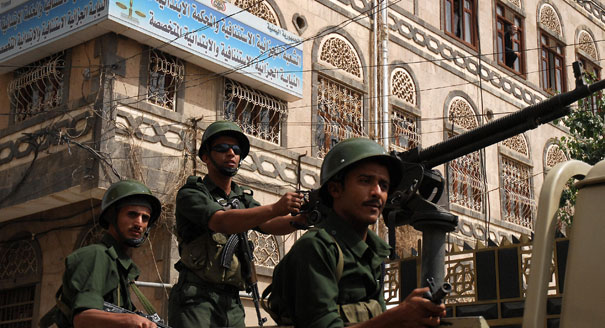
The Yemeni government is mired in an unwinnable and sporadic civil conflict in the northern governorate of Saada that has weakened the central government, accelerated the economic crisis, and threatens global stability by emboldening al-Qaeda.
The Yemeni government has been mired in an unwinnable and sporadic civil conflict in the northern governorate of Saada since 2004. This war has weakened the central government, accelerated the economic crisis, and threatened global stability by emboldening al-Qaeda, concludes a paper by Christopher Boucek.
“The government’s uncompromising position in Saada has exacerbated local grievances and rapidly accelerated Yemen’s economic crisis,” writes Boucek. “Without a serious international effort at mediation, further fighting is inevitable—and poses a serious threat to Yemeni stability.”
Former Associate, Middle East Program
Boucek was an associate in the Carnegie Middle East Program where his research focused on security challenges in the Arabian Peninsula and Northern Africa.
Recent Work
Christopher Boucek

Christopher Boucek, Karim Sadjadpour
Carnegie does not take institutional positions on public policy issues; the views represented herein are those of the author(s) and do not necessarily reflect the views of Carnegie, its staff, or its trustees.

Funding Ukraine remains a priority for European leaders. As Russia’s war of aggression heads into another winter, two feasible options to mobilize support for Kyiv should be fast-tracked.


Vladyslav Rashkovan, Gregory P. Wilson

Russian strikes are weakening the economy sustaining Ukraine’s war effort. Closing the growing funding gap will require more European support and politically contentious reforms in Kyiv.

Balázs Jarábik

While the EU and European governments are embracing the much-lauded middle-power moment, this entails three difficult conundrums.

Richard Youngs

The middle power moment will not be defined by sovereign states alone, and California stands out for its potential contributions to international cooperation.


Ian Klaus, Stewart Patrick

Ex-president Gurbanguly Berdimuhamedov remains interested in politics, but his son Serdar, Turkmenistan’s current president, is becoming increasingly independent and willing to break with his father’s legacy. If their covert rivalry goes too far, both risk losing power.

Galiya Ibragimova