

Commentary
- +2
Memduh Karakullukçu, Dmitri Trenin, Ümit Pamir, …
{
  "authors": [
    "Adnan Vatansever"
  ],
  "type": "legacyinthemedia",
  "centerAffiliationAll": "dc",
  "centers": [
    "Carnegie Endowment for International Peace",
    "Carnegie Europe",
    "Carnegie Russia Eurasia Center"
  ],
  "collections": [],
  "englishNewsletterAll": "ctw",
  "nonEnglishNewsletterAll": "",
  "primaryCenter": "Carnegie Endowment for International Peace",
  "programAffiliation": "russia",
  "programs": [
    "Russia and Eurasia",
    "Sustainability, Climate, and Geopolitics"
  ],
  "projects": [],
  "regions": [
    "Caucasus",
    "Russia",
    "North America"
  ],
  "topics": [
    "Political Reform",
    "Climate Change"
  ]
}
Source: Getty
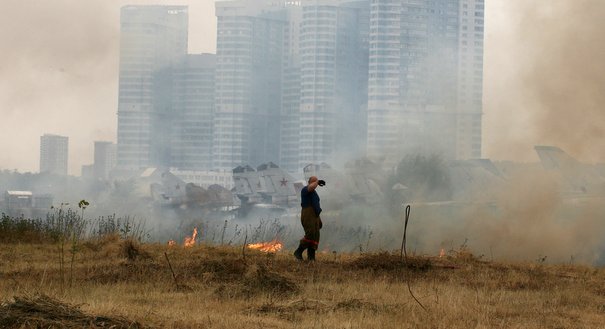
The wildfires and heat wave that recently ravaged central Russia brought climate change to the forefront of the country’s domestic agenda and provide the Kremlin with an opportunity to prove its commitment to energy efficiency as well as economic modernization.
Source: The Moscow Times

Climate change has long been seen by Russian leaders as someone else’s problem. Not too long ago, then-President Vladimir Putin said Russia would simply have “fewer fur coats and a longer wheat growing season.” And only a few months before last year’s climate summit in Copenhagen, President Dmitry Medvedev warned that “we will not cut our development potential” to reach a new global deal.
Last December, there were new hopes of a turnaround when Russia adopted its first climate doctrine. However, Moscow has maintained its “wait and see” approach to international climate negotiations. There is no indication of a shift toward a more proactive strategy or sign that there are any aspirations to assume a leadership role in this growing transnational challenge.
Waiting for others to take the lead is a mistake. Russia is the world’s third-largest emitter of carbon dioxide, and only a handful of economies are more energy intensive. Not only is Russia a major source of greenhouse gases, it may also turn out to be one of the most vulnerable countries to the effects of climate change. A recent report by the Federal Service for Hydrometeorology and Environmental Monitoring revealed that the country’s average temperature rose faster than the global average over the past century — almost twice as fast for the country overall and nearly three times faster in parts of Siberia during the winter. Russia is suddenly finding itself on the front line of climate repercussions.
Medvedev now has a chance to step up his rhetoric in favor of a more active approach — if not leadership — in climate talks. And he suddenly seems to get the message. “Unfortunately, what is happening now in our central regions is evidence of this global climate change because we never in our history faced such weather conditions in the past,” Medvedev said in response to the recent fires. “This means that we need to change the way we work — to change the methods that we used in the past.”
Russia must do two things to show the world that it is getting serious about fighting climate change. First, it needs to move toward more daring emission targets. As a follow-up to the Copenhagen summit, Russia submitted a plan in February to reduce emissions by 15 to 25 percent from 1990 levels by 2020. This target is hardly inspiring. At the end of 2009, Russia’s emissions were already about 40 percent below the mark in 1990 because of the painful economic collapse during Boris Yeltsin’s presidency and the more recent recession.
Many critics argue that the 20 percent reduction target would mean that emissions could actually accelerate during the next decade compared with the years of rapid economic growth from 2000 to 2007. This is often referred to as “success without really trying” or “compliance without implementing vigorous environmental measures.” Medvedev should set Russia’s target at 30 percent — at the minimum — to dispel such doubts about Russia’s dedication to combating climate change.
Second, it is time to end the disconnect between Russia’s energy efficiency agenda and targets for carbon emission reductions. In 2008, Medvedev signed a decree aiming to improve Russia’s energy efficiency by 40 percent by 2020. Meeting this objective could undoubtedly help Russia reach more ambitious emission reduction targets — possibly more than 30 percent according to some studies. The government, however, has shied away from presenting a clear assessment of the climate-related repercussions of its energy efficiency program.
Russian officials are more comfortable referring to energy efficiency than emission targets as this leaves more room for maneuvering, particularly when officials are inclined to advocate overly optimistic economic growth. But, for Russia to be a true climate leader, it must show a commitment to both economic development and absolute reductions in carbon emissions.
As life in Moscow returns to normal, Russia has a unique opening to advance its newly proclaimed commitment to economic modernization. By setting ambitious emission reduction targets, Russia can boost investor confidence by proving its commitment to a broader agenda that both improves energy efficiency and enhances economic modernization. As energy efficiency gains could be achieved by rapid economic growth and restructuring alone, potential investors in renewable energy would feel more confident if Russia establishes meaningful emission targets.
By committing to absolute levels of carbon reduction and taking action to meet more ambitious targets, Russia can take its rightful place as a global leader in climate protection and modernize its economy at the same time.
Former Senior Associate, Energy and Climate Program
Vatansever was a senior associate in the Energy and Climate Program where he specializes in the energy sectors of the former Soviet republics and Eastern Europe.
Recent Work
Memduh Karakullukçu, Dmitri Trenin, Ümit Pamir, …
Adnan Vatansever, Анна Корппоо
Carnegie does not take institutional positions on public policy issues; the views represented herein are those of the author(s) and do not necessarily reflect the views of Carnegie, its staff, or its trustees.
The return of war as the organizing factor in Middle Eastern politics has predictable consequences: governments are prioritizing regime stability and becoming averse to political and social reform.


Sarah Yerkes, Amr Hamzawy

The internet is awash not only with instructions from digital security experts, but also with urban legends and conspiracy theories that divert attention away from the real dangers of Max.
David Frenkel
Putin’s blunder has created new and enduring security challenges for Russia and Europe.
Eugene Rumer

The prospect of a total block on Russia’s most popular messaging app has sparked disagreement between the regime’s political managers and its security agencies.

Andrey Pertsev
Ukraine’s asymmetric approach has rendered Russia’s Black Sea Fleet functionally useless. But a long-term commitment will be needed to maintain this balance of power.
Alina Frolova, Stepan Yakymiak