

Other
Michael D. Swaine
{
  "authors": [
    "Michael D. Swaine"
  ],
  "type": "legacyinthemedia",
  "centerAffiliationAll": "dc",
  "centers": [
    "Carnegie Endowment for International Peace",
    "Carnegie China"
  ],
  "collections": [
    "China’s Foreign Relations",
    "U.S.-China Relations"
  ],
  "englishNewsletterAll": "asia",
  "nonEnglishNewsletterAll": "",
  "primaryCenter": "Carnegie China",
  "programAffiliation": "AP",
  "programs": [
    "Asia"
  ],
  "projects": [],
  "regions": [
    "East Asia",
    "China",
    "North America",
    "United States",
    "South Asia",
    "India",
    "Southeast Asia"
  ],
  "topics": [
    "Political Reform",
    "Security",
    "Military",
    "Foreign Policy",
    "Arms Control"
  ]
}
Source: Getty
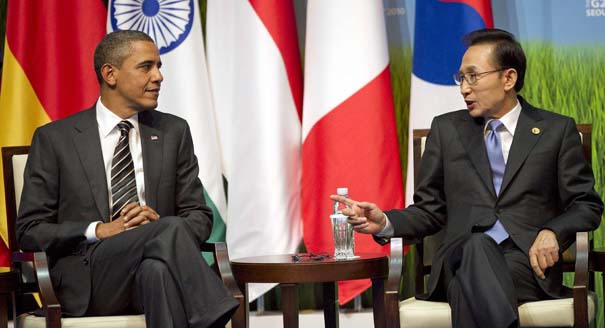
The execution of America’s strategic 'pivot' to Asia, and China's response, are combining to deepen mutual suspicions and potentially destabilize the entire area.
Source: National Interest

At that time, Washington moved decisively away from viewing China ominously as a rising "strategic competitor" (to quote George W. Bush) and toward significant levels of Sino-U.S. cooperation in combating terrorism and dealing with a growing array of common problems, from climate change to global economic instability. This shift brought Washington’s approach back into line with an earlier, long-standing U.S. policy of fostering greater Sino-American engagement while conducting low-key military hedging against the possibility of a future hostile China.
With President Obama and Secretary Clinton's recent trips to the South and Western Pacific, expanding U.S. involvement in multilateral economic and security-related fora, and a strengthening of Washington's traditional military alliances, the United States is now signaling an intention to move back toward the pre-9/11 strategic focus on a rising China. That focus places a premium on explicitly balancing against and constraining Chinese power and influence across the region.
This piece was originally published at the National Interest. Click here to continue reading.

Former Senior Fellow, Asia Program
Swaine was a senior fellow at the Carnegie Endowment for International Peace and one of the most prominent American analysts in Chinese security studies.
Recent Work
Michael D. Swaine
Michael D. Swaine
Carnegie does not take institutional positions on public policy issues; the views represented herein are those of the author(s) and do not necessarily reflect the views of Carnegie, its staff, or its trustees.
Five problems—and solutions—to make it actually work as a tool of great power competition.

Afreen Akhter
The Russian leadership wants to avoid a dangerous precedent in which it is squeezed out of Iran by the United States and Israel—and left powerless to respond in any meaningful way.

Nikita Smagin
One is hopeful. One is realistic. One is cautionary.

Andrew Leber, Sam Worby
In Ukraine, Gaza, and Iran, AI warfare has come to dominate, with barely any oversight or accountability. Europe must lead the charge on the responsible use of new military technologies.

Raluca Csernatoni
Cairo’s efforts send a message to the United States and the region that it still has a place at the diplomatic table.

Angie Omar