
• Research
  • Emissary
  • About
  • Experts
Carnegie Global logoCarnegie lettermark logo
DemocracyIran
  • Donate
{
  "authors": [
    "Frederic Wehrey"
  ],
  "type": "other",
  "centerAffiliationAll": "dc",
  "centers": [
    "Carnegie Endowment for International Peace",
    "Malcolm H. Kerr Carnegie Middle East Center"
  ],
  "collections": [],
  "englishNewsletterAll": "menaTransitions",
  "nonEnglishNewsletterAll": "",
  "primaryCenter": "Carnegie Endowment for International Peace",
  "programAffiliation": "MEP",
  "programs": [
    "Middle East"
  ],
  "projects": [],
  "regions": [
    "North Africa",
    "Libya"
  ],
  "topics": [
    "Security",
    "Foreign Policy"
  ]
}
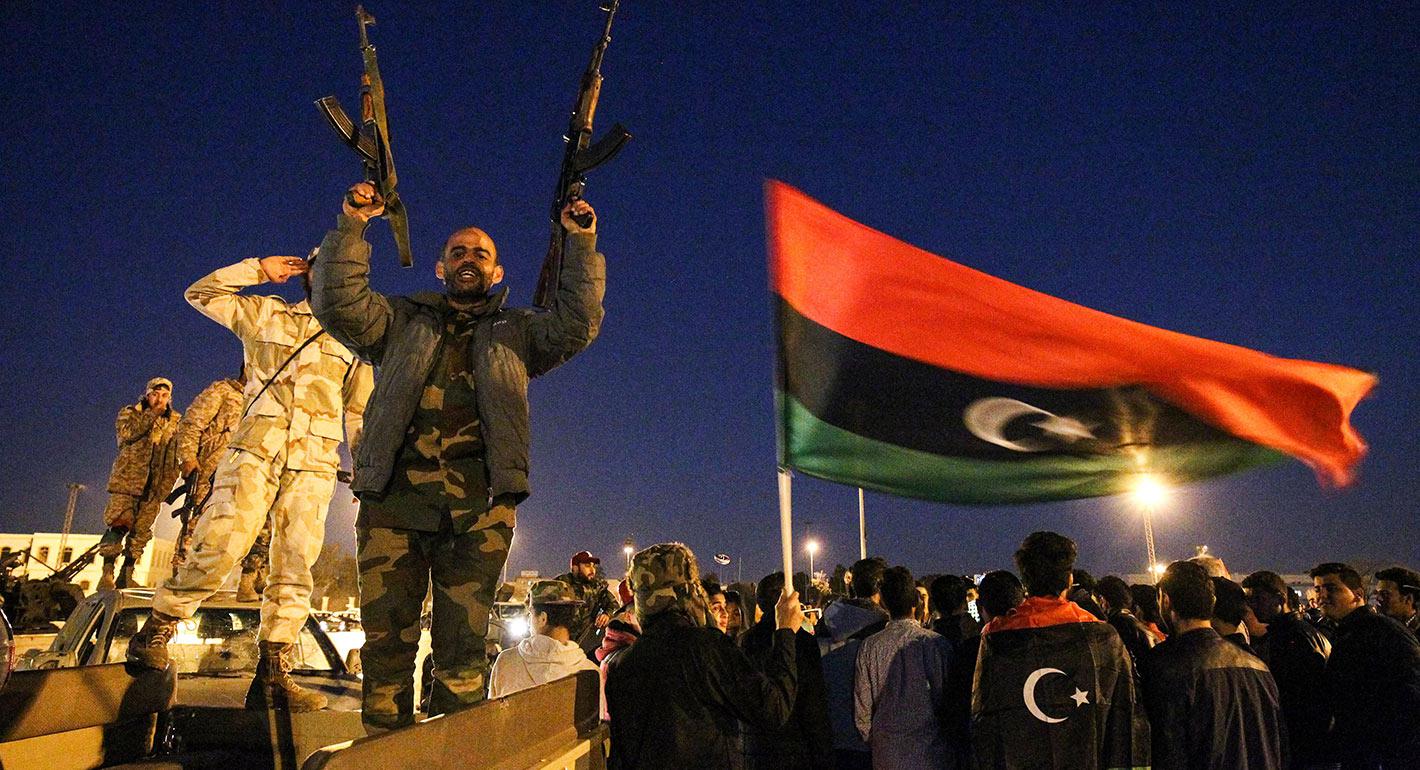
Source: Getty

Other

“This War Is Out of Our Hands”: The Internationalization of Libya’s Post-2011 Conflicts From Proxies to Boots on the Ground

For almost a decade, Libya has been riven by increasingly internationalized conflicts. Foreign missteps and the failures of Libyan elites to produce political unity and workable institutions have opened the field for an escalating proxy war.

Link Copied
By Frederic Wehrey
Published on Sep 14, 2020
Program mobile hero image

Program

Middle East

The Middle East Program in Washington combines in-depth regional knowledge with incisive comparative analysis to provide deeply informed recommendations. With expertise in the Gulf, North Africa, Iran, and Israel/Palestine, we examine crosscutting themes of political, economic, and social change in both English and Arabic.

Learn More

Source: New America

Executive Summary

For almost a decade, Libya has been riven by increasingly internationalized conflicts, stemming from local and regional fissures during the 2011 anti-Qadhafi revolution and the NATO-led intervention. In the wake of that conflict, foreign missteps and the failures of Libyan elites to produce political unity and workable institutions opened the field for an escalating proxy war.

Beginning in 2014, Libya’s internecine struggle became militarized, first in Benghazi and then in Tripoli, with a significant uptick in foreign weapons shipments to two opposing constellations of armed groups and political factions. The first was the eastern-based “Operation Dignity” camp, led by General Khalifa Haftar and supported by the United Arab Emirates, Egypt, Jordan, Saudi Arabia, and France. The second was the anti-Haftar “Libya Dawn” coalition in Tripolitania and its militia allies in Benghazi and Derna, backed by Turkey, Qatar, and Sudan. Though outside forces intervened directly with airstrikes and limited raids by special operations forces, Libyans still carried out the actual combat. Starting with Haftar’s attack on Tripoli in 2019, the international actors themselves have assumed a greater prominence in the conflict over local Libyan proxies, via foreign mercenaries, foreign-piloted aircraft, and other forms of interference.

A number of factors have driven the internationalization of Libya’s wars: global disorder and the weakening of multilateral norms and institutions, American ambivalence and mixed signals on Libya, European paralysis, military adventurism by regional powers, and Russian opportunism. However, Libyan elites and local actors themselves also played a key role in internationalizing the conflict by soliciting and manipulating foreign support for self-serving ends.

Amplifying these geopolitical and economic aspects is the convergence of military and technological innovations in the Libyan conflict, especially the widespread use of armed drones and foreign mercenaries. Beyond this kinetic dimension, outside actors have waged a war for public opinion in traditional and social media spaces, often through disinformation tactics that conceal the foreigners’ influence. Even so, notions of a high-tech, sanitized, science-fiction war in which the human (and Libyan) role is absent are misplaced. The fighting remains highly personal for Libyans, who will bear its devastating costs for years to come.
Key Findings:

  • Libya’s post-2011 civil wars are a casualty of a broader global disorder and the deterioration of multilateral institutions and norms, as evidenced by divisions and paralysis within the United Nations Security Council. Compounding these trends are American retrenchment and mixed signals, European disunity and partisanship, military assertiveness and hegemonic aspirations by rival Middle Eastern powers, and Russian opportunism. A mix of ideological motives, economic interests, leadership ambitions, and geopolitics has informed the actions of Libya’s foreign interveners.
  • In addition to ideological competition and geopolitics, Libya’s oil wealth indirectly drives outside intervention, fragmentation, and conflict prolongation. Libya’s hydrocarbon resources have long been an incentive for international involvement, though it was often not the main motivation for foreign meddling. Access to this wealth became a zero sum prize between competing Libyan factions, who wield it to gain domestic support and entice foreign sponsors. This marketplace dimension, while hardly the sole or even primary conflict driver, differentiates Libya from the Middle East’s other proxy wars.
  • The increasing convergence of military and technological innovations has shaped the kinetic and informational war in Libya. oreigner interveners in Libya have relied extensively on cheap armed drones, which helps mitigate risks to their personnel and evade outside scrutiny—an evasion that is also made possible by international divisions and, in the case of the United Arab Emirates, Western diplomatic protection. In addition, foreign mercenaries and auxiliaries have been used by both Libyan factions and their foreign patrons, reflecting a global trend toward the outsourcing of extraterritorial military force driven partly by the availability of itinerant, pay-for-hire fighters from failed revolutions and civil wars in Africa and the Middle East and the growth of private military companies. In tandem, outside states are using traditional media outlets, social media trolls and Twitter “bots,” co-opted journalists and commentators, lobby organizations, and agents provocateurs to wage a sophisticated war for public opinion in which the foreign hand is often obscured.
  • Despite the war’s internationalization, Libyans play a vital role as intermediaries, brokers, and fixers for foreign powers. Bereft of institutions, Libya’s fragmented and hyperlocalized landscape has been dominated by Libyan political elites, armed group leaders, and foreign-based brokers who’ve solicited outside patronage to bolster their own power and agendas. Adding an unpredictable layer of arbitration to foreign influence, these brokers have competed with one another and sometimes defected or switched sides, diluting foreign control over local proxies. A net result of this individual, transnational activism has been an attenuation of Libyan sovereignty and a prolongation of the conflict.

Read Full Text

This paper was originally published by New America.

About the Author

Frederic Wehrey

Senior Fellow, Middle East Program

Frederic Wehrey is a senior fellow in the Middle East Program at the Carnegie Endowment for International Peace, where his research focuses on governance, conflict, and security in Libya, North Africa, and the Persian Gulf.

    Recent Work

  • Article
    Parallel Climate Reckonings: Colonial Water Legacies and Indigenous Adaptation, from Morocco to the American West

      Frederic Wehrey, Charles H. Johnson

  • Commentary
    The Iran War Is a Stress Test for Gulf States

      Frederic Wehrey, Charles H. Johnson

Frederic Wehrey
Senior Fellow, Middle East Program
Frederic Wehrey
SecurityForeign PolicyNorth AfricaLibya

Carnegie does not take institutional positions on public policy issues; the views represented herein are those of the author(s) and do not necessarily reflect the views of Carnegie, its staff, or its trustees.

More Work from Carnegie Endowment for International Peace

  • Commentary
    Turning Russian Assets into Financing for Ukraine Now

    Funding Ukraine remains a priority for European leaders. As Russia’s war of aggression heads into another winter, two feasible options to mobilize support for Kyiv should be fast-tracked.


      Vladyslav Rashkovan, Gregory P. Wilson

  • Commentary
    Carnegie Politika
    Stalled at the Front, Russia Seeks to Undermine Ukraine’s Economic Capacity

    Russian strikes are weakening the economy sustaining Ukraine’s war effort. Closing the growing funding gap will require more European support and politically contentious reforms in Kyiv.

      Balázs Jarábik

  • Commentary
    Strategic Europe
    The EU’s Middle-Power Puzzle

    While the EU and European governments are embracing the much-lauded middle-power moment, this entails three difficult conundrums.

      Richard Youngs

  • The dome of the California State Capitol, Sacramento
    Paper
    California’s Middle Power Moment

    The middle power moment will not be defined by sovereign states alone, and California stands out for its potential contributions to international cooperation.


      Ian Klaus, Stewart Patrick

  • The Scramble for Europe. Russia, China, and Turkey Challenging Regional Order
    Book
    The Scramble for Europe. Russia, China, and Turkey Challenging Regional Order

    Europe is facing rising populism internally as well as external pressures from Russia, China, Turkey, and the United States.

      Dimitar Bechev

Get more news and analysis from
Carnegie Endowment for International Peace
Carnegie global logo, stacked
1779 Massachusetts Avenue NWWashington, DC, 20036-2103Phone: 202 483 7600
  • Research
  • Emissary
  • About
  • Experts
  • Donate
  • Programs
  • Events
  • Blogs
  • Podcasts
  • Contact
  • Annual Reports
  • Careers
  • Privacy
  • For Media
  • Government Resources
Get more news and analysis from
Carnegie Endowment for International Peace
© 2026 Carnegie Endowment for International Peace. All rights reserved.