

Commentary
Despite its flop at the box office, the film raises important questions for the climate community to answer.
Leonardo Martinez-Diaz
{
  "authors": [
    "Kholofelo Kugler",
    "Georgia Schaefer-Brown"
  ],
  "type": "commentary",
  "blog": "Emissary",
  "centerAffiliationAll": "dc",
  "centers": [
    "Carnegie Endowment for International Peace"
  ],
  "collections": [
    "Trade and Investment",
    "Africa’s Shifting Politics and Geopolitics"
  ],
  "englishNewsletterAll": "africa",
  "nonEnglishNewsletterAll": "",
  "primaryCenter": "Carnegie Endowment for International Peace",
  "programAffiliation": "AFP",
  "programs": [
    "Africa"
  ],
  "projects": [],
  "regions": [
    "United States",
    "Southern, Eastern, and Western Africa",
    "South Africa"
  ],
  "topics": [
    "Economy",
    "Trade",
    "Foreign Policy"
  ]
}
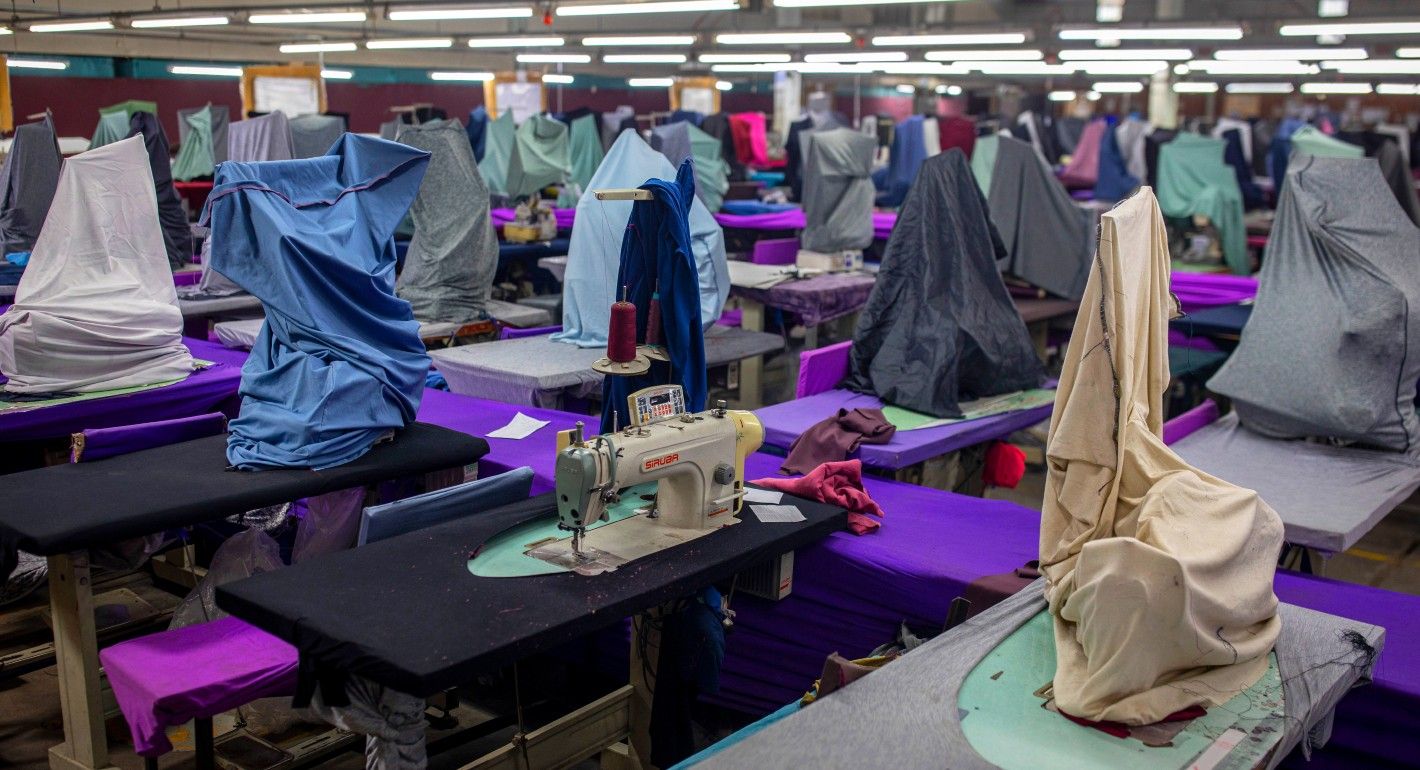
An idle sewing factory in July in Maseru, Lesotho. (Photo by Per-Anders Pettersson/Getty Images)
African countries need to adapt to a new era of U.S. trade relations.
The foundational economic agreement between Africa and the United States has taken its first step toward resuscitation, passing a vote in the House on Monday. But even if the African Growth and Opportunity Act (AGOA) clears the Senate and is signed into law, the short-term renewal should not be considered a long-term win. African countries should continue to reposition themselves for a new era of U.S.-Africa trade relations.
Though results have been mixed, AGOA has been crucial for U.S.-Africa economic relations since it began in 2000. The agreement provides eligible “sub-Saharan” African countries with duty-free access to U.S. markets for over 1,800 goods (and over 5,000 more when including the Generalized System of Preferences (GSP) trade program). Throughout its tenure, AGOA created 300,000 direct and 1.3 million indirect jobs in Africa and 100,000 jobs in the United States, and it further incentivized investment on the African continent. In 2023, U.S. imports under AGOA (and the GSP) were $9.7 billion.
But in September 2025, Congress allowed AGOA to expire, despite numerous efforts to renew it, including one in December. A major lobbying effort is underway, driven by a coalition of U.S. and African business, policy, and trade leaders, and delegations from Madagascar, Kenya, Lesotho, and Tanzania are expected in Washington this month to push for the act’s renewal. The administration of President Donald Trump has stated that it would support a one-year extension of the program, despite a planned expiration at the end of 2028.
Even if AGOA is renewed, previous beneficiaries may no longer be eligible for the preference scheme. For example, South Africa is one of the largest beneficiaries of AGOA: In 2023, it was the second-largest AGOA exporter and the largest exporter of non-crude oil products. But relations between the United States and South Africa have deteriorated steeply in recent months. The Trump administration imposed a 30 percent tariff on South African products, refused to participate in the G20 meeting in Johannesburg, and announced its intention to exclude South Africa from this year’s G20 in Miami.* U.S. Trade Representative Jamieson Greer informed a Senate subcommittee that the administration is open to granting South Africa “different treatment” under any possible AGOA renewal.
Other AGOA beneficiaries should take note of South Africa’s predicament. If passed, the AGOA extension would provide a valuable opportunity for African countries to adapt to the United States’s new economic foreign policy. But it’s only a stopgap measure, and Africa should continue to recalibrate its unilateral economic relationship with the United States toward a mutually beneficial one. It should not assume that AGOA’s return signals the return to business as usual between the continent and the United States.
In addition, negotiations in the aftermath of the so-called Liberation Day tariffs have demonstrated that Washington is seeking to advance its interests through bilateral trade deals rather than regional or multiparty agreements. In this sense, AGOA’s progress toward renewal—even for one year—is surprising. Nevertheless, mineral-rich African countries could leverage this U.S. willingness to engage collectively and pursue a sectoral trade agreement, particularly for critical minerals. Collective bargaining might strengthen individual African countries’ negotiating positions and prevent mineral deals from being subsumed into peace negotiations or tied to other nontrade issues.
That said, any new trade agreement must clarify that qualifying products are exempt from the Liberation Day tariffs. Absent this agreement, additional duties could still put African products at a competitive disadvantage in the U.S. market—even if AGOA were renewed.
Furthermore, a return to AGOA should not trigger false nostalgia for the continent, as Africa largely failed to maximize its trade preferences the first time around. Previous Carnegie research, along with other analysis, showed that AGOA was underutilized for a variety of reasons. These included the fact that a significant portion of African imports to the United States already entered duty-free, and some products opted out of AGOA preferences entirely due to a lack of internal capacity to comply with U.S. product standards and unfamiliarity with AGOA processes and documentation.
Although renewing AGOA would be a positive step in U.S.-Africa relations, African countries still need to look beyond the United States to ensure long-term, sustainable economic growth. They should diversify their export destinations by vetting other lucrative markets, such as the EU and its Economic Partnership Agreements and its frameworks for low-income and least-developed countries. Another option is China’s offer of duty-free, quota-free market access to products from all African countries (except Eswatini, which maintains diplomatic relations with Taiwan). Finally, African countries must continue to accelerate their efforts to boost intra-African trade through the African Continental Free Trade Area, including by upholding their commitment to eliminate tariff and nontariff barriers. Just as AGOA’s future is uncertain, so is the future of global U.S. trade relationships, and the continent should use this opportunity to adjust its outlook and better plan for the future.
*Correction, January 14, 2026: This sentence originally stated that the Trump administration will exclude South Africa from this year’s G20. It has been updated to reflect that the administration has stated its intention to exclude South Africa.

Nonresident Scholar, Africa Program
Kholofelo Kugler is a nonresident scholar in the Carnegie Africa Program.
Georgia Schaefer-Brown
Former James C. Gaither Junior Fellow, Africa Program
Georgia Schaefer-Brown was a James C. Gaither Junior Fellow in the Carnegie Africa Program.
Carnegie does not take institutional positions on public policy issues; the views represented herein are those of the author(s) and do not necessarily reflect the views of Carnegie, its staff, or its trustees.

Despite its flop at the box office, the film raises important questions for the climate community to answer.

Leonardo Martinez-Diaz

The acknowledgment has sparked fears of a new arms race with China and Russia.

Chris O’Meara

The summit may be remembered as a fatal blunder, when Washington, Beijing, and the AI industry collectively chose ceremony over action.

Jeffrey Prescott

The real test may come after the leaders leave the room.



Sheena Chestnut Greitens, Oriana Skylar Mastro, Yukon Huang, …

The Horn of Africa countries are among those facing a new security calculus.


Andrew Leber, Lesley Anne Warner