Iran Primer: The Politics of Iran's Nuclear Program
International tension over Iran’s nuclear ambitions has turned the nuclear program into a major domestic political issue and has caused conflict between the regime and conservatives as well as the opposition.
Iran Primer: The Politics of Iran's Nuclear PrograOne of the central ironies about Iran is that its controversial nuclear program has become a defining political issue, even though many of the program’s details remain shrouded in secrecy. Tehran is public about its quest to acquire peaceful nuclear energy to serve a population that has doubled since the 1979 revolution. But the theocracy vehemently denies any interest in developing a nuclear weapon—even as it boasts about its growing ability to enrich uranium, a capability that can be used to generate power or for a weapons program.
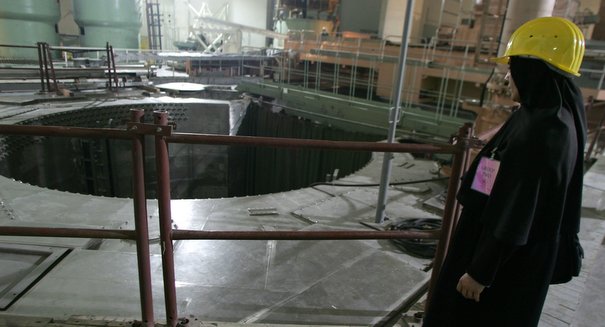
Technically, Iran does not yet need to enrich, since Russia is providing the fuel for the new reactor it built in Bushehr. Tehran counters that it has the right to enrich uranium as a signatory to the Nuclear Non-Proliferation Treaty (NPT). It also intends to build additional reactors and says it does not want to be dependent on foreign powers for fuel. But since 2002, international suspicions about Iran’s long-term intentions have deepened because of revelations—by other governments or Iranian exile groups—that it has built secret facilities that could be used for a weapons program. The Islamic Republic has only acknowledged them after the fact. And as of mid-2010, Tehran had still not provided full details about its programs to the International Atomic Energy Agency, as it is also required to do under the NPT.
Iran appears to have wanted to start a secret program for several reasons, from its experience during Iran-Iraq War to the fact that five of the world’s nine nuclear powers are nearby or on its borders. At the same time, it also appears to have adopted a strategy of nuclear hedging—or maintaining the option of a weapons program, while trying to remain within the nuclear treaty. But the disclosures between 2002 and 2009 about its secret facilities and the subsequent international pressure have turned the program into a major political issue at home. In the already tense environment after disputed 2009 presidential elections, Iran’s nuclear program became a political issue that pitted the hardline regime against both conservatives and the Green Movement opposition.
Program’s evolution
Iran’s nuclear weapons program was part of a broader attempt to become more self-reliant in arms and technology in the 1980s. Increasingly isolated, Tehran struggled to acquire arms to fight Iraq, which used chemical weapons and had a nuclear weapons program. The eight-year war was the Middle East’s bloodiest modern conflict. Iran’s nuclear program was an outgrowth of this experience.
The program may also have been a byproduct of the troubled revolution’s omnipresent need for legitimacy and Iranian nationalism’s quest for respect and international status. Tehran has long sought access to nuclear technology generally as a key to development and a means of restoring its former greatness as a center of scientific progress. The theocracy appears to have further dug in its heels because of a perception that the outside world is trying to deny technology and discriminating against a country that—unlike Israel, Pakistan and India—signed the global treaty on non-proliferation. The regime views the international community’s dictates as an attack on a founding principle of the revolution, namely Iran’s independence from outside influence or intervention.
Nuclear politics
Iran’s nuclear program unfolded in context of its overall politics. Since the 1979 revolution, Iran’s political elite has long been divided over how the theocracy should evolve and what international role it should pursue. Beyond broad concepts, such as independence, self-reliance and social justice, consensus has proven elusive—even three decades after the Islamic Republic’s birth. The most fundament difference is whether Iran should continue as a revolutionary state willing to defy the world, or whether it should settle down and become a normal state that plays by international rules. The nuclear issue is increasingly a reflection of this basic division.
Throughout the program’s early stages, there appeared to be a general consensus among the political elite about the need or right to proceed. But by 2005, the consensus appeared to be crumbling. Rival factions in Iran’s political labyrinth began to criticize the nuclear program’s costs and centrality to Iran’s development goals. Iran’s nuclear program had become a domestic political football.
For the public, the nuclear program also initially enjoyed broad popular support since it promised energy independence and scientific progress. It was also popular because the regime depicted it as an assertion of Iran’s rights against foreign arrogance. But the program has not been subjected to informed debate or public discussion about its ultimate goals, the costs, and the relationship with Iran’s other objectives. Consensus ends where specifics begin.
Politics goes nuclear
The nuclear program has evolved through three phases.
Phase one: Period of consensus (1987-2002)
The period of maximum consensus on Iran’s nuclear program spanned 15 years. The revival of the shah’s nuclear program was initially presented as necessary to diversify energy sources. Nuclear technology was equated as cutting edge for development and indispensable for any self-respecting power.
But the regime only presented a rationale for energy; it did not acknowledge whatever weapons intentions it had. The program progressed slowly during this phase, as Iran encountered problems of organization and getting access to technology that had to be acquired clandestinely abroad. The United States, already wary of Iran’s weapons intentions, sought to block its access to any nuclear technology. Ironically, the regime may have received a boost from blanket U.S. opposition, which extended to the construction of a light-water reactor at Bushehr that Washington had approved when the shah was in power. Iran’s attempts to evade international opposition—which included purchases from the Pakistan network run by A.Q. Khan—were never discussed domestically.
Phase two: Early controversy (2003-2005)
Throughout this period, the nuclear program was largely a concern of Iran’s political elites. The Supreme National Security Council technically acted as the body that reflected all political tendencies. Its decisions therefore allegedly reflected a national consensus.
The 2002 revelation about Iran’s construction of an undeclared enrichment facility at Natanz put Tehran on the defensive. The disclosure coincided with U.S. concern about the spread of weapons of mass destruction to rogue regimes and extremist networks. To avoid exacerbating the issue, the reformist government of President Mohammad Khatami won agreement in the Supreme National Security Council to meet international concerns halfway. Iran agreed to apply the NPT’s Additional Protocol – without ratifying it—which permitted stricter international inspections. It also agreed to voluntarily suspend enrichment for a limited though unspecified time.
Iran’s ensuing negotiations with Britain, France and Germany proved unproductive and added to mutual suspicions. With the U.S. military preoccupied in Iraq, the threat of military action against Iran receded. But hardliners who gained control of Iran’s parliament in 2004 began criticizing reformists for being too soft on the United States for compromising Iran’s interests. In 2005, newly elected President Mahmoud Ahmadinejad, backed by Iran’s supreme leader, began enriching uranium again. The deal with the Europeans was dead.
Phase three: Deep divisions (2005-2010)
Iran’s nuclear program became increasingly political during this phase. As of 2005, both the executive branch and parliament were dominated by hardliners and conservatives. Both Ahmadinejad and Supreme Leader Ayatollah Ali Khamenei used the nuclear issue to stigmatize reformists, depicting them as defeatists willing to negotiate away Iran’s interests. Their use of the nuclear issue as an instrument of partisan politics ended the phase when the nuclear program was supposed to be a national issue. And debate was actively discouraged.
Yet the nuclear issue gradually slipped from the hands of the elite to the street. Among hardliners, Ahmadinejad’s populist rallies included frequently orchestrated chants in favor of Iran’s nuclear rights. The president announced that Iran’s nuclear program was “like a train without brakes,” not susceptible to deflection by outside pressure. Slogans, stamps, banknotes and medals became substitutes for informed discussion.
Two factors spurred intense backlash—and a reaction on the other side of the street. First, the United Nations imposed a series of U.N. resolutions between 2006 and 2010 that included punitive sanctions. The United States and the European Union imposed even tougher unilateral sanctions. For the Iranian public, the costs of continued defiance became increasingly clear—and complicated daily life.
Second, Iran’s disputed 2009 election—won by Ahmadinejad amid widespread allegations of fraud—sparked the largest protests against the regime since the 1979 revolution. A new Green Movement opposition was born. Many conservatives also had growing concerns about the populist hardline president, particularly his economic mismanagement. Iran’s new political chasm quickly began to play on the nuclear issue. Four months after the election, Ahmadinejad agreed to a U.S.-backed interim agreement designed to ease tensions and open the way for broader negotiations on Iran’s long-term program. Leaders of the Green Movement as well as key conservatives publicly criticized the deal—reportedly in large part just to oppose Ahmadinejad and prevent him from taking credit for ending tensions with the outside world. Iran soon walked away from the deal.
By 2010, the divide over Iran’s nuclear program had more to do with domestic politics—and very little to do with what many of the key players actually wanted to see happen.
Factoids
Iran envisages an energy program that encompasses 10 to 12 reactors generating some 24,000 megawatts and several enrichment plants. It is also building a heavy-water plant at Arak, a source of proliferation concern.
Bushehr’s 1,000 megawatt light-water reactor was built by Russia and took 15 years to complete. The deal stipulates that fuel is provided by Russia and the spent fuel rods will return to Russia.
The average reactor takes at least a decade to construct and a minimum of $1 billion before start-up, with costs likely to increase with inflation and international sanctions.
Even with its own enrichment capability, Iran may lack sufficient indigenous sources of uranium ore.
Major players
Akbar Hashemi Rafsanjani is a two-time president and veteran political operative who was in charge of Iran’s defense when the decision to revive the nuclear program was taken in the 1980s. He has alluded to the need for Iran to be prepared for the unexpected in defense matters, and most likely led the decision to hedge by seeking a weapons option. Known as a leading pragmatist, he is personally opposed to Ahmadinejad, whom he ran against for president in 2005. On the nuclear issue, he is more likely to seek a pragmatic accommodation with the world than to accelerate enrichment.
Mir Hossein Mousavi was prime minister during the Iran-Iraq War. Considered a radical supporter of the revolution at the time, he would have been privy to and may have strongly supported the revival of the nuclear program, including a weapons option. Mousavi reflects the evolution of first generation of revolutionaries. Now more pragmatic, he is also more disillusioned by the tendency toward authoritarianism and praetorianism, the control of society by force or fraud. He leads the Green Movement opposition, and straddles the rift between those who feel the regime can be reformed and those who feel it needs to be replaced. On the nuclear issue, he has suggested a reasonable accommodation with the international community.
Moshen Rezaie was the Revolutionary Guards commander during the Iran-Iraq War and is known to have told Rafsanjani that Iran could not pursue the war with Iraq to victory without a nuclear weapon. He is now considered a “pragmatic conservative,” and was a presidential candidate in 2009. He suggested an “international consortium” as a possible compromise solution on the enrichment issue. All three of the opposition presidential candidates – Mousavi, Rezaie and former Parliamentary Speaker Mehdi Karroubi – criticized Ahmadinejad’s nuclear policy as provocative and costly for Iran, despite the supreme leader’s explicit support of it.
Ali Larijani, parliamentary speaker and formerly chief nuclear negotiator (2005-2007), is ambitious and a political opportunist. Larijani started the factionalization of the nuclear issue by accusing the reformists of selling out Iran’s enrichment “pearl” for “candy.” He is a conservative but has also had disputes with Ahmadinejad.
Supreme Leader Ali Khamenei, weakened since the disputed 2009 election, has aligned himself with the hardliners. He has rarely pronounced on the nuclear program except in generalities. He insists that there is an unspecified fatwa against the development of nuclear weapons, but has supported polices that make it impossible to verify this fatwa in practice.
The future
Support for Iran’s nuclear program, always vague, is likely to become even more politicized. The weapons component of the program has never been debated or acknowledged and further revelations or costs associated with it could make it more controversial. Since 2009, factions take positions that do not reflect their real preferences, mainly to thwart political rivals.
Increased international pressure and sanctions are likely to increase the program’s costs, which is also likely to make the program more contentious at home – and potentially exacerbate existing political differences in the leadership.
Iran’s hardline default position—to negotiate only under the most severe pressure—has been reinforced by the change in the domestic balance of power. The Revolutionary Guards are now a principal player in decision-making.
A wild card is the possibility of an Israeli or U.S. military strike on Iran’s nuclear facilities; the repercussions are unpredictable. A reasonable assumption is that initially Iranians may rally around the flag and hardliners will try to further consolidate their position by purging the moderates. The regime will also see its rationale for a weapons option reinforced, and may shift to an overt weapons program and even leave the NPT. Once the dust settles, however, the domestic backlash to an attack may discredit the regime for its brinksmanship and intransigence.
Iran’s technical progress is uneven and allows time for more diplomacy. Any compromise agreement will need to find a balance between not rewarding Iran’s confrontational policies while also meeting Tehran’s minimal political needs in order to win domestic support for an agreement. This may be harder than it sounds.
Former Nonresident Senior Fellow, Nuclear Policy Program
Chubin, who is based in Geneva, focuses his research on nonproliferation, terrorism, and Middle East security issues. He was director of studies at the Geneva Centre for Security Policy, Switzerland, from 1996 to 2009.
Carnegie does not take institutional positions on public policy issues; the views represented herein are those of the author(s) and do not necessarily reflect the views of Carnegie, its staff, or its trustees.
More Work from Carnegie Endowment for International Peace
Russian strikes are weakening the economy sustaining Ukraine’s war effort. Closing the growing funding gap will require more European support and politically contentious reforms in Kyiv.
Ex-president Gurbanguly Berdimuhamedov remains interested in politics, but his son Serdar, Turkmenistan’s current president, is becoming increasingly independent and willing to break with his father’s legacy. If their covert rivalry goes too far, both risk losing power.
A notable degree of participative democracy has firmly arrived in Europe. But to have more far-reaching impact, democratic deliberation needs to move into a radically new phase.
Sergei Kiriyenko used Russia’s parliamentary vote to further hone his strategy of corporate mobilization that is designed to maximize votes for United Russia.