

Q&A
- +1
Sheena Chestnut Greitens, Oriana Skylar Mastro, Yukon Huang, …
{
  "authors": [
    "Yukon Huang"
  ],
  "type": "legacyinthemedia",
  "centerAffiliationAll": "dc",
  "centers": [
    "Carnegie Endowment for International Peace",
    "Carnegie China"
  ],
  "collections": [],
  "englishNewsletterAll": "asia",
  "nonEnglishNewsletterAll": "",
  "primaryCenter": "Carnegie China",
  "programAffiliation": "AP",
  "programs": [
    "Asia"
  ],
  "projects": [],
  "regions": [
    "East Asia",
    "China"
  ],
  "topics": [
    "Political Reform",
    "Economy",
    "Trade"
  ]
}
Source: Getty
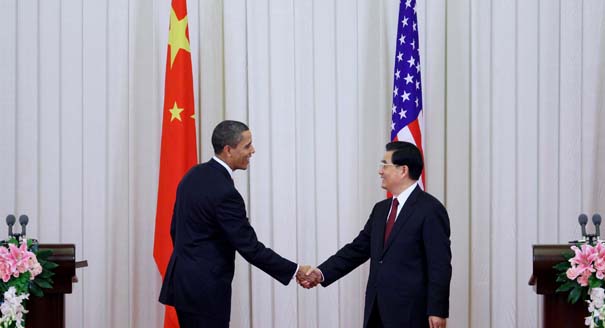
During Chinese President Hu's state visit to Washington, he and President Obama will likely discuss the four key economic issues of currency revaluation, the trade balance, China's domestic imbalances, and the internationalization of the renminbi.
Source: The Diplomat

With Chinese President Hu Jintao preparing to head to Washington next week, there are four issues that are worth revisiting to better understand the situation.
The first is what has been the headline-grabbing issue of currency revaluation. China claims that it’s moving to a more flexible system and gradually appreciating the currency. Flexibility is clearly desired, but a major appreciation isn’t. Beijing tends to adjust its currency in light of international political considerations, and significant upward movement has been seen shortly before three high-profile events—Premier Wen Jiabao’s meetings with Barack Obama and European leaders in the early autumn, the G-20 meeting in November, and now Hu’s upcoming US visit—since the renminbi (yuan) was allowed to fluctuate in June 2010 following the collapse of the euro.
The net change so far has been an appreciation of only 2.5 percent—a far cry from the 20 percent suggested by mainstream observers. Political events clearly matter in the 135 daily adjustments taken by China’s central bank since June 21. In September, during the build up to Wen’s meetings, the renminbi appreciated 1.5 percent; in November prior to the G-20 meeting it appreciated another 1 percent; and after confirmation of Hu’s visit in late December, it went up another 0.6 percent. During these three episodes, the renminbi moved up 34 times and down just 8 times. Aside from these three periods, the renminbi moved up roughly the same number of times it moved down (48 to 45) and on balance actually depreciated by 0.6 percent.
Looking at this, it’s no wonder critics continue to be agitated by the perceived pace of revaluation of the currency. Speculation is now focused on whether the recent adjustments are real or just another politically driven half step. The most likely scenario appears to be continued event driven small appreciations with a net rise of no more than 5 or 6 percent over the coming year.
The second issue to consider is China’s trade surplus—it’s lower than before the financial crisis, but it continues to be larger than expected. Despite significant wage increases and cost pressures, China’s labour productivity remains high relative to competitors. And, even though global trade is down, China is still capturing a larger share. Any reduction in exports due to diminished demand in the United States and Europe appears to be moderated by gains in emerging markets, meaning that China’s competitors in the developing world may become as vociferous on currency issues as the West.
The third concern is China’s ability to increase consumption and reduce investment to moderate global imbalances. The fact here is that any hopes for change need to be tempered. Although Chinese consumption is exceptionally low as a share of GDP, consumption has been increasing at an impressive 8-9 percent annually for years. While it makes sense to expect a rebound in consumption after a recession in the United States and Europe, this argument is less convincing in China.
It’s often assumed that a stronger social welfare system in China would encourage households to consume more and save less, but the evidence suggests that households are actually saving more because they lack confidence in the emerging pension system. As a result, the potential for rebalancing lies more in stimulating investments in social infrastructure than encouraging more consumption.
And the final issue? While China’s economy has become globalized, the global economy has become ‘sinicized’. China now holds over $2.8 trillion in foreign exchange reserves, outward flows of foreign direct investment are accelerating, and the renminbi is much sought after in off-shore markets. This is causing China’s currency to be internationalized more rapidly than envisaged. So far, China has retained capital controls and the renminbi has become a valued asset outside the global financial system rather than inside it.
Until recently, Beijing couldn’t decide whether internationalizing the renminbi was an opportunity, necessity, or ruse. Minimizing volatility is a special concern, and while China sees an advantage in making the renminbi a world currency, it also still believes that its value and use should be controlled—that these are conflicting objectives hasn’t been fully appreciated.
China is beginning to make it easier for firms to launch renminbi bonds and off-shore renminbi markets are becoming a reality. All of this will contribute to the gradual internationalization of its currency—from settling trade accounts to becoming a reserve currency for central banks. But for this to happen, the renminbi must be more readily moved abroad by both firms and households to create a larger pool of liquid assets. This will encourage China to gravitate to more open capital markets and force the currency to fluctuate in line with market sentiments.
This change in attitude comes from the increasing Chinese desire for the renminbi to be used for settling international transactions given the perceived structural weaknesses in major reserve currencies. While at one time China viewed the non-convertibility of the renminbi as protection against the destabilizing vagaries of foreign financial markets, internationalizing the currency is now seen as a key to expanding China’s global interests.
These four issues will undoubtedly be discussed when Hu arrives in Washington, and will continue to be talked about in international circles in 2011. We’ll likely see more modest appreciations in China’s exchange rate tied to international politics, while emerging markets will become as vociferous about needed adjustments as developed countries.
Meanwhile, expect to see China’s exports remain buoyant, but with the focus possibly shifting to increasing imports. There will be less attention given to propping up consumption with more focus on sustaining investment. And finally, expect increasing attention over liberalizing China’s external capital flows, which will be seen by some as a solution to global imbalances.

Senior Fellow, Asia Program
Huang is a senior fellow in the Carnegie Asia Program where his research focuses on China’s economy and its regional and global impact.
Recent Work


Sheena Chestnut Greitens, Oriana Skylar Mastro, Yukon Huang, …


Yukon Huang, Isaac B. Kardon, Matt Sheehan
Carnegie does not take institutional positions on public policy issues; the views represented herein are those of the author(s) and do not necessarily reflect the views of Carnegie, its staff, or its trustees.

The acknowledgment has sparked fears of a new arms race with China and Russia.

Chris O’Meara

The European Commissioner for Trade is headed to China. But after President Xi’s bridge-building visit to Washington, can a more isolated EU overcome Beijing’s stranglehold on critical raw materials? Who will blink first?

Rym Momtaz, ed.
The summit may be remembered as a fatal blunder, when Washington, Beijing, and the AI industry collectively chose ceremony over action.

Jeffrey Prescott

Cargo traffic through Russia’s Northern Sea Route has increased because of the disruption caused by the conflict in the Middle East, the Ukraine war, and U.S.-China tensions.

Mikhail Korostikov

The domestic impacts of how long it is taking to end the war in Ukraine have pushed the French electorate to the political extremes and compromised the country’s diplomatic capacity.
Rym Momtaz