

Paper
Douglas H. Paal
{
  "authors": [
    "Douglas H. Paal"
  ],
  "type": "legacyinthemedia",
  "centerAffiliationAll": "dc",
  "centers": [
    "Carnegie Endowment for International Peace",
    "Malcolm H. Kerr Carnegie Middle East Center"
  ],
  "collections": [
    "Arab Awakening"
  ],
  "englishNewsletterAll": "asia",
  "nonEnglishNewsletterAll": "",
  "primaryCenter": "Carnegie Endowment for International Peace",
  "programAffiliation": "AP",
  "programs": [
    "Asia"
  ],
  "projects": [],
  "regions": [
    "North Africa",
    "Libya",
    "East Asia",
    "China",
    "Maghreb"
  ],
  "topics": [
    "Political Reform",
    "Security"
  ]
}
Source: Getty
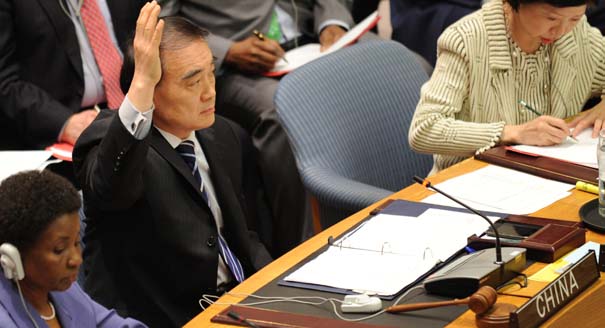
China’s stance on the recent UN Security Council Resolutions on Libya demonstrates that Beijing’s traditional foreign policy of noninterference is being challenged by its growing international involvement and expanding economic ties.
Source: Asia Pacific Brief

What happened? Why did China support or facilitate international actions it would undoubtedly have vetoed if directed against itself? What has happened to China’s principle of non-interference?
Reality happened. As Chinese official statements have repeatedly made clear, Beijing still upholds its long-standing, but now tattered, principle of non-interference. Security Council President and Chinese Ambassador Li Baodong said China had serious difficulty with the resolution authorizing “all necessary measures” to protect civilians. Nevertheless, China did not block the resolution “because it attached great importance to the requests of the Arab League and the African Union.”
The fact is that China’s increasingly far-flung interests are pricking the bubble of isolation and ideology within which it lived during the decades before “opening and reform” commenced in 1978. This is awkward for Beijing because its leaders are reluctant to abandon the familiar ideology that permitted them to resist outside pressure on China while circumscribing China’s own responsibilities in the world beyond its shores. Its policy today rhymes with American pre-World War II isolationism, under which the United States earned great riches in world markets, but turned its back on overseas entanglements. But just like isolationism, non-interference is an endangered principle in a globalized world.
Mugged by the facts. As the Jasmine revolution migrated to Libya, China found it had 36,000 workers in the country working on $18 billion worth of projects, largely consisting of railroad and petroleum contracts. When civil war erupted, China—whose power projection capabilities have been growing, but are still not robust—found it could not sit idly by. It had to protect its citizens and interests.
The Chinese military set a number of notable precedents by successfully evacuating its citizens from Libya. The People’s Liberation Army Navy (PLAN) sent the frigate Xuzhou through the Suez Canal and into the Mediterranean for the first time to oversee the evacuation of workers by ferry and transport vessels. The PLA Air Force sent four IL-76 transport aircraft to airlift workers into Sudan, another first and probably a risky stretch for the air force. Many more crossed the Libyan border by ground transportation into Egypt.
The evacuation was impressive, but why did China go further and facilitate the two UNSC Resolutions? As repeated official comments made clear, China viewed the views of the Arab League and the African Union as “important.” This is another way to say, first, that China has interests in those other countries as well and could not afford to fall back on the principle of “non-interference” to thwart so many capitals’ intent to punish Gaddafi. Colonel Gaddafi’s many assassination and coup attempts against his neighbors very likely helped make this a special case—one where unity against him was easy to achieve.
Second, regional unity left Beijing with no place to hide. Reliable sources report that Chinese diplomats tried hard to persuade or rent other votes from Arab League or African Union members to oppose the UNSC Resolutions. Having failed to find diplomatic cover, China had to go along.
But, like the other nations that abstained on UNSC Resolution 1973 (Germany, India, Russia, and Brazil), China subsequently tried to separate itself from NATO’s actions against Libyan armed forces. On the basis of dubious information, Beijing’s officials have berated the alleged civilian casualties caused by air strikes against Gaddafi’s forces. They have claimed they did not mean for “all necessary measures” to enforce a “no fly zone” to include coalition attacks on Gaddafi’s ground forces. And Chinese President Hu Jintao berated NATO’s coalition promoter French President Nicolas Sarkozy personally.
Despite these weak attempts to uphold faith in China’s founding ideology, “non-interference” is going the way of “socialism” in a market-driven world. And, in fact, this is nothing new. America constantly battles between its high-minded values and its baser interests. Libya is another good example, where U.S. interests are slight, yet many clamored for humanitarian relief through military intervention, and the Obama administration ended up splitting the difference.
For China, former paramount leader Deng Xiaoping started off China’s modern contest between ideology and pragmatism when recovering from the excesses of the Cultural Revolution. One of the first signs was his decision to end assistance to the splinter Marxist-Leninist parties China had long supported in South East Asia in the interest of developing profitable relations with China’s neighbors.
Going forward, it is hard to imagine that China’s need to deal pragmatically with countries where its interests are intertwined will diminish. Ideology in foreign affairs will be an increasingly ill-fitting suit. If China’s economy continues to boom, it will grow those connections abroad. If it stumbles, it will need the ones it has all the more.
A footnote: those who advocate expansion of the permanent membership of the UN Security Council might want to take a second look at how those candidates voted on Resolution 1973. Updated isolationists may make for irresponsible stake holders.

Distinguished Fellow, Asia Program
Paal previously served as vice chairman of JPMorgan Chase International and as unofficial U.S. representative to Taiwan as director of the American Institute in Taiwan.
Recent Work
Douglas H. Paal


Douglas H. Paal, Tong Zhao, Chen Qi, …
Carnegie does not take institutional positions on public policy issues; the views represented herein are those of the author(s) and do not necessarily reflect the views of Carnegie, its staff, or its trustees.
A leak of Russian gas price data helps establish that China is paying Russia far less than Central Asian countries and Gazprom’s former European customers.

Sergey Vakulenko

China’s political future will be shaped between now and next October. As the Communist Party enters its intense “campaign season” to prepare for a major political transition in 2027, reading Beijing's actions and responses may become more difficult as domestic politics weigh on its behavior more than usual.

Damien Ma

Japan’s long-term security policy is driven by concerns about China, and there is little appetite for (or interest in) pursuing a confrontation with Moscow.

James D.J. Brown

Russia is testing the waters of NATO’s mutual defense clause. What do strikes in Romanian territorial waters mean for the alliance’s posture toward Moscow?

Dimitar Bechev

China has showcased its engineering prowess with small modular reactor demonstration projects. But turning these technological achievements into commercial success will be a greater challenge.
Tong Zhao