

Commentary
Dmitri Trenin
{
  "authors": [
    "Dmitri Trenin"
  ],
  "type": "questionAnswer",
  "centerAffiliationAll": "",
  "centers": [
    "Carnegie Endowment for International Peace",
    "Carnegie Russia Eurasia Center"
  ],
  "collections": [],
  "englishNewsletterAll": "",
  "nonEnglishNewsletterAll": "",
  "primaryCenter": "Carnegie Russia Eurasia Center",
  "programAffiliation": "",
  "programs": [],
  "projects": [],
  "regions": [
    "Caucasus",
    "Russia"
  ],
  "topics": [
    "Political Reform",
    "Democracy",
    "Economy",
    "Domestic Politics"
  ]
}
Source: Getty
Russian authorities see the protests as the most serious challenge to their power since taking office in 2000. The coming year will be momentous for Russian politics, with unpredictable outcomes and potentially dangerous consequences.
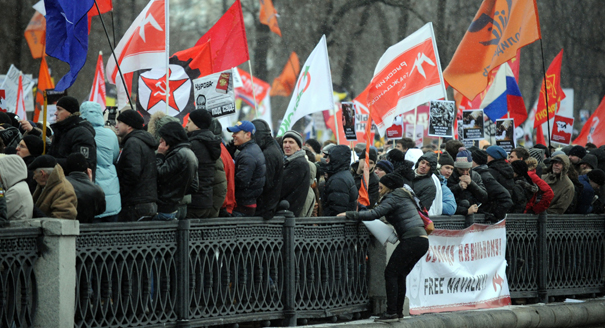
Tens of thousands of protesters filled the streets of Moscow on December 24, demonstrating against the results of the Russian parliamentary elections just a few weeks earlier. Accusing the Kremlin of vote rigging, they called for new elections and the ouster of the chair of the Central Electoral Commission.
In a Q&A, Dmitri Trenin examines the protesters’ demands, the government’s response, and the possible impact on the March presidential elections. Trenin says Russian authorities see the protests as the most serious challenge to their power since taking office in 2000. The coming year will be momentous for Russian politics, with unpredictable outcomes and potentially dangerous consequences.
In terms of numbers, the latest round of protests, held on Moscow’s Sakharov Avenue, showed a progression—from almost 50,000 to around 120,000 people in Moscow in two weeks. Thus, the protest momentum has been sustained, despite the winter weather and the approaching holiday season.
The protest movement continued to embrace all the major population centers, although the numbers of demonstrators outside of Moscow ranged from a few hundred to a few thousand in each case. The movement remained very broad based and included people of different persuasions, from liberals to ultranationalists. The protests also kept their peaceful character, with the demonstrators maintaining order and the police apparently under orders to refrain from forceful measures.
After December 24 it has become clear that the protests were not a one-off event, contrary to what quite a few people had thought and many in the Kremlin had hoped. It is also evident that the protest movement is still on the rise and can gather even more people in the future. The prospect of a million-strong vigil lasting through the presidential election night on March 4, 2012, has ceased to be impossible.
This has raised, for the first time in nearly twenty years, the possibility of a mass upheaval capable of threatening the very system of power. December 24, 2011, has made it clear that 2012 is going to be a momentous year in Russian politics, with unpredictable outcomes, giddying promises, and potentially dangerous consequences.
The protest movement emerged as a reaction to the rigging of the December 4 parliamentary election. Thus, fair elections is the protesters’ unifying battle cry. Many of them demand the holding of new elections to the State Duma and the postponement of the presidential poll, set for March 4. Specifically, they call for the removal of the chair of the Central Electoral Commission. The more radical groups want Putin’s departure from the political scene. The more thoughtful people in the opposition milieu concede that simply replacing the head of the regime will not solve Russia’s problems and suggest that a major constitutional change away from a neo-czarist system to one which securely prohibits anyone’s monopoly on power is necessary.
The discontent that been displayed so far is largely driven by the new urban middle classes, and their highest concentration by far is found in Moscow. These largely successful professional people have learned to respect themselves, and they want the authorities to respect their dignity and civic rights as well. They are generally young, well educated, Internet savvy, and have little memory of the Soviet past and virtually none of the paralyzing Soviet fear.
They are flanked by the members of “old” liberal intelligentsia and the assortment of nonsystem opposition groups spanning the entire ideological spectrum. Outside of Moscow, most of these people live in St. Petersburg, Nizhny Novgorod, Ekaterinburg, Novosibirsk, Irkutsk, and several other large urban centers.
Interestingly, the December 24 protests did not include members of the Russian Communist Party who held their own rally in Moscow on December 17. And social themes are rather muted among the relatively prosperous December 24 protesters, whose demands are mostly political.
It is also important to remember that, though the protesters are making headlines, there is a silent majority in Russia who are still preoccupied with their own private matters, are politically apathetic, usually vote for the authorities in power, and detest Moscow and Muscovites almost as intensely as some of the Kremlin’s more fiery propagandists detest the United States. Most of these men and women still stick with Putin, either as their champion or simply the default choice.
Both men’s presence is highly significant, but for different reasons. Prokhorov, who has announced his intention to compete for the presidency next March, has effectively begun campaigning. As a billionaire with a reputation of a bon vivant and a political novice, he stands little chance of winning or even making it to the second round. Prokhorov’s candidacy, however, has been given a nod by the Kremlin, and Putin stands to benefit from Prokhorov winning a portion of the liberal constituency and part of the protest vote. That would reduce even further the chances—however slim—of a unifying opposition candidate. In fact, Putin’s best defense could be letting more flowers bloom, more candidates to run for president, and more parties contest the Duma seats.
Kudrin’s appearance on Sakharov Avenue is far more significant. As a competent economist and financier, a longtime and successful finance chief, a confidant of Putin’s, and at the same time a strong critic of Putin’s party, United Russia, Kudrin has credibility to act as a communication channel between the authorities and the liberal opposition. For Kudrin to play a useful role, however, the authorities—that is, Putin—need to express their willingness to make serious concessions and eventually agree to share power. The opposition has to shed some of its more radical demands, such as Putin’s ouster, and, above all, unite. Neither is possible at the moment. In addition, personal animosities, as always in Russia, poison political relationships.
The Russian authorities see the protests as the most serious challenge to their power since the establishment of the present political regime in the early 2000s. In principle, some in the Kremlin view this as a matter of life and death. Quite a few are haunted by the specter of an Orange Revolution, Russia-style, ordered and orchestrated by Washington.
The Kremlin, however, has a limited choice of pretty stark options. The authorities might crack down on the protesters, using force against them. This is obviously not Putin’s first choice. He has never practiced wholesale oppression and detests mass violence. He would also have good reason to fear the consequences. While the crackdown option is never to be ruled out entirely, its probability is low—for the time being.
The Kremlin hard-liners might mobilize Putin’s own supporters, also among the youth, industrial workers, and ultranationalists, and set them against the liberal opposition, painting them as the “U.S. stooges.” Such a “counterforce” strategy would come close to initiating a civil conflict, which could get out of hand and lead to the kind of chaos the Kremlin—and everybody else—abhors.
In theory, the authorities might use some pretext to declare a state of emergency and postpone elections or hold them under conditions of martial law. It is not certain, however, that time is on Putin’s side and that postponing the elections would work to his advantage. Very importantly, imposing a state of emergency would deny the Kremlin any international legitimacy.
Finally, the authorities might decide on a complex pre-election strategic mix of populism vis-à-vis the poorer social strata, partial concessions to the protesters, and dialogue with the opposition. This last option is interesting, but tricky, as it presumes talking with the opposition while trying to divide it, weaken it, and win time to modify and thus save the system.
The Kremlin has already made a few steps down that path. On December 22, President Medvedev announced a number of policy proposals: reinstating direct elections of governors—this had been previewed a few days earlier by Premier Putin—and easing registration of political parties, again something to which Putin had publicly consented. Medvedev’s proposals, which are yet to be made into law and implemented, have been seen as concessions to the protesters.
The protesters, however, are unlikely to be fully satisfied with what they have just been offered. If the soft line is confirmed as the authorities’ main strategy for the future, the Kremlin will not only have to give more, such as symbolically dumping the chief election “magician,” but also open up the Russian political system for serious changes. After that, when Putin goes will be a matter of time.
To some within the current ruling circle, such a course is high treason; for others, the only path to salvation— including their own. Seeing this, the opposition will try to breach the walls of the Kremlin and engage some of its towers, even as the authorities try to splinter the opposition.
The next few months will be a thrilling period. Russia’s domestic politics is back—with gusto.
As of this writing, most observers conclude that Putin will win the presidency. It is not clear, however, whether Putin would win in the first round. First or second round, Putin is certainly interested in being seen as winning clean, and the Kremlin knows any credible charges of vote rigging in Moscow, St. Petersburg, and the other larger cities would lead to massive protests and a lack of legitimacy.
Putin, of course, has more support in the smaller towns—the countryside—and he can rely on the special constituencies such as the military, security, and law enforcement officers and families, industrial workers, and the notoriously pro-government electoral machines in the ethnic republics of the North Caucasus and some other territories.
Getting Mr. Putin elected president is still possible, but it will require the kind of electoral brilliancy the Kremlin may not be able to muster. The replacement of Vladislav Surkov, the Kremlin’s chief political operator, with a more straightforward United Russia politician, Vyacheslav Volodin, may herald a change in strategy. Still reluctant to engage his opponents in election debates, Mr. Putin is less cavalier in brushing off the idea. Putin, who had heretofore been the sole master of the game, is weighing out unfamiliar courses of action. Those who wanted to see a different Putin in the run-up to the elections may be seeing just that—Putin having to subject himself to a new political environment in Russia, ushered in on December 5, the first day of protest against the Duma election rigging.
The developments in Russia are Russia’s own business. It is up to the Russian people to elect those who govern them in their name.
Russia is better equipped for making the right choices than ever before in its history. Many people are stepping out of their private domains into the public square. Information and views are shared instantaneously and independently across the country’s many time zones. A sense of self-preservation is spreading across all quarters, which works for change but bars chaos. Russians are also proud: many felt insulted by Putin’s claim that the rallies in Moscow had been organized by Hillary Clinton and her U.S. State Department.
As long as the newly enlivened political process in Moscow remains peaceful and orderly, there is no need to “respond” to it and appear to be meddling. Secretary Clinton’s remarks, which she made in Vilnius right after the Duma elections, were widely interpreted in Russia as a statement primarily designed for “the other party” in Washington, lest congressional Republicans accuse the Obama administration of cuddling Kremlin authoritarians in the name of the reset. Similar statements in the future could be devalued and turned around in the same way—by pointing to the context of America’s own election campaign. The European leaders, gripped by their seminal crisis, have remained, by and large, intently interested in Russian developments but publicly silent.
Rather than telling the Russian authorities how they must manage their country, Western leaders need first to try to understand what is happening there. 2012 is going to be very different from Russia’s 1991 and 1993, Serbia’s 2000, or Ukraine’s 2004. This is not a case of an ancien régime being overthrown by a broad democratic movement that draws its inspiration from the United States and Europe. Today, Russia, in terms of its national capacity and international importance, can be likened neither to Serbia nor Ukraine.
Thus, Western leaderships need to use whatever influence they have to encourage the continued peaceful and orderly nature of the Russian political process. They need to offer as many international observers as possible to ensure that the Russian presidential election is properly monitored. And they need to do nothing that could be construed as interference in Russia’s domestic affairs.
The key word in U.S. and European approaches to Russia in the run-up to the March elections is responsibility. This does not equate to keeping mum out of caution, but it certainly does not lay a premium on Sunday preaching. Beyond March 4, there is another day.
Former Director, Carnegie Moscow Center
Trenin was director of the Carnegie Moscow Center from 2008 to early 2022.
Recent Work
Dmitri Trenin
Dmitri Trenin
Carnegie does not take institutional positions on public policy issues; the views represented herein are those of the author(s) and do not necessarily reflect the views of Carnegie, its staff, or its trustees.

Rubio’s recent visit brought welcome attention, but more capital requires governance changes that may be a hard sell for regional governments.

Jennifer B. Murtazashvili

Japan’s long-term security policy is driven by concerns about China, and there is little appetite for (or interest in) pursuing a confrontation with Moscow.

James D.J. Brown

Russia is testing the waters of NATO’s mutual defense clause. What do strikes in Romanian territorial waters mean for the alliance’s posture toward Moscow?

Dimitar Bechev
China has showcased its engineering prowess with small modular reactor demonstration projects. But turning these technological achievements into commercial success will be a greater challenge.

Tong Zhao

The truth of the strategic situation is that Europe and Russia are extremely unlikely to be able to “turn the page” on their confrontation within the next two decades.

Arkady Moshes