

In The Media
Kevin Jianjun Tu
{
  "authors": [
    "Kevin Jianjun Tu"
  ],
  "type": "legacyinthemedia",
  "centerAffiliationAll": "dc",
  "centers": [
    "Carnegie Endowment for International Peace",
    "Carnegie China"
  ],
  "collections": [],
  "englishNewsletterAll": "ctw",
  "nonEnglishNewsletterAll": "",
  "primaryCenter": "Carnegie China",
  "programAffiliation": "SCP",
  "programs": [
    "Sustainability, Climate, and Geopolitics"
  ],
  "projects": [],
  "regions": [
    "East Asia",
    "China",
    "North America"
  ],
  "topics": [
    "Climate Change",
    "Nuclear Policy"
  ]
}
Source: Getty
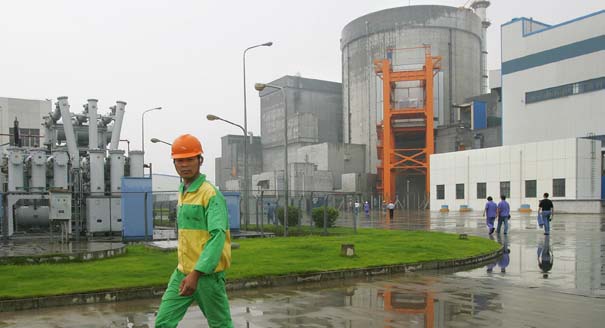
Beijing needs to resolve a number of fundamental nuclear safety deficiencies before China increases its nuclear capacity.
Source: Diplomat

As a result, China’s 2020 nuclear target is widely expected to fall to 60 to 70 gigawatts (GW). While China’s nuclear advocacy groups are still actively lobbying the government to set the 2020 nuclear target as high as 80 GW, the country needs to resolve a number of fundamental deficiencies in China’s nuclear safety before further increasing its nuclear capacity.
It’s first important to acknowledge that the safety oversight mechanism is one of the weakest links of the Chinese nuclear industry. Currently, the National Development and Reform Commission, which overseas nuclear development, is the most politically powerful ministry. In comparison, China’s civil nuclear watchdog is supervised by a much weaker Ministry of Environmental Protection (MEP). Such an unbalanced bureaucratic hierarchical arrangement and internal power struggle among different stakeholders has prevented a timely overhaul of China’s nuclear oversight mechanism.
Right after the Fukushima disaster, the MEP publically expressed support for the further expansion of the Chinese nuclear industry. Since the MEP supervises China’s civil nuclear safety watchdog, such a gesture has unnecessarily blurred the administrative boundary between the nuclear safety regulator and industry development administration. This again underlines the urgent need for China to fundamentally reform its nuclear safety oversight mechanism in order to avoid the cozy bureaucratic collusion between government and industry that has befallen the Japanese nuclear industry.
A lack of transparency in the industry also remains an issue. Immediately after the disaster in Japan, there was a panicked buying spree of iodized salt across China. Even after both the Chinese government and experts publically clarified that this was entirely unnecessary, it still took quite a while for the general public to calm down. This event not only indicates Chinese society’s lack of fundamental understanding on nuclear issues, due largely to the prolonged secretive operations of the Chinese nuclear industry, but also clearly illustrates the absence of basic trust between the Chinese government and civil society.
Since then, the lack of transparency hasn’t fundamentally changed. On January 11, when a new Global Nuclear Materials Security Index was launched, China ranked 29th among a group of 32 nuclear nations in terms of nuclear security and materials transparency.
The country’s ability to safely export nuclear technology and equipment to overseas markets is yet another challenge that needs to be addressed. Thus far, China has exported its second generation reactors to Pakistan, which are less sophisticated than the imported third generation reactors under construction in China. But the country lacks both sufficient domestic capacity and faces numerous patent-related constraints before it can develop its own export-ready advanced nuclear reactors. While the second generation nuclear technology exported to Pakistan has already been phased out domestically due to safety concerns, it’s still possible for China to be lured by economic and geopolitical considerations into additional nuclear export deals with other developing countries in the future.
Last year, both Germany and Switzerland decided to gradually phase out nuclear power. Furthermore, any nuclear project in the United States has become much more difficult to finance and license. Even France, the most nuclear reliant major economy, has already expressed its intention to increase the share of renewables in its electricity mixture. Such dim prospects for nuclear power in developed countries may lead international nuclear companies to look to developing countries – especially China – for business opportunities.
Related, if more nuclear power plants are built in developing countries with little experience of operating a reactor, or bordering a region where terrorism is a concern, or without sufficient financial resources to import state of the art technology, then the chance of a major nuclear accident hitting the developing world will loom large in the coming decades. Not surprisingly, the ability of the Chinese government to resist short-term geopolitical and economic temptation and stop exporting outdated nuclear reactors to other developing countries will have profound safety implications in a post-Fukushima world.
Nuclear emergency planning, meanwhile, is important in ensuring the safety of nuclear power plants. Yet due to concerns about cost escalation and the unwillingness to scare the general public, both national governments and nuclear power companies often ignore the worst-case scenarios of nuclear accidents when facility-specific emergency plans are prepared and exercised. For instance, although 25 years have passed since the Chernobyl disaster, the Fukushima nuclear crisis still caught both the Japanese government and the plant operator entirely unprepared.
When China’s first national nuclear emergency drill was held at Tianwan Nuclear Power Plant in November 2009, authorities simply assumed that an effective emergency response would be sufficient to contain the hypothetic accident. However, after Three Mile Island in 1979, Chernobyl in 1986 and Fukushima Daiichi in 2011, it becomes increasingly difficult for the Chinese government and state-owned nuclear power companies to continue to not prepare emergency plans for worst-case nuclear accidents that have already befallen major nuclear economies in the past.
Given the devastating impacts of major nuclear accidents, and the tarred safety record of global nuclear industry, the Chinese government should prioritize its nuclear safety agenda by fundamentally reforming its nuclear oversight mechanism and continuously improving transparency of its nuclear industry. Instead of actively advocating an overly ambitious nuclear target by 2020, Chinese nuclear power companies should build and indigenize imported third generation nuclear reactors step by step. Finally, the Chinese government needs to continue to suspend the approval of new nuclear power plants until China gains sufficient experience to operate and improve advanced reactors that are still under construction. Otherwise, deficiencies in the insufficiently tested prototype reactors could be easily built into a hastily ordered nuclear generation fleet, which is a fatal mistake that energy-thirsty China can’t afford to make.

Former Senior Associate , Energy and Climate Program
Tu was a senior associate in Carnegie’s Energy and Climate Program, where he led the organization’s work on China’s energy and climate policies.
Recent Work
Kevin Jianjun Tu
Kevin Jianjun Tu
Carnegie does not take institutional positions on public policy issues; the views represented herein are those of the author(s) and do not necessarily reflect the views of Carnegie, its staff, or its trustees.

China’s political future will be shaped between now and next October. As the Communist Party enters its intense “campaign season” to prepare for a major political transition in 2027, reading Beijing's actions and responses may become more difficult as domestic politics weigh on its behavior more than usual.

Damien Ma

China has showcased its engineering prowess with small modular reactor demonstration projects. But turning these technological achievements into commercial success will be a greater challenge.

Tong Zhao

Despite public disputes over trade and immigration, the strategic partnership’s foundations remain sturdy.

Sameer Lalwani

Without a ceasefire with Ukraine on attacking each other’s energy infrastructure—to which the Kremlin is unlikely to agree—the diesel agreement between Putin and Trump is largely for show, rather than representing a genuine increase in the volumes of Russian diesel on the global market.

Sergey Vakulenko

Despite its flop at the box office, the film raises important questions for the climate community to answer.

Leonardo Martinez-Diaz