

In The Media
Vikram Nehru
{
  "authors": [
    "Vikram Nehru"
  ],
  "type": "legacyinthemedia",
  "centerAffiliationAll": "dc",
  "centers": [
    "Carnegie Endowment for International Peace",
    "Carnegie China"
  ],
  "collections": [
    "China’s Foreign Relations"
  ],
  "englishNewsletterAll": "asia",
  "nonEnglishNewsletterAll": "",
  "primaryCenter": "Carnegie Endowment for International Peace",
  "programAffiliation": "AP",
  "programs": [
    "Asia"
  ],
  "projects": [],
  "regions": [
    "Southeast Asia"
  ],
  "topics": [
    "Political Reform",
    "Economy",
    "Trade",
    "Security",
    "Foreign Policy"
  ]
}
Source: Getty
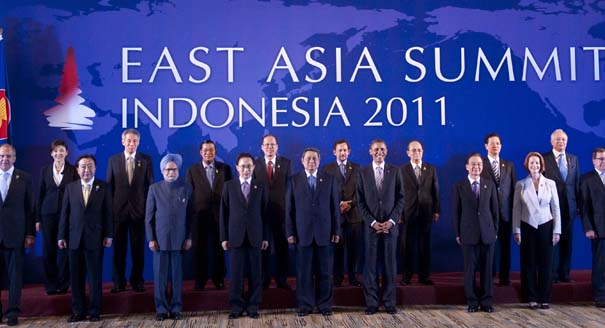
President Obama’s trip to Southeast Asia provides him with an opportunity to present a common vision of partnership to Southeast Asia that will resonate throughout the region.
Source: CNN

The visit is the culmination of painstaking preparatory work by his senior officials – Secretary of State Hillary Clinton, Defense Secretary Leon Panetta, and U.S. Trade Representative Ron Kirk – who have assiduously put flesh on the bones of Obama’s rebalancing strategy toward Asia. Obama’s trip could add substantially by providing the strategic framework that combines the different strands of work related to trade, investment, aid, security, governance, diplomacy, and culture. He could do this by offering Southeast Asia the vision of a comprehensive partnership that builds on these initiatives and the foundational values and interests common between the region and the United States.
From a strategic perspective, Obama couldn’t have chosen a better set of destinations for his first post-election foreign trip. Asia, after all, has been the focus of Obama’s foreign policy “rebalancing,” which recognizes the dynamism of the region and its central importance to America’s long-term strategic interests.
This trip will send an early and strong signal that, notwithstanding critical issues at home, America’s strategic interests in Asia are being given priority attention by none other than the president himself. Moreover, after what is sure to be a tense week of negotiations on tax and expenditure policy at the White House and on Capitol Hill, the trip will spotlight a foreign policy issue on which there is strong bipartisan support in Washington – the restoration of democracy and human rights in Myanmar.
On the way to Myanmar, the president will stop in Bangkok, where he will formalize Secretary Panetta’s efforts to reinvigorate the U.S.-Thai military alliance and applaud Thailand’s intention to join the Trans-Pacific Partnership, which will give a welcome boost to the American-supported free trade initiative in the Asia-Pacific. And by attending his second East Asia Summit in Cambodia, he will underline America’s determination to be a constructive part of the conversation in Asia on the key issues that confront the region.
The trip presents an opportunity to correct two misperceptions about the Obama administration’s rebalancing toward Asia.
The first is the overwhelming and unfortunate impression that the rebalancing is almost exclusively to do with an increased U.S. military presence in the region, especially in light of rising tensions in the South China Sea. Obama’s trip should convey a new and different message that will help restore the other dimensions of U.S. involvement in Southeast Asia to their proper place, notably the promotion of trade, investment, good governance, human rights, disaster relief, education, technology cooperation, and so on.
The second is that the whole of the rebalancing policy appears to be less than the sum of its parts. Obama’s trip should be the start of a new narrative of how the recent initiatives on trade, security, and diplomacy fit together and the strategic objectives they eventually hope to achieve.
To do this, Obama should offer Southeast Asia the vision of a comprehensive partnership with the United States. This would provide a framework that binds together its myriad components into one cohesive whole and embodies the principle of equality and mutual respect.
To be sure, this is not a new concept. The United States already has a comprehensive partnership with a Southeast Asian country – Indonesia – that covers three broad dimensions: economy and development; political and security; and socio-cultural (which includes education, science and technology, environmental protection, democracy promotion, among others).
These areas are being developed through six joint U.S.-Indonesian working groups that have their progress reviewed periodically by the U.S. secretary of state and the Indonesian foreign minister. By working together on a broad range of topics of mutual interest and importance, both sides are building cooperative structures that will deepen understanding and advance shared programs.
Given the diversity of countries in Southeast Asia, developing a comprehensive partnership with the entire Southeast Asian region will prove difficult. Instead, the approach adopted by the U.S.-Indonesia comprehensive partnership is a model that could be advanced on a bilateral basis with other countries in the region.
Certainly, Thailand, Malaysia, Philippines, and Vietnam would be excellent candidates. The areas for partnership and joint development in each case would need to be identified separately and will likely be very different.
Over time, however, as these partnerships develop, they will undoubtedly display common features that have the potential of being brought together gradually across the entire Southeast Asian region.
President Obama’s Southeast Asia trip will reinforce the importance the United States attaches to a strong relationship with Asia. But rather than seeing Thailand, Myanmar, and Cambodia as three different stops requiring three different talking points, the U.S. administration has an opportunity to present a common vision of partnership to Southeast Asia that will resonate in all three countries and throughout the region. Obama should grab it.
This article was originally published in CNN's Global Public Square.
Former Nonresident Senior Fellow, Asia Program
Nehru was a nonresident senior fellow in the Carnegie Asia Program. An expert on development economics, growth, poverty reduction, debt sustainability, governance, and the performance and prospects of East Asia, his research focuses on the economic, political, and strategic issues confronting Asia, particularly Southeast Asia.
Recent Work
Vikram Nehru
Vikram Nehru
Carnegie does not take institutional positions on public policy issues; the views represented herein are those of the author(s) and do not necessarily reflect the views of Carnegie, its staff, or its trustees.

Funding Ukraine remains a priority for European leaders. As Russia’s war of aggression heads into another winter, two feasible options to mobilize support for Kyiv should be fast-tracked.


Vladyslav Rashkovan, Gregory P. Wilson

Russian strikes are weakening the economy sustaining Ukraine’s war effort. Closing the growing funding gap will require more European support and politically contentious reforms in Kyiv.

Balázs Jarábik

While the EU and European governments are embracing the much-lauded middle-power moment, this entails three difficult conundrums.

Richard Youngs

The middle power moment will not be defined by sovereign states alone, and California stands out for its potential contributions to international cooperation.


Ian Klaus, Stewart Patrick

Ex-president Gurbanguly Berdimuhamedov remains interested in politics, but his son Serdar, Turkmenistan’s current president, is becoming increasingly independent and willing to break with his father’s legacy. If their covert rivalry goes too far, both risk losing power.

Galiya Ibragimova