

In The Media
David Rothkopf
{
  "authors": [
    "David Rothkopf"
  ],
  "type": "legacyinthemedia",
  "centerAffiliationAll": "",
  "centers": [
    "Carnegie Endowment for International Peace"
  ],
  "collections": [],
  "englishNewsletterAll": "",
  "nonEnglishNewsletterAll": "",
  "primaryCenter": "Carnegie Endowment for International Peace",
  "programAffiliation": "",
  "programs": [],
  "projects": [],
  "regions": [
    "North America",
    "United States",
    "East Asia",
    "North Korea"
  ],
  "topics": [
    "Security",
    "Nuclear Policy",
    "Arms Control",
    "Foreign Policy"
  ]
}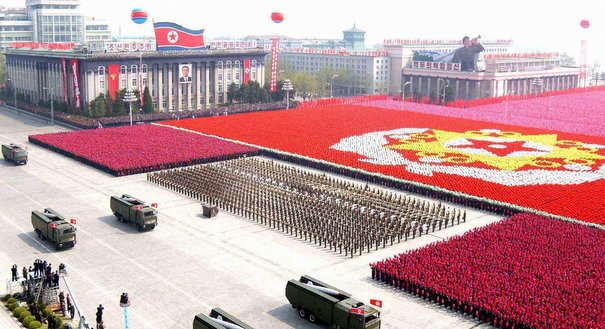
Source: Getty
North Korea is dangerously close to crossing the line that separates being a rogue state from being a parody of a rogue state.
Source: CNN
North Korea is dangerously close to crossing a line. Not the line that leads to a missile attack on the United States, but the one that separates being a rogue state from being a parody of a rogue state. Pyongyang's bluster is as comical as its nuclear threats are implausible.
This does not mean the United States should take the threats lightly. As Defense Secretary Chuck Hagel has explained, when a country with a big army and nuclear weapons starts getting reckless, it is irresponsible to dismiss the possibility that it would actually do something insanely self-destructive. But the bigger concern has to do with why North Korea is rattling its saber. The reason may reflect more on the United States than we care to acknowledge.
It is possible that North Korea is threatening America because it thinks that there is little cost in doing so, that the United States is less likely to strike back than ever before. It may well be acting out a scene from one of those old Hollywood movies that Kim Jong Un's father, the batty Kim Jong Il, used to love. In those Westerns, there was often a moment when some wannabe gunslinger, a crazy kid, challenges an old cowboy with a much bigger reputation. He does so to lift himself up. But he also doesn't think the old guy has it in him to pull the trigger anymore.If America's enemies think that we are shrinking away from crises, that rhetoric and nonintervention are now our standard operating procedure, that would indeed be worrisome. And the idea is not unknown in international circles. A senior Middle Eastern diplomat suggested to me several months ago that because the United States has pulled out of Iraq and is pulling out of Afghanistan, and has been so reluctant to be drawn into Syria even as horrors and the regional threat mount there, America's enemies are starting to conclude we have "gone soft."
A former top U.S. government official, a career guy who has served both Republicans and Democrats, told me he's worried that President Barack Obama is sending the message that he doesn't believe in Madeleine Albright's famous view of the U.S. as "the indispensable nation."
What the United States appears to be willing or unwilling to do is often more important to world affairs than what we actually do. More often than not, our posture is our policy.
This doesn't mean the United States will make the world safer by adopting the recklessness of the first term of George W. Bush's administration. That, too, produces unintended consequences. But we do have to be careful about how our sensible restraint translates into other languages. If situations such as Syria make us look too timid about needed intervention, it can be as dangerous and provocative internationally as when tin-pot troublemakers such as Kim Jong Un bang the table and cry for attention.
That said, when the kid in those old Westerns tries to take out the fastest gun in the West, it usually ends badly for him. Were North Korea to misread America's restraint as a lack of resolve, it won't survive the response it triggers.
Obama has shown that when the threat is most urgent he does not hesitate to act, whether it means deciding to double down in Afghanistan, increasing the number of drone and special operations missions against terrorists, getting Osama bin Laden or bringing down Moammar Gadhafi. America may not be as aggressive as it has been in the recent past, but Obama's record -- the surfeit of caution regarding Syria aside -- suggests it would be a fatal error to test this cool hand in the White House.
America's troop and weapons movements in recent days are a welcome clarification to those who doubt the country will protect its national interests wherever they are actively challenged.

Former Visiting Scholar
David Rothkopf was a visiting scholar at the Carnegie Endowment as well as the former CEO and editor in chief of the FP Group.
Recent Work
David Rothkopf
David Rothkopf
Carnegie does not take institutional positions on public policy issues; the views represented herein are those of the author(s) and do not necessarily reflect the views of Carnegie, its staff, or its trustees.

Despite its flop at the box office, the film raises important questions for the climate community to answer.

Leonardo Martinez-Diaz

Funding Ukraine remains a priority for European leaders. As Russia’s war of aggression heads into another winter, two feasible options to mobilize support for Kyiv should be fast-tracked.


Vladyslav Rashkovan, Gregory P. Wilson

Russian strikes are weakening the economy sustaining Ukraine’s war effort. Closing the growing funding gap will require more European support and politically contentious reforms in Kyiv.

Balázs Jarábik

In an interview, Rozina Ali discusses her new book on the rise and manifestations of Islamophobia in the United States.

Michael Young

While the EU and European governments are embracing the much-lauded middle-power moment, this entails three difficult conundrums.

Richard Youngs