

Article
C. Raja Mohan, Darshana M. Baruah
{
  "authors": [
    "C. Raja Mohan"
  ],
  "type": "legacyinthemedia",
  "centerAffiliationAll": "dc",
  "centers": [
    "Carnegie Endowment for International Peace",
    "Carnegie China",
    "Carnegie India"
  ],
  "collections": [
    "China’s Foreign Relations"
  ],
  "englishNewsletterAll": "ctw",
  "nonEnglishNewsletterAll": "",
  "primaryCenter": "Carnegie India",
  "programAffiliation": "SAP",
  "programs": [
    "South Asia"
  ],
  "projects": [],
  "regions": [
    "South Asia",
    "India",
    "East Asia",
    "China"
  ],
  "topics": [
    "Economy",
    "Foreign Policy"
  ]
}
Source: Getty
Nepal's overtures to China and India signal its progress toward geopolitical maturity.
Source: Indian Express
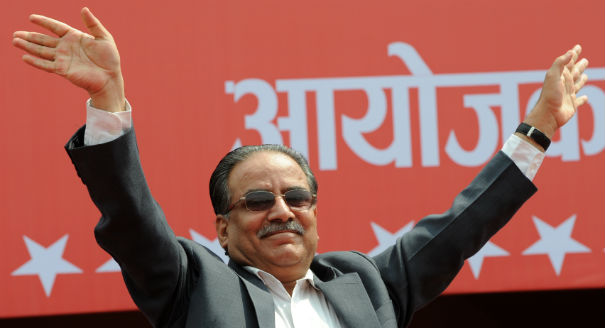
The proposal for trilateral cooperation between Nepal, India, and China from the Maoist leader Pushpa Kumar Dahal, also known as Prachanda, may have been aired at an inopportune moment last week, when Delhi was desperately trying to de-escalate the military standoff with China in eastern Ladakh.
The prolonged incursion by the People's Liberation Army and the highest political intervention that was needed to resolve it have certainly renewed doubts in Delhi's mind about Beijing's peaceful intentions in the Great Himalayas. But it is important that Prachanda's initiative towards Delhi and Beijing is debated on its merits. While Prachanda has been musing about the proposal for some time, his Maoist colleague, Baburam Bhattarai, had begun to articulate the idea during his recently concluded tenure as the prime minister of Nepal.Media reports from Nepal say Prachanda had discussed the idea of trilateral cooperation during his visit to Beijing barely days before his just concluded trip to India. Prachanda was received at the highest levels in Beijing, including by Chinese President Xi Jinping. In recent months, Chinese scholars, in track two interactions, have been suggesting that Delhi consider cooperation with Beijing in Nepal and think of joint developmental projects there. Put simply, Prachanda was not shooting the breeze when he suggested triangular cooperation.
Whether or not the proposal takes off, it represents a significant political evolution of the Maoist worldview in Nepal. Maoists had long viewed with great suspicion Nepal's traditional relationship with India. They denounced the 1950 bilateral treaty of friendship as "hegemonic" and demanded that it be scrapped. The Maoists made no secret of their preference for an ideological and political partnership with China. It is against such a background that Prachanda's argument that Nepal must have good relations with both India and China must be assessed.
In an interview to an Indian newspaper last month, on the eve of his visit to Delhi, Prachanda had said, "our geography, dictates that Nepal can make progress and protect its independence only by cooperating with our large neighbors. Looking at this historical truth dictated by our geography, and the political developments, I saw that the tripartite agreement benefits all three countries. But it benefits Nepal more than India or China."
This marks the geopolitical education of a leader reared in the awful nihilism spawned by the Chinese Cultural Revolution. It also marks the transition of the Maoist ideologues in Nepal from an ideological worldview to one informed by Nepal's national interest.
In his address to the Indian Council of World Affairs in Delhi last week, Prachanda said it "would be unfathomable for Nepal to remain underdeveloped, poor and backward," when it sits between two of the world's fast-growing economies. Repeated visits to China in recent years seem to have convinced Prachanda that Nepal must embark on the path of radical economic reform. A strategy of globalization for Nepal, Prachanda is now willing to concede, would necessarily mean deeper economic integration with both India and China.
For its part, Delhi should welcome this turn to realism among Nepal's Maoists. For too long, the Kathmandu elite shot itself in the foot by politicizing economic cooperation with India and opposing all developmental projects in the name of asserting Nepalese sovereignty. The political classes in Kathmandu were more interested in playing the two giant neighbors against each other for narrow political ends rather than leverage their proximity to India and China to promote Nepal's national interest. Prachanda's proposal is the most impressive articulation so far of an alternative strategy for Kathmandu.
Many in Delhi will be concerned about the implications of the proposed trilateral cooperation for India's special relationship with Nepal and reluctant to accept any suggestion of symmetry in Kathmandu's ties with India and China. It will certainly take a while to convince the skeptics in Delhi of the virtues of Prachanda's trilateralism. In the interim, Delhi could consider four practical ways forward on trilateral economic cooperation with Kathmandu and Beijing.
One is to encourage Indian and Chinese companies to jointly bid for the development of Nepal's massive hydropower resources, which hold the key to the republic's rapid economic growth. Such cooperation could help depoliticize these projects, have them benefit from massive Chinese financial and engineering resources, and serve the power-hungry markets in Nepal and India.
Second, let Indian and Chinese companies build east-west as well as north-south transportation corridors in Nepal that will help integrate the country and connect it to the markets of western China and northern India.
Third, Nepal can consider opening up its territory for a two-way transit trade between India and China. Delhi and Beijing, in turn, could offer duty free access to goods produced in Nepal with appropriate agreements on rules of origin and local content.
Fourth, Indian companies could seek a substantive stake in the Chinese consortium that wants to build world-class facilities at Lord Buddha's birthplace, Lumbini, in Nepal. The development of Lumbini is a project that could transform not just Nepal but also the entire Buddhist circuit in India and contribute to the economic growth of some of the world's poorest regions.
The four proposals could certainly help boost Nepal's economic prospects and promote trans-Himalayan cooperation between Delhi and Beijing. They could be discussed when External Affairs Minister Salman Khurshid visits Beijing this week and Chinese Premier Li Keqiang comes to Delhi later this month.
On the face of it, Prachanda has a big idea, but his geopolitical epiphany could soon be a forgotten footnote if India and China can't find ways to ensure peace and tranquility on their long and contested boundary. Major trans-border projects, including those involving third countries like Nepal, however, could transform the Great Himalayas over time from a zone of military contestation into a frontier of economic cooperation.
Former Nonresident Senior Fellow, Carnegie India
A leading analyst of India’s foreign policy, Mohan is also an expert on South Asian security, great-power relations in Asia, and arms control.
Recent Work

C. Raja Mohan, Darshana M. Baruah


Alexander Gabuev, Paul Haenle, C. Raja Mohan, …
Carnegie does not take institutional positions on public policy issues; the views represented herein are those of the author(s) and do not necessarily reflect the views of Carnegie, its staff, or its trustees.

This collection of essays by scholars from Carnegie India’s Technology and Society program traces the evolution of the AI summit series and examines India’s framing around the three sutras of people, planet, and progress. Scholars have catalogued and assessed the concrete deliverables that emerged and assessed what the precedent of a Global South country hosting means for the future of the multilateral conversation.



Nidhi Singh, Tejas Bharadwaj, Shruti Mittal, …

China’s rapid technological progress and its first-rate infrastructure are often cited as refuting the claim that China has been systematically overinvesting in non-productive projects for many years. In fact, as the logic of overinvestment and the many historical precedents show, the former is all-too-often consistent with the latter.

Michael Pettis
For the Middle Corridor to fulfill its promises, one of these routes must become scalable. At present, neither is.

Friedrich Conradi
If Washington cannot adapt to the ongoing transformations of a multipolar world, its superiority will become a liability.

Amr Hamzawy
Following Ursula von der Leyen’s gaffe equating Turkey to Russia and China, relations with Ankara risk deteriorating even further. Without better, more consistent diplomatic messaging, how can the EU pretend to be a geopolitical power?

Sinan Ülgen