

Article
Frederic Grare
{
  "authors": [
    "Frederic Grare"
  ],
  "type": "other",
  "centerAffiliationAll": "dc",
  "centers": [
    "Carnegie Endowment for International Peace"
  ],
  "collections": [],
  "englishNewsletterAll": "ctw",
  "nonEnglishNewsletterAll": "",
  "primaryCenter": "Carnegie Endowment for International Peace",
  "programAffiliation": "SAP",
  "programs": [
    "South Asia"
  ],
  "projects": [],
  "regions": [
    "South Asia",
    "Pakistan"
  ],
  "topics": [
    "Political Reform",
    "Democracy",
    "Security",
    "Military",
    "Civil Society",
    "Foreign Policy"
  ]
}
Source: Getty
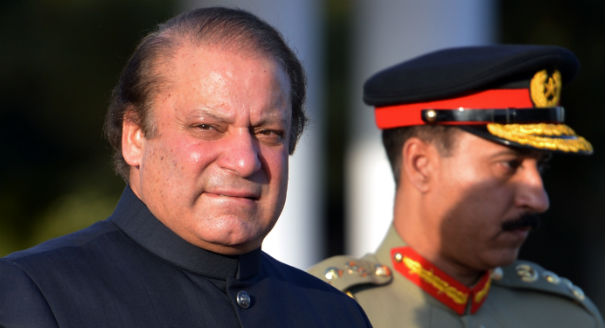
Nawaz Sharif’s biggest challenge will be to improve Pakistan’s security without provoking a military backlash.
Source: International Affairs
This article examines the consequences of Nawaz Sharif's electoral victory in Pakistan's 2013 general election on the country's foreign and security policies. It analyses the relationships the new government is likely to entertain with the military institutions and the judiciary, and tries to identify the potential vulnerabilities of the new authorities.It concludes that the security situation will improve marginally, at best, and that a relatively smooth working relationship with the US, dictated by the constraints of the US withdrawal from Afghanistan, can be anticipated.
Relations with India are likely to constitute the real test of the political freedom enjoyed by Prime Minister Nawaz Sharif vis-à-vis the military. The difficulty will be to calibrate the relationship to avoid provoking a backlash with the military.
The full paper is available for download from International Affairs.
Former Nonresident Senior Fellow, South Asia Program
Frédéric Grare was a nonresident senior fellow at the Carnegie Endowment for International Peace, where his research focuses on Indo-Pacific dynamics, the search for a security architecture, and South Asia Security issues.
Recent Work
Frederic Grare
Frederic Grare
Carnegie does not take institutional positions on public policy issues; the views represented herein are those of the author(s) and do not necessarily reflect the views of Carnegie, its staff, or its trustees.

Despite public disputes over trade and immigration, the strategic partnership’s foundations remain sturdy.

Sameer Lalwani

It signals a new era of tech diffusion and warfare.

Steve Feldstein

With its public finances in shambles, the far right polling at 35 percent ahead of the 2027 presidential election, and a growing protest movement, is France’s crisis a threat to the EU’s geopolitical awakening?

Rym Momtaz, ed.

Putin’s conservative staffing policies and search for ever greater control have cemented parliament’s transformation into a bureaucratic appendage of the executive branch.

Andrey Pertsev

Russia’s AI-driven propaganda campaigns operate in a fragmented, chaotic, and often illogical manner. That’s not necessarily a problem for the Kremlin, though: It’s much easier to mimic genuine public debate that way.

Ilya Klishin