

Research
- +6
Yasmine Farouk, Nathan J. Brown, Maysaa Shuja Al-Deen, …
{
  "authors": [
    "Anouar Boukhars"
  ],
  "type": "legacyinthemedia",
  "centerAffiliationAll": "dc",
  "centers": [
    "Carnegie Endowment for International Peace",
    "Malcolm H. Kerr Carnegie Middle East Center"
  ],
  "collections": [],
  "englishNewsletterAll": "menaTransitions",
  "nonEnglishNewsletterAll": "",
  "primaryCenter": "Carnegie Endowment for International Peace",
  "programAffiliation": "MEP",
  "programs": [
    "Middle East"
  ],
  "projects": [],
  "regions": [
    "North Africa",
    "Algeria",
    "Morocco",
    "Maghreb"
  ],
  "topics": [
    "Political Reform",
    "Security",
    "Foreign Policy"
  ]
}
Source: Getty
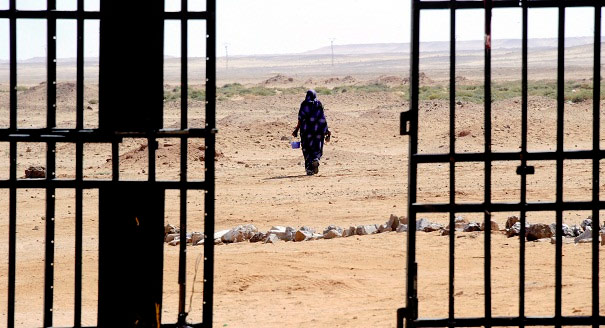
The dispute over the Western Sahara has been one of the most complex conflicts in recent times. After over 38 years of war and diplomacy, the parties are no closer to reaching a mutually-satisfactory settlement.
Source: FRIDE
The dispute over the Western Sahara has been one of the most complex conflicts in recent times. After over 38 years of war and diplomacy, the parties are no closer to reaching a mutually-satisfactory settlement.
The stand-off between Morocco and the Algerian-backed Popular Front for the Liberation of Saguia al-Hamra and Rio de Oro (Polisario) – a Sahrawi independence movement founded in 1973 and based in Algeria – has had disastrous human, economic, and political consequences across North Africa and beyond. From the onset of the war in 1975 until the 1991 ceasefire, the fighting between Morocco and the Polisario also caused the displacement of thousands of people, resulted in the death of thousands of fighters, and led to the division of the territory. On the one side, a heavily-fortified Moroccan zone, protected by defensive walls (called the “Berm”) built in the mid-1980s and manned by 150,000 soldiers, constitutes 85 per cent of the territory. The Polisario controls the remaining area.
Besides the high human and economic costs, the conflict has also negatively impacted on trans-Saharan security. United Nations Secretary General Ban Ki-moon recently warned about the vulnerability of the Sahrawis in the Polisario-controlled refugee camps in southwest Algeria to instability and radicalisation stemming from other parts of the region. This is the first time that the UN chief has acknowledged what many experts have been describing for years as a ‘ticking time bomb’.Understanding the various dimensions of the Western Sahara conflict and the political challenges that hinder its resolution is paramount to reaching a solution.
Since its annexation of the Western Sahara in 1975, Morocco has used a mix of threats and incentives to win the support, or at least the acquiescence, of the indigenous population. Most great powers, including the United States, wish that the territory remain Moroccan and support the country’s autonomy plan. Western governments fear the prospect of a weak independent state, of almost the size of Britain, in an area already afflicted by many fragile or failing states. In 2006, the architect of the United Nations Mission for the Referendum in the Western Sahara (MINURSO) and the fifth Secretary-General of the United Nations, Javier Perez de Cuellar, wrote in his memoirs that the only realistic solution is for Western Sahara to be integrated as an autonomous structure within Morocco. But despite Western support and Morocco’s substantial investments, Rabat has struggled to win the hearts and minds of the Sahrawis.
Interviews I conducted throughout June in the Western Sahara reveal that what the locals really want is genuine self-governance, including better access to and management of their natural resources. Morocco’s investments (nearly 3 billion dollars just for critical basic infrastructure) have not fostered sustainable development. The region is almost entirely dependent on state welfare and social assistance. Direct aid programmes target 34,000 Sahrawis, with a budget of over $68 million. This represents half of the national budget aid devoted to Morocco alone. The Moroccan state also devotes $535 million annually to combat poverty in the Western Sahara through direct and indirect aid. The main problem is not necessarily a lack of resources but rather opacity, waste and inequitable distribution.
Also, since 2005, writes Spanish scholar Bernabe García López, the Polisario has used reports about human rights violations in the Western Sahara to garner support in international fora and bolster its case for independence. The April 2013 failed attempt by the US to broaden the mandate of the MINURSO to include human rights monitoring in the territory should serve as a warning to Morocco to act quickly on its promises to improve its management of the area and expedite the devolution of power.
Earlier this year, the Economic, Social and Environmental Council, an independent advisory institution to the Moroccan government, released an exhaustive report about the root causes of the political, social and economic problems facing the Western Sahara. It is the first time that a commission was allowed to investigate, interview and operate unhindered in the area. The fact that it was made public also reveals a growing realisation in government circles in Rabat that only openness and transparency can help address the enormous regional socio-economic challenges.
The same shift can be seen regarding human rights. The creation in 2011 of the independent National Council for Human Rights (CNDH) and the recent enhancement of its investigative powers is a first step in this regard. The CNDH has three regional commissions in the Western Sahara that independently monitor the human rights situation, investigate complaints, and issues special reports.
Now it is vital that these efforts by the Council be broadened and deepened. Also, confidence-building measure programmes with the police and those devised to combat the prevalent culture of impunity of misconduct by the security forces must be supported, as well as the regional commissions’ complaints system in charge of dealing with allegations of police abuse.
In interviews carried out in Rabat, Laayoune and Dakhla, some state authorities and local elected officials admitted that more must be done to protect freedom of speech. The realisation seems to finally have arrived that suppressing opposing views will not help Morocco’s case. Only democracy can.
Former Nonresident Fellow, Middle East Program
Boukhars was a nonresident fellow in Carnegie’s Middle East Program. He is a professor of countering violent extremism and counter-terrorism at the Africa Center for Strategic Studies, National Defense University.
Recent Work


Yasmine Farouk, Nathan J. Brown, Maysaa Shuja Al-Deen, …
Frederic Wehrey, Nathan J. Brown, Bader Al-Saif, …
Carnegie does not take institutional positions on public policy issues; the views represented herein are those of the author(s) and do not necessarily reflect the views of Carnegie, its staff, or its trustees.

Despite public disputes over trade and immigration, the strategic partnership’s foundations remain sturdy.

Sameer Lalwani

It signals a new era of tech diffusion and warfare.

Steve Feldstein

With its public finances in shambles, the far right polling at 35 percent ahead of the 2027 presidential election, and a growing protest movement, is France’s crisis a threat to the EU’s geopolitical awakening?

Rym Momtaz, ed.

Putin’s conservative staffing policies and search for ever greater control have cemented parliament’s transformation into a bureaucratic appendage of the executive branch.

Andrey Pertsev

Russia’s AI-driven propaganda campaigns operate in a fragmented, chaotic, and often illogical manner. That’s not necessarily a problem for the Kremlin, though: It’s much easier to mimic genuine public debate that way.

Ilya Klishin