

Article
C. Raja Mohan, Darshana M. Baruah
{
  "authors": [
    "C. Raja Mohan"
  ],
  "type": "legacyinthemedia",
  "centerAffiliationAll": "dc",
  "centers": [
    "Carnegie Endowment for International Peace",
    "Carnegie China",
    "Carnegie India"
  ],
  "collections": [
    "China’s Foreign Relations"
  ],
  "englishNewsletterAll": "ctw",
  "nonEnglishNewsletterAll": "",
  "primaryCenter": "Carnegie India",
  "programAffiliation": "SAP",
  "programs": [
    "South Asia"
  ],
  "projects": [],
  "regions": [
    "South Asia",
    "India",
    "Pakistan",
    "East Asia",
    "China"
  ],
  "topics": [
    "Security",
    "Foreign Policy",
    "Arms Control"
  ]
}
Source: Getty
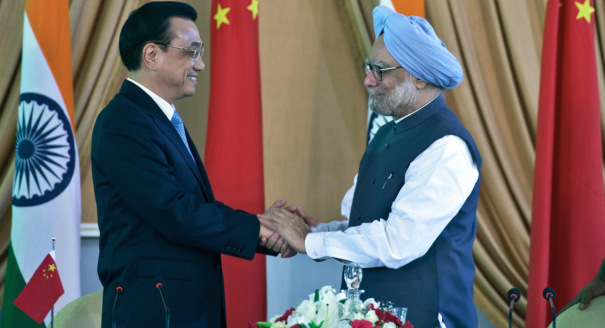
Delhi must move toward more responsible management of its borders with Pakistan and China.
Source: Indian Express
India’s contested borders with China and Pakistan are seeing more frequent military tension. The UPA government’s failure to effectively manage these borders has pushed India into crises of the kind that followed the recent Chinese intrusion in Ladakh and the violent incidents on the Pakistan frontier.
The military character of India’s borders with China and Pakistan has significantly changed in the last couple of decades. Yet, the political instruments to maintain peace on these borders have not evolved. While that gap is generating repeated military confrontations, the domestic and international political costs of these crises have risen. Delhi, then, must find ways to prevent these incidents from occurring and better manage the political fallout when they do.
While both borders demand more effective management, the problems are somewhat different on either front. It is for good reason that India has separate names for the contested frontiers with Pakistan (Line of Control) and China (Line of Actual Control). The 776 km LoC with Pakistan in Jammu and Kashmir is demarcated and the two armies signed off on its precise alignment after the 1971 war. Delhi and Beijing, however, have not been able to delineate the LAC. They don’t even agree on its length. The divergent perceptions of the LAC lead to regular military friction in many parts of the disputed frontier with China.Over the decades, the LoC has become intensely militarised. It is the lighting rod for unending conflict, as the Pakistan army pushes militants across the LoC to destabilise Kashmir and the Indian army counters the infiltration. In contrast, the Indian and Chinese armies have not fired a shot in anger across the LAC for many decades. That happy situation may be coming to an end thanks to the rapid modernisation of the Chinese armed forces and Beijing’s greater assertiveness on territorial disputes.
India’s effort to restore the military balance on the border has run into Chinese opposition. As the two armies draw close to the once neglected border and aggressively patrol the disputed areas, there are more “intrusions” across the LAC, followed by political tension. During Rajiv Gandhi’s visit to China at the end of 1988, the two sides agreed to maintain peace and tranquility on the long and disputed boundary. Since then, there have been many agreements on this theme.
The Ladakh intrusion has underlined the importance of moving beyond general statements on maintaining peace and tranquility to specific procedures and practices to prevent military confrontation and its escalation. That is the focus of Delhi’s current efforts to finalise a border defence cooperation agreement with Beijing. In negotiating a new military regimen with Beijing, Delhi needs more active army inputs on border management strategy to redress one important imbalance. In China, it is the PLA that drives the border policy. On the Indian side, it is dominated by the foreign office.
Unlike on the LAC with China, there is little political effort to manage the military dynamic on the LoC with Pakistan. The UPA government ducks for cover and the opposition BJP plays to domestic galleries; together they turn even routine incidents into major political crises. In the end, though, it is the responsibility of the government to lead. But the ministry of defence (MoD) has little intellectual heft or administrative capacity to define and supervise policies for LoC management. The PMO and the MoD have, in recent years, abandoned the civilian responsibility for policy leadership of the military domain. That largely leaves the Indian army to handle the LoC dynamic as it sees fit, with no input or support from the political and bureaucratic side. This is not good for the army or the nation as a whole.
It is now time for Prime Minister Manmohan Singh to inject some coherence into the management of the LoC. Three propositions present themselves. First, the PM should publicly underline the value of the LoC ceasefire that was negotiated by the BJP government in 2003. The current passionate responses to the killings on the border should not blind us to the fact that the ceasefire has brought significant reductions in LoC violence.
Second, the PM must order a comprehensive review of the current military policy on the LoC, including the rules of engagement and standard operating procedures. He should set up an apex body, with all relevant civilian and military officials as members, to continually monitor and respond to the volatile dynamic on the LoC.
Third, India must seek more details on Pakistan Prime Minister Nawaz Sharif’s offer to jointly find ways to reduce the LoC violence. If Sharif, who is also in charge of Pakistan’s defence ministry at the moment, is serious, Delhi must propose specific steps to strengthen the implementation of the ceasefire and call for early talks between the two armies for additional confidence building measures on the LoC.
A decade and a half ago, Prime Ministers Atal Bihari Vajpayee and Nawaz Sharif unveiled the Lahore Declaration to deal with some of the post-nuclear security challenges facing India and Pakistan. Talks on military security and border management are not a reward from India for Pakistan’s good behaviour. They are an integral part of managing a very complex relationship and reducing the risks of a war that neither side wants.
After the Ladakh intrusion, Delhi has sensibly stepped up the conversation on LAC management with Beijing. The recent violence on the LoC demands the same with Islamabad. When he meets Sharif in New York next month, Manmohan Singh must seek Pakistan’s renewed political support for the LoC ceasefire and an agreement to translate that commitment into a military reality. If he does not move towards responsible management of India’s borders, the country will be sucked, sooner rather than later, into a costly military conflict that it neither wants nor is prepared to cope with.
This article was originally published in the Indian Express.
Former Nonresident Senior Fellow, Carnegie India
A leading analyst of India’s foreign policy, Mohan is also an expert on South Asian security, great-power relations in Asia, and arms control.
Recent Work

C. Raja Mohan, Darshana M. Baruah


Alexander Gabuev, Paul Haenle, C. Raja Mohan, …
Carnegie does not take institutional positions on public policy issues; the views represented herein are those of the author(s) and do not necessarily reflect the views of Carnegie, its staff, or its trustees.
The U.S. midterm elections signal the opening of a narrow window for bold Saudi diplomacy on Palestine.


Andrew Leber, Zaha Hassan

A leak of Russian gas price data helps establish that China is paying Russia far less than Central Asian countries and Gazprom’s former European customers.

Sergey Vakulenko

China’s political future will be shaped between now and next October. As the Communist Party enters its intense “campaign season” to prepare for a major political transition in 2027, reading Beijing's actions and responses may become more difficult as domestic politics weigh on its behavior more than usual.

Damien Ma

The EU can impose sanctions but struggles to enforce them without the United States. With Washington increasingly disinterested in backing European interests, the bloc must now fend for itself.


Nicu Popescu, Tiago Antunes

Global and rising powers will need to engage with Africa’s priorities and agency in order to secure the continent’s increasingly attractive partnerships.

Fonteh Akum