

Commentary
Dmitri Trenin
{
  "authors": [
    "Dmitri Trenin"
  ],
  "type": "legacyinthemedia",
  "centerAffiliationAll": "",
  "centers": [
    "Carnegie Endowment for International Peace",
    "Malcolm H. Kerr Carnegie Middle East Center",
    "Carnegie Russia Eurasia Center"
  ],
  "collections": [],
  "englishNewsletterAll": "",
  "nonEnglishNewsletterAll": "",
  "primaryCenter": "Carnegie Russia Eurasia Center",
  "programAffiliation": "",
  "programs": [],
  "projects": [
    "Eurasia in Transition"
  ],
  "regions": [
    "Levant",
    "North America",
    "United States",
    "Middle East",
    "Syria",
    "Russia"
  ],
  "topics": [
    "Security",
    "Foreign Policy"
  ]
}
Source: Getty
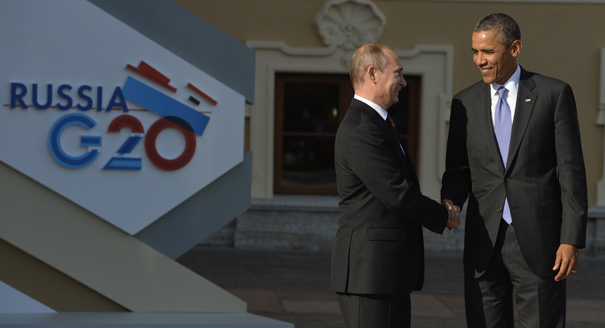
Though Putin purported to oppose any attempt to hijack the economic agenda of the G-20, he succeeded in setting the stage for a critical debate on U.S. foreign policy with the global leaders.
Source: International Herald Tribune
As Barack Obama was agonizing over what to do after the poison-gas attacks last month in Syria, Vladimir Putin was dealing with a different kind of emergency: record floods in the Russian Far East. At a press conference in Khabarovsk, the Russian president himself set out the Kremlin’s reading of the Syrian situation.
The reports that the Syrian government had used chemical weapons were “utter nonsense,” he said. His analysis was essentially based on his sense of who stood to gain from crossing Obama’s “red line,” especially when a U.N. inspection team was already on the ground in Syria. It was not the Assad government, in Putin’s view; he had earlier declared that such an attack would be suicidal for the government. While the Russians generally see Bashar al-Assad as tough and even brutal, they still believe he is basically rational and has full control over his chemical weapons.In Putin’s judgment, therefore, the Syrian opposition was a much likelier perpetrator. Lacking support, weapons and expertise to topple Assad themselves, the rebels have an interest in involving the United States directly in the war. Thus, in Putin’s mind, what happened in the Ghouta area of Damascus was a deliberate provocation.
Putin also admitted being surprised by what followed the Aug. 21 event. While Secretary of State John Kerry’s tough statement on Aug. 26 was predictable — the United States was preparing to attack Syria and to make Assad accountable for the alleged chemical weapons use — the rest of the week’s developments were not foreseen. The British Parliament vote against the Cameron government’s motion robbed the United States of the support of its closest ally, which had been at America’s side in all U.S. military missions since the Cold War. Putin’s concept of the Western alliance as a latter-day replica of the Warsaw Pact was dealt a serious blow.
Obama’s dual decision to attack Syria but to seek advance support from the U.S. Congress must have surprised the Russian leader even more. Some in Russia took this for a sign of Obama’s weakness; most agreed that the U.S. president was trying to share personal responsibility for the strikes and their aftermath with members of the U.S. political class; a small group of experts detected a design in the White House to build a coalition with influential Republicans in order to advance his domestic agenda, ever uppermost on Obama’s mind.
With opinions in the United States and Europe about what to do with Syria so divided, and the invasion of Iraq still weighing on many people’s minds, the Kremlin saw an opening to use the delay of the American military strikes in several ways. Putin publicly compared Kerry’s statement on Syria with Colin Powell’s charges against Iraq, which later turned out to be false. Referring to the U.S.-produced evidence of chemical weapons use by the Syrian authorities, Putin echoed the “I am not convinced” incantation of Joschka Fischer, the German foreign minister at the time.
And encouraged by the British parliamentary vote, Putin proposed to send Russian legislators to Washington to debate the issue with American legislators — an offer promptly spurned on Capitol Hill.
Finally, Putin decided to use the opportunity of the G-20 summit, conveniently being held in St. Petersburg between the announcement of U.S. strikes and their execution, for a global debate on the world order, with himself as both a prominent participant and moderator.
On the eve of the G-20 meeting, Putin presented Russia’s position on Syria as support for the principles of international law and the United Nations, rather than as support for the Assad regime. He briefly raised some eyebrows — and some hopes — when he did not rule out agreeing to the use of force against Damascus. In the same breath, however, Putin named his conditions: hard evidence of chemical weapons use and those responsible for it, which Russia would find acceptable; a thorough debate at the U.N. Security Council; and full control and oversight of the operation by the council.
And even though Obama had canceled a bilateral summit with the Russian president that was to have been held in conjunction with the G-20 meeting, and did not agree to a bilateral meeting on the margins of the G-20 itself, Putin expressed his clear interest in discussing Syria with Obama in St. Petersburg. Although he had been stung by Obama’s negative and highly personal comments about himself, Putin was studiously polite about his U.S. counterpart, declaring that meetings with Obama were “always constructive.” He played down the widening rift between Russia and the United States, and even purported to pity Obama, depicting the U.S. president’s statements as a result of stress.
In effect, though he purported to oppose any attempt to hijack the economic agenda of the G-20, Putin succeeded in setting the stage for a critical debate on U.S. foreign policy with the global leaders. In February 2007, when he vented his frustration with George W. Bush’s policies at the Munich security conference, Putin had been a lonely voice at somebody else’s party. This time, hosting the world’s top-league players in his native St. Petersburg, he evidently felt himself on a surer footing.
This article was originally published in the International Herald Tribune.
Former Director, Carnegie Moscow Center
Trenin was director of the Carnegie Moscow Center from 2008 to early 2022.
Recent Work
Dmitri Trenin
Dmitri Trenin
Carnegie does not take institutional positions on public policy issues; the views represented herein are those of the author(s) and do not necessarily reflect the views of Carnegie, its staff, or its trustees.

A review of a detailed account of how antipathy toward Tehran has assumed a life and logic of its own in Washington, DC.

Jane Darby Menton
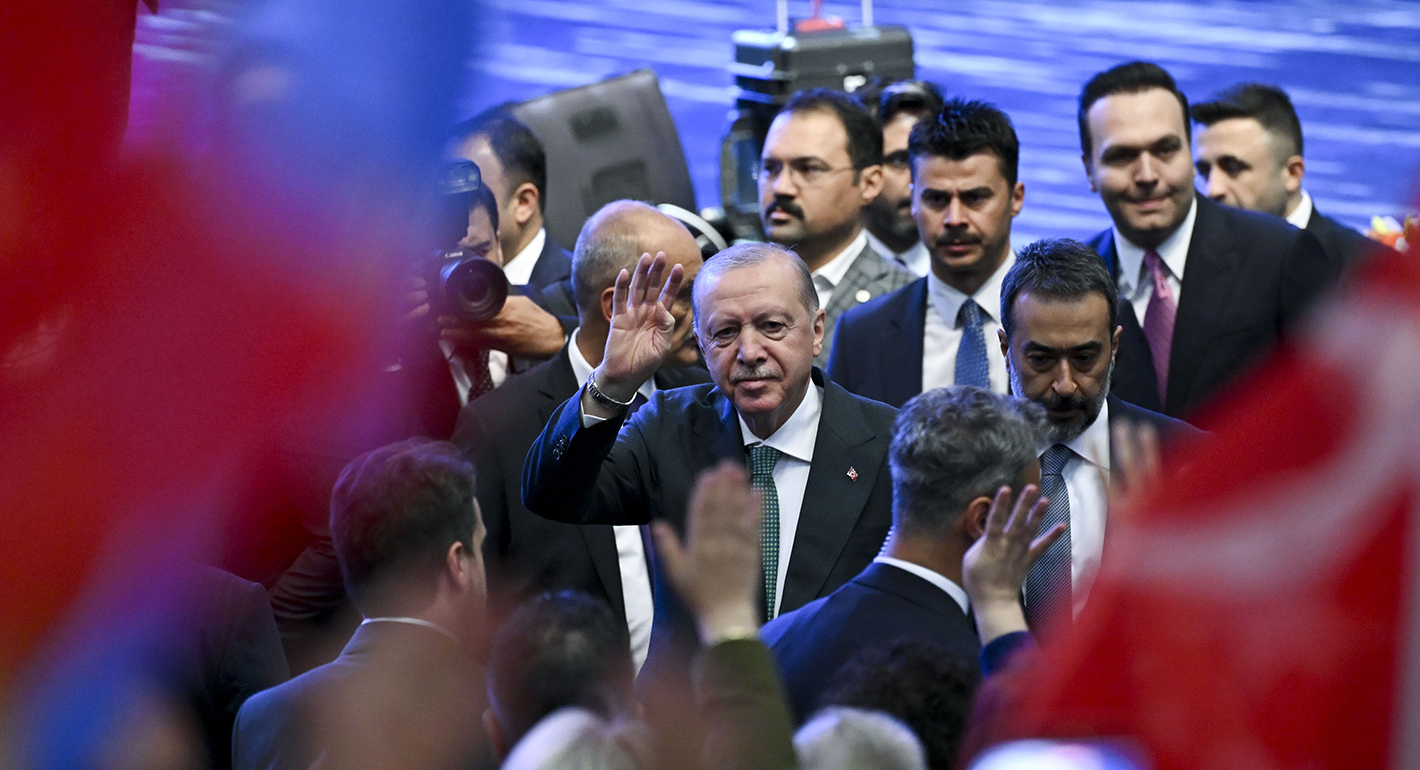
Turkish right-wing populists have been trying to advance the country’s middle-power goals based on perceptions of what the public wants, but they have been doing so in ways that reinforce their project of autocratic political consolidation.
Murat Somer

In Colombia and elsewhere in the region, the United States is trying to shape election outcomes—but at what cost?
Oliver Stuenkel, Adrian Feinberg
The world’s climate adaptation funds must adapt to address the ways that climate change is deepening state fragility.
Ray Salvatore Jennings, Paul Andrew Mayewski
Russia looks set to reap economic benefits from closer ties with Southeast Asian countries that are keen to find reliable energy suppliers and diversify trade ties.

Alexander Gabuev