

Research
- +4
Milan Vaishnav, Rahul Verma, Rukmini S., …
{
  "authors": [
    "Christophe Jaffrelot"
  ],
  "type": "legacyinthemedia",
  "centerAffiliationAll": "dc",
  "centers": [
    "Carnegie Endowment for International Peace"
  ],
  "collections": [],
  "englishNewsletterAll": "ctw",
  "nonEnglishNewsletterAll": "",
  "primaryCenter": "Carnegie Endowment for International Peace",
  "programAffiliation": "SAP",
  "programs": [
    "South Asia"
  ],
  "projects": [],
  "regions": [
    "South Asia",
    "Afghanistan",
    "Pakistan"
  ],
  "topics": [
    "Security",
    "Military"
  ]
}
Source: Getty
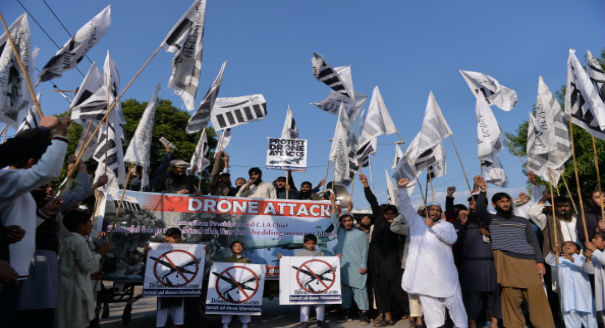
The appointment of Mullah Fazlullah to lead the Tehrik-e-Taliban Pakistan (TTP) may have negative consequences for negotiations in both Pakistan and Afghanistan.
Source: Indian Express
Mullah Fazlullah, the recently appointed chief of the Tehrik-e-Taliban Pakistan (TTP), is not new to the scene. But his background differs from that of his predecessors, who were Mehsuds from the Federally Administered Tribal Areas (Fata). Fazlullah comes from the Tehrik-e-Nifaz-e-Shariat-e-Mohammadi (TNSM — Movement for the Enforcement of Islamic Law), which has its roots in the Malakand Agency. The movement's initial programme is evident from its name, but its methods have changed over time.
The TNSM was founded in 1989 by Maulana Sufi Muhammad, a native of Dir, a former princely state of the Malakand Agency. Once a member of the Jamaat-e-Islami, Sufi Muhammad soon eschewed electoral politics (though he had participated in it to become a local elected official). He grew in influence after the Supreme Court decision of 1994, which deprived the local executive authorities of their judicial powers and merged the Provincially Administered Tribal Areas (Pata) into the legal mainstream. The discontented Khans and Maliks of the Pata then rallied around him. In November 1994, the TNSM staged an armed operation and forced the government to promulgate the Shariah Regulation, making the Shariah the primary source of law. Aftab Sherpao, then chief minister of the North West Frontier Province, was compelled to make substantial concessions.In September-October 2001, the TNSM marshalled about 10,000 militants to aid the Taliban in fighting the post-9/11 Western (and Northern Alliance) military attacks. Its poorly armed foot soldiers crossed the Durand Line and came under a hail of bombs. When Sufi Mohammad returned to Pakistan, he was arrested and imprisoned. The TNSM was banned.
The movement continued to function under the leadership of his son-in-law, Mullah Fazlullah, who began to broadcast his sermons on the radio from Swat, his stronghold. These sermons, pronounced in a quietistic tone, gained an enormous following and Fazlullah soon became known as "Mullah Radio". The TNSM then pursued its career with the blessings of all political parties. As the 2002 elections approached, they attempted to share the TNSM's popularity, particularly in the Swat Valley. But the TNSM only backed Islamic parties affiliated with the Muttahida Majlis-e-Amal — which returned the favour. The rescue operations undertaken by the movement in the wake of the 2005 earthquake further polished its image.
The turning point came in 2007. After the storming of the Red Mosque, the TNSM struck up an alliance with the TTP of Baittullah Mehsud. In late October, about 4,500 TNSM combatants took control of some 60 villages in the Swat Valley, which they subjected to cultural policing operations and Shariah courts. The formidable army response forced the TNSM to enter into negotiations.
The TNSM went back on the offensive in 2008. Its troops took control of the valley in a wave of unspeakable violence and Shariah courts started operating in the region. Girls were prevented from attending school (their schools were the first to be demolished), women were no longer to appear in public, men had to grow beards. As a result, about a third of the valley's 1.7 million inhabitants fled towards the south. By late 2008, the Swat Valley, a place known for its picturesque tourist attractions, was virtually under the complete control of TTP representatives.
The ISI then decided to release Sufi Mohammad to hammer out a ceasefire agreement with him. In February 2009, the provincial government (dominated by the ANP Pashtun nationalists since 2008) and the militants agreed to a truce, according to which the Shariah became law in Malakand Division (to which the Swat Valley belonged) in exchange for an end to the violence. But in April, the TNSM violated the agreement it had only just signed, on the pretence that the government had not allowed it to appoint the judges of Shariah courts. The ISI again turned to Sufi Mohammad, but he had become hostage to the TTP, which was not in favour of any agreement.
The movement then extended its control over the Swat Valley, into the districts of Lower Dir, Shangla and Buner, about 65 miles from Islamabad. Apart from its usual methods, of which women and girls were the principal victims, they stepped up punitive executions, hanging their opponents from trees and at traffic circles as an example. This campaign caused nearly millions to flee and prompted the army — now with public approval — to launch an assault. According to some sources, the operation left 128 dead among security forces, but about 1,500 militants were killed. Along with a massive deployment of army troops, helicopters and fighter planes were used to crush resistance. The scale of the damage prevented many refugees from returning to their devastated towns and villages. For the first time, Pakistan was experiencing a civil war some 65 miles from its capital, but it still did not manage to break the back of the TNSM. Fazlullah found sanctuary in Afghanistan.
From the Afghan provinces of Nuristan and Kunar, Fazlullah launched raids on the other side of the Durand line. In September, the TTP claimed responsibility for the killing of Major General Sanaullah, GOC for the Malakand division, and Lieutenant Colonel Tauseef Ahmed in Upper Dir district, near the Afghan border. This assassination was attributed to Fazlullah because these regions were part of his battlefield — and because he was notoriously opposed to the peace talks Nawaz Sharif had initiated (by targeting a Pakistani general, he consolidated Kayani's reluctance to talk). Indeed, the negotiation process will probably be suspended on the Pakistani side, or will follow the stop-and-go pattern of the Swat discussions in 2008-09.
The appointment of Fazlullah may also be revealing of the lack of interest for meaningful negotiations on the Afghan side. While there were apparently several candidates for replacing Hakimullah Mehsud, Fazlullah has been selected not only by a representative shura but also by Mullah Omar. Last October, American soldiers had arrested Latif Mehsud — Hakimullah's right-hand man — in Afghanistan, which suggests relations between the Afghan Taliban and the TTP had already become more intense. Eventually, with the prospect of Nato forces leaving the battleground in one year, both may fully converge and target not only the Afghan National Army but also Pakistan — from a new safe haven called Afghanistan.
Postscript: The politicians of Pakistan are denouncing the assassination of Hakimullah Mehsud as an attack on the peace talks between Islamabad and the TTP. And it might well be one. The Pakistan army (which probably approved of the drone strike beforehand) is not actively supporting them and the U.S. may fear that once the TTP stops concentrating on Pakistani targets, it may turn its guns on Nato forces. Anyway, the killing of the elder son of the founder of the Haqqani network near the power centres of Islamabad (once again) has also killed the prospect of peace talks.
This article was originally published in the Indian Express.
Former Nonresident Scholar, South Asia Program
Jaffrelot’s core research focuses on theories of nationalism and democracy, mobilization of the lower castes and Dalits (ex-untouchables) in India, the Hindu nationalist movement, and ethnic conflicts in Pakistan.
Recent Work

Milan Vaishnav, Rahul Verma, Rukmini S., …
Christophe Jaffrelot
Carnegie does not take institutional positions on public policy issues; the views represented herein are those of the author(s) and do not necessarily reflect the views of Carnegie, its staff, or its trustees.

Despite public disputes over trade and immigration, the strategic partnership’s foundations remain sturdy.

Sameer Lalwani
It signals a new era of tech diffusion and warfare.

Steve Feldstein

With its public finances in shambles, the far right polling at 35 percent ahead of the 2027 presidential election, and a growing protest movement, is France’s crisis a threat to the EU’s geopolitical awakening?

Rym Momtaz, ed.

Russia’s AI-driven propaganda campaigns operate in a fragmented, chaotic, and often illogical manner. That’s not necessarily a problem for the Kremlin, though: It’s much easier to mimic genuine public debate that way.

Ilya Klishin

Ahead of a tough winter for Ukraine, Donald Trump’s swing back toward Russia bodes ill. But instead of panicking, Kyiv’s European allies are focusing on action.
Rym Momtaz