

In The Media
Martha Brill Olcott
{
  "authors": [
    "Martha Brill Olcott"
  ],
  "type": "legacyinthemedia",
  "centerAffiliationAll": "dc",
  "centers": [
    "Carnegie Endowment for International Peace",
    "Carnegie Europe"
  ],
  "collections": [
    "Europe’s Eastern Neighborhood"
  ],
  "englishNewsletterAll": "ctw",
  "nonEnglishNewsletterAll": "",
  "primaryCenter": "Carnegie Endowment for International Peace",
  "programAffiliation": "russia",
  "programs": [
    "Russia and Eurasia",
    "Europe"
  ],
  "projects": [],
  "regions": [
    "Russia",
    "Eastern Europe",
    "Ukraine",
    "Europe",
    "Iran"
  ],
  "topics": [
    "Political Reform",
    "Security",
    "Foreign Policy"
  ]
}
Source: Getty
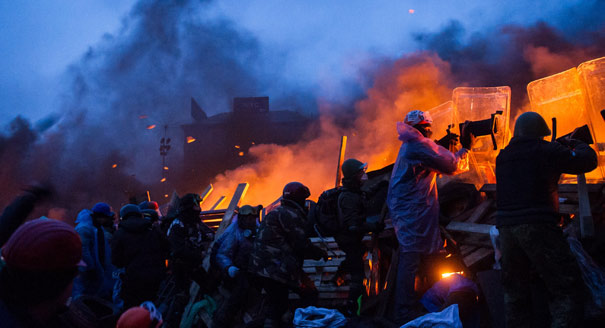
Whatever the ultimate outcome in Ukraine, Russia’s influence in its neighborhood will be substantially reduced.
Source: National Interest
For anyone who witnessed the collapse of the U.S.S.R. up close, the message of Maidan is clear: the idea of a “post-Soviet space” with shared values, shared goals, and Russian leadership is now obsolete. No matter what ultimately happens in Ukraine, Russia’s influence in its “neighborhood” will be substantially reduced. Vladimir Putin’s “managed democracy” (read: autocracy) is unworkable in twenty-first century Europe.
We are witnessing the end of the post-Soviet state unfold in the streets of Ukraine.
While Ukraine’s government has labeled the protesters “terrorists,” Carl Bildt, Sweden’s foreign minister, writes how chilling it is to hear the protests labeled as an “attempted coup d’etat” by Russia and that anti-terrorist operations are being launched against them. Yanukovych and Putin won’t be able to hide behind a distorted story of events.In today’s world anyone interested can make up his or her own mind about what is happening in Ukraine. Live feeds from webcams in Kyiv’s main square are available on numerous websites and there are a virtually infinite number of Twitter feeds in your choice of languages, with Google Translate to help you navigate them.
The media revolution of the late 1980s and early 1990s opened space for what was then unprecedented information sharing, allowing mobilization within republics and across republics. Activists could learn what was possible and what was dangerous, ridding the U.S.S.R. of its last vestiges of legitimacy.
Today, the webcam transports you directly into Maidan and makes you feel like a virtual participant in the action. Your eyes and ears allow you to create your own instant truth about what is occurring.
You see young and older people (the formerly young from the protests in 1990 and 1991) in the crowds and watch opposition politicians, sports figures, and media personalities speak on stage. And most importantly, you hear Ukrainian Orthodox priests leading the demonstrators in prayer and invoking the sacrifices of Jesus Christ. Bulletins are read regularly informing the demonstrators of protests in other parts of Ukraine, including in some communities in the Russian-speaking east.
But even though the crisis is unfolding for all the world to see, the situation is not well understood. Ukraine cannot be easily explained as a battle between East and West. It is a country struggling to shape its own, independent future and there are no easy solutions on the horizon.
While Russian president Vladimir Putin blames the West for the unrest, the Kremlin’s hand casts an unmistakable shadow over everything that has gone on in Ukraine in recent months. Putin considers the collapse of the Soviet Union the biggest tragedy of the twentieth century, but those camped out in Maidan don’t agree with him.
The presence of the Church, in particular, is testimony to the fact that this is not a struggle of Eastern Ukraine versus Western Ukraine. It is a crisis within Ukraine’s polity, as the nation tries to define itself. Ukrainians want a national identity that gives the country a place among European nations while not closing off improved trade relations with Russia.
Similar identity struggles—fortunately still peaceful—are going on in several other states that Putin views as Russia’s natural partners. Recent days have seen protests in Kazakhstan over a sharp rise in the exchange rate. The country devalued its currency because of the precipitous drop in the value of the Russian ruble. Wage increases and price controls have since been introduced to try to appease the population, but the inflationary spiral this will kick off means further confrontations are unavoidable.
In countries with smaller economies, like Uzbekistan, Tajikistan and Kyrgyzstan, the Kremlin manipulates Russian xenophobia as a mechanism for attempted control using threats that it will expel Central Asian migrant laborers from the Russian labor market.
There is no rolling back the recent events in Ukraine. The further use of force to end the demonstrations will mean either civil war or the arrival of a repressive regime whose likes have not been seen since Stalin’s day. And even that would likely be short-lived.
The only thing that will produce a peaceful outcome is a constitutional change that restores the balance of power between all of Ukraine’s political forces. While Western leaders may try to nudge the Ukrainians toward this, it must be done by the Ukrainians themselves, and certainly without the Russians exerting pressure on them.
The protests in Ukraine can’t be properly understood solely as part of an East-West struggle. They are part of the legacy of the breakup of the Soviet Union, which can no longer be viewed through a “post-Soviet” lens. They must be understood as part of the maturation process of countries that are now nearly a quarter-century old, and whose citizens want to define their own identity and their own future.
This article was originally published in the National Interest.
Former Senior Associate, Russia and Eurasia Program and, Co-director, al-Farabi Carnegie Program on Central Asia
Olcott is professor emerita at Colgate University, having taught political science there from 1974 to 2002. Prior to her work at the endowment, Olcott served as a special consultant to former secretary of state Lawrence Eagleburger.
Recent Work
Martha Brill Olcott
Martha Brill Olcott
Carnegie does not take institutional positions on public policy issues; the views represented herein are those of the author(s) and do not necessarily reflect the views of Carnegie, its staff, or its trustees.

Funding Ukraine remains a priority for European leaders. As Russia’s war of aggression heads into another winter, two feasible options to mobilize support for Kyiv should be fast-tracked.


Vladyslav Rashkovan, Gregory P. Wilson

Russian strikes are weakening the economy sustaining Ukraine’s war effort. Closing the growing funding gap will require more European support and politically contentious reforms in Kyiv.

Balázs Jarábik

While the EU and European governments are embracing the much-lauded middle-power moment, this entails three difficult conundrums.

Richard Youngs
The middle power moment will not be defined by sovereign states alone, and California stands out for its potential contributions to international cooperation.


Ian Klaus, Stewart Patrick

Ex-president Gurbanguly Berdimuhamedov remains interested in politics, but his son Serdar, Turkmenistan’s current president, is becoming increasingly independent and willing to break with his father’s legacy. If their covert rivalry goes too far, both risk losing power.

Galiya Ibragimova