

Q&A
Dara Massicot, Aaron David Miller, Andrew S. Weiss
{
  "authors": [
    "Andrew S. Weiss"
  ],
  "type": "legacyinthemedia",
  "centerAffiliationAll": "dc",
  "centers": [
    "Carnegie Endowment for International Peace"
  ],
  "collections": [],
  "englishNewsletterAll": "ctw",
  "nonEnglishNewsletterAll": "",
  "primaryCenter": "Carnegie Endowment for International Peace",
  "programAffiliation": "russia",
  "programs": [
    "Russia and Eurasia"
  ],
  "projects": [],
  "regions": [
    "North America",
    "United States",
    "Russia",
    "Eastern Europe",
    "Ukraine",
    "Western Europe"
  ],
  "topics": [
    "Economy",
    "Security",
    "Foreign Policy"
  ]
}
Source: Getty
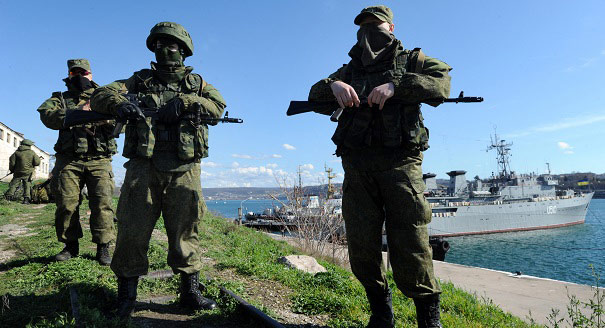
U.S.-Russia relations are clearly at a turning point after Russia has moved to annex Crimea. The West needs to develop a long-term strategy to deal with Russia.
Source: NPR
JEREMY HOBSON, HOST:
Well now to the latest on Crimea. NPR has learned today that two Ukrainian officers were shot when Russians stormed a Ukrainian military base in Crimea. One of those officers has died. This is happening on the same day that Russia signed a treaty to incorporate Crimea into Russia, a move that President Vladimir Putin described as a restoration of historical justice necessary to protect Russian citizens. Here is Vladimir Putin speaking through an interpreter.
PRESIDENT VLADIMIR PUTIN: (Through translation) The Russians, as well as other citizens of Ukraine, were suffering from constant, permanent crisis that has been shattering Ukraine over two decades.
HOBSON: Well, the United States and the European Union are not recognizing the move and have responded by freezing assets and placing travel restrictions on Russian officials involved in the crisis with promises of stricter and stronger sanctions to come. Also, leaders of the Group of Eight announced today that they are suspending Russia's participation in the group. President Obama has invited leaders of the remaining countries to meet next week in the Netherlands.
For more on all this, let's bring in Andrew Weiss, who oversees research on Russia and Eurasia for the Carnegie Endowment for International Peace. He served as a policy assistant for presidents from both parties. He's with us from Washington. Andrew, welcome back.
ANDREW WEISS: Hey, great to be here.HOBSON: Well, where does this leave U.S.-Russia relations?
WEISS: We're clearly at a turning point, and I think we'll see the administration speak out in coming hours about its immediate response. But there's no mistaking that the administration needs a long-term strategy. Here we have Russia moving to annex territory of a neighbor under very dubious circumstances.
There's real questions about what Russia's real goals are here. Do they plan to take other parts of Ukrainian territory? Do they have designs on other territory belonging to their neighbors? It's a whole new game.
HOBSON: Well yeah, let's go further on that front. Where would Putin go next?
WEISS: I think the place that people really need to be focusing on is in eastern Ukraine. Over the past week, we've seen a series of violent demonstrations, some of which seem to have a Russian hand in terms of provoking the ethnic Russian population of eastern Ukraine to demand treatment similar to what their fellow Russians have gotten in Crimea.
There's talk about staging referenda. There's talk about need to be protected against alleged ultra-nationalist groups that are operating in these parts of the country. The Putin press corps line has been consistent: the government in Kiev is illegitimate. There are these threatening signs of ultra-nationalist or Nazi-type groups operating in Ukraine that are armed and that are going to terrorize the Russian population.
So far there's nothing to validate those Russian claims, but that is the predicate for possible Russian military intervention at some point in the future.
HOBSON: But what about the response that we've seen so far from the Obama administration and now from European countries, sanctions, frozen assets, travel bans? They're being called the harshest since the Cold War. But are they likely to work?
WEISS: I don't think I would dispute what former Defense Secretary Bob Gates said the other day, when he said sanctions that are being talked about right now - visa bans, assets seizures, those are not going to deter Russia's actions. So the question is are the U.S. and European governments prepared to go much further than that. Are they prepared to look at steps that look a lot more like what we've done in the case of Iran or Syria, where you basically try to cut off Russia's access to the international economy and the international financial system?
The president's executive order, which was released yesterday, is basically an amendment of an earlier executive issued on March 6th, seems to give the administration scope for those kinds of steps. Whether there's political will in Washington or in Brussels to go down that road is very unclear at this point, but those are the kinds of steps that I would be really focused on in the coming days.
HOBSON: Still economic steps, though.
WEISS: Correct. I don't think anyone's talking about military action. There aren't good military options to defend Ukraine. What we're talking about at this point are steps to basically show Putin that his economy, that the health of his economy's role in the global system, all of those are now under threat.
Again, I'm not sure there's political will in Washington or Brussels for those steps. It's really - it's a fluid situation. But if you had to see the pressure escalate, it's going to go in that direction.
HOBSON: Well to that end, how significant is the removal of Russia from the G8?
WEISS: I don't think it's a significant step at all. Basically for the last several years, Russia has made abundantly clear that it views the G8 as a club for losers. It's a group of countries who have anemic economies, that are heavily indebted. It's not the wave of the future. Russia is trying to position itself as part of that wave of rising powers. It loves to try to sort of rub shoulders with other major powers like China, India, Brazil, those countries...
HOBSON: The (unintelligible) countries.
WEISS: Those countries that Russia believes are the future, exactly. And so for them, G8 membership, you know, Putin - part of the reason why Putin frankly stopped being president about five or six years ago and handed things over to Medvedev is he was tired of going to all these representational events that he thought were kind of pointless.
So uninviting him from a meeting, it's just not going to have a major impact on how he sees the world.
HOBSON: Well, and who's holding the cards here? Because he's got economic cards of his own, Putin does.
WEISS: I think throughout this crisis, Putin has shown that he's - he's shown a remarkably ability to act nimbly, to show willingness to take great risks and to basically keep the outside world off-balance. At this point I think the initiative still lies with the Russians, and we're really scrambling to keep up.
HOBSON: Andrew Weiss oversees research on Russia and Eurasia for the Carnegie Endowment for International Peace. Andrew, thanks as always.
WEISS: Thank you.
HOBSON: We'll keep following this story. This is HERE AND NOW.
James Family Chair, Vice President for Studies
Andrew S. Weiss is the James Family Chair and vice president for studies at the Carnegie Endowment for International Peace, where he oversees research on Russia, Ukraine, and Eurasia. His graphic novel biography of Vladimir Putin, Accidental Czar: the Life and Lies of Vladimir Putin, was published by First Second/Macmillan in 2022.
Recent Work

Dara Massicot, Aaron David Miller, Andrew S. Weiss

Frances Z. Brown, Nate Reynolds, Priyal Singh, …
Carnegie does not take institutional positions on public policy issues; the views represented herein are those of the author(s) and do not necessarily reflect the views of Carnegie, its staff, or its trustees.

In an interview, Ian Lustick and Eli Clifton discuss their new book on why a prominent ally has so much influence in America.

Michael Young
Germany, India, and other middle powers can’t build frontier AI alone, and they risk being cut off if they depend on the United States or China. The way through is to build the capacity for a frontier sprint while hoping never to use it.

Anton Leicht, Sam Winter-Levy

Sergei Kiriyenko used Russia’s parliamentary vote to further hone his strategy of corporate mobilization that is designed to maximize votes for United Russia.

Andrey Pertsev

The Plaza Accord was not an externally imposed punishment of Japan but part of a broader restructuring that Japanese economists and policymakers themselves recognized was necessary. Its effects were undermined, however, when Tokyo responded to the resulting slowdown with policies that exacerbated investment, credit expansion, and the very imbalances the adjustment was intended to resolve.

Michael Pettis

Trump has promised Belarus a massive potash deal. But Minsk is seeking something greater: restored Western transit and greater room for maneuver from Russia.

Balázs Jarábik