

Research
- +5
Alper Coşkun, Fatih Ceylan, Tacan İldem, …
{
  "authors": [
    "Sinan Ülgen"
  ],
  "type": "legacyinthemedia",
  "centerAffiliationAll": "dc",
  "centers": [
    "Carnegie Endowment for International Peace",
    "Carnegie Europe",
    "Malcolm H. Kerr Carnegie Middle East Center"
  ],
  "collections": [
    "Turkey’s Transformation"
  ],
  "englishNewsletterAll": "menaTransitions",
  "nonEnglishNewsletterAll": "",
  "primaryCenter": "Carnegie Europe",
  "programAffiliation": "MEP",
  "programs": [
    "Middle East",
    "Europe"
  ],
  "projects": [],
  "regions": [
    "Middle East",
    "Europe",
    "Türkiye",
    "Iran"
  ],
  "topics": [
    "Political Reform"
  ]
}
Source: Getty
After winning recent local elections, Turkey’s prime minister may opt to lower the political temperature at home in the hope of repairing the country’s frayed relations abroad.
Source: Project Syndicate
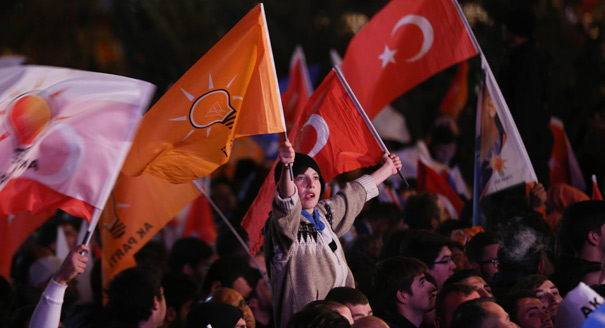
ISTANBUL – Turkey’s beleaguered Prime Minister Recep Tayyip Erdoğan and his Justice and Development Party (AKP) have emerged victorious from this week’s local elections. Still, the AKP’s triumph is unlikely to ameliorate the country’s internal conflicts, much less revive its tarnished international standing.
The local elections were widely seen as a referendum on Erdoğan. The AKP received 44% of the national vote and now controls 49 of Turkey’s 81 metropolitan municipalities, including Istanbul and the capital, Ankara. The main opposition force, the center-left Republican People’s Party (CHP), received 26% and won only 13 municipalities.
The outcome can be seen as a vindication of Erdoğan’s strategy of using political polarization to consolidate his support and counter the challenge to his rule posed by followers of his former ally, the US-based Islamic preacher Fethullah Gülen. With the AKP’s initial support, the Gülen movement gradually infiltrated state institutions, particularly the judiciary and law enforcement, until the alliance eventually ended in an acrimonious split over the distribution of power within Turkey.The end result was a dirty war of graft allegations spread through social media, apparently by Gülen’s followers primarily. In response, the government has branded its opponents as enemies, and sought to promulgate new laws undermining the independence of the judiciary and restricting freedom of expression – including shutdowns of Twitter and YouTube.
Erdoğan’s strategy sought to complement this exercise in damage limitation with a demonstration of its popular legitimacy. With the AKP’s overwhelming triumph in the local elections, Erdoğan can now justifiably claim that the Turkish electorate backs his approach, including his government’s suspension of the rule of law in order to obstruct corruption investigations that it views as a judicial coup attempted by Gülen’s followers.
Yet the AKP’s electoral victory heralds two specific dangers for the future of Turkey’s democracy. The first is the persistence of intense political polarization in the run-up to the presidential election in August and the parliamentary election in the first half of 2015.
In Turkey, polarization does not have the same political costs as it does elsewhere: Given a weak system of checks and balances, the Turkish executive still has ample room to manage the state’s affairs. And Erdoğan’s recent victory will embolden him to continue his polarizing politics as the basis of a presidential run.
The other danger is that of growing alienation from the West. With a renewed popular mandate, the government is likely to begin prosecuting Gülenists for alleged criminal behavior. But the creation of a wider siege mentality to boost domestic support also requires the invention of external co-conspirators – global financial markets, the international media, or even Turkey’s NATO allies. Such allegations have been a part of the government’s conspiratorial rhetoric since last summer’s protests, and the authorities dismissed the recent corruption accusations against Erdoğan in the same way.
Turkey’s international standing has thus suffered enormously from Erdoğan’s strategy of internal polarization. Long gone are the days when the prospect of accession to the European Union sustained a powerful dynamic of democratic reform. With hope of EU membership fading, reform momentum has been lost, and the European Commission is expected to issue a sharply critical progress report in October.
The bilateral relationship with the United States is also under strain. President Barack Obama and Erdoğan rarely speak with one another anymore, whereas Obama once considered Erdoğan among his favorite world leaders.
Turkey has also lost several regional allies, particularly some of the Gulf monarchies, which are angry at the Erdoğan government’s unconditional support for the Muslim Brotherhood in Egypt. Turkey’s much-vaunted soft-power diplomacy and neighborhood policy now lie in tatters.
Yet Turkey remains a large and important regional power. With his popularity reaffirmed, Erdoğan could still move in a different direction. Aware of the dangers of extreme polarization and reassured by the level of support obtained by the AKP in the local elections, Erdoğan may opt to lower the political temperature at home in the hope of repairing Turkey’s frayed relations abroad.
How Erdoğan behaves will not only determine the intensity of domestic political conflict; it will also greatly affect Turkey’s potential to regain the regional clout that it once enjoyed. If Erdoğan believes that a higher level of antagonism is necessary to retain power, he may remain oblivious to the harm done to Turkey’s international standing.
This article was originally published in the Project Syndicate.

Senior Fellow, Carnegie Europe
Sinan Ülgen is a senior fellow at Carnegie Europe in Brussels, where his research focuses on Turkish foreign policy, transatlantic relations, international trade, economic security, and digital policy.
Recent Work

Alper Coşkun, Fatih Ceylan, Tacan İldem, …
Carnegie does not take institutional positions on public policy issues; the views represented herein are those of the author(s) and do not necessarily reflect the views of Carnegie, its staff, or its trustees.

China’s political future will be shaped between now and next October. As the Communist Party enters its intense “campaign season” to prepare for a major political transition in 2027, reading Beijing's actions and responses may become more difficult as domestic politics weigh on its behavior more than usual.

Damien Ma

The EU can impose sanctions but struggles to enforce them without the United States. With Washington increasingly disinterested in backing European interests, the bloc must now fend for itself.


Nicu Popescu, Tiago Antunes

Russia is testing the waters of NATO’s mutual defense clause. What do strikes in Romanian territorial waters mean for the alliance’s posture toward Moscow?

Dimitar Bechev
Why Pakistan, Saudi Arabia, and Turkey are joining forces on regional security.

Alper Coşkun, Amr Hamzawy

The truth of the strategic situation is that Europe and Russia are extremely unlikely to be able to “turn the page” on their confrontation within the next two decades.

Arkady Moshes