

Commentary
Alexey Malashenko
{
  "authors": [
    "Alexey Malashenko"
  ],
  "type": "commentary",
  "centerAffiliationAll": "",
  "centers": [
    "Carnegie Endowment for International Peace",
    "Carnegie Russia Eurasia Center"
  ],
  "collections": [],
  "englishNewsletterAll": "",
  "nonEnglishNewsletterAll": "",
  "primaryCenter": "Carnegie Russia Eurasia Center",
  "programAffiliation": "",
  "programs": [],
  "projects": [
    "Eurasia in Transition"
  ],
  "regions": [
    "Central Asia",
    "Kyrgyz Republic",
    "Russia",
    "Eastern Europe",
    "Ukraine"
  ],
  "topics": [
    "Political Reform",
    "Economy",
    "Trade",
    "Foreign Policy"
  ]
}
Source: Getty
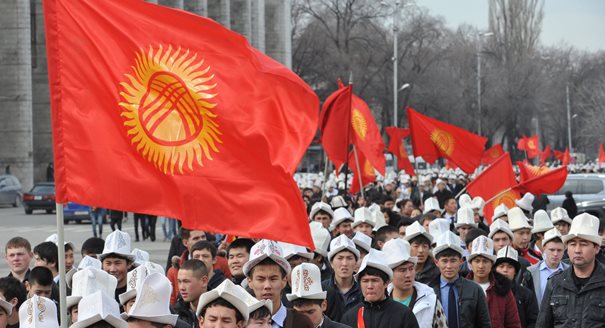
It is likely that Kyrgyzstan will become a member of the Customs Union. Moreover, Kyrgyzstan’s integration process with Russia was not substantially affected by the developments in Ukraine.
My visit to Bishkek at the end of March coincided with Prime Minister Zhantoro Satybaldiyev being replaced by Djoomart Otorbayev. This move, however, did not change the makeup of the ruling coalition. It still includes the Social Democratic Party, the Ata Meken (Fatherland) Party, and the Ar-Namys (Dignity) Party. This means that Kyrgyzstan has fully adjusted to the regime of political power-sharing, in place after the revolution of 2010. Askar Akayev’s soft authoritarian rule (1991-2005) and Kurmanbek Bakiyev’s harsher and, as they call it in Bishkek, “thievish” authoritarian regime (2005-2010) were succeeded by a viable parliamentary system. The opposition is represented in parliament by the Ata Zhurt (Homeland) and Republic parties. A third Kyrgyz revolution is not about to happen.
Djoomart Otorbayev had previously worked as an advisor to the European Bank for Reconstruction and Development. He is on the Board of Trustees of the American University for Central Asia and is among the principal authors of economic reforms in Mongolia and Myanmar. Otorbayev is considered a proponent of Western values. At the same time, he does not oppose economic integration with Russia. He has already stated that he would continue to work on Kyrgyzstan’s accession to the Customs Union.
Most Kyrgyz analysts agree that the country will become a member of the Customs Union. Apart from the economic reasons, this choice is dictated by Russia’s very strong influence on the local political class. Some in Bishkek say that both the ruling coalition and its opponents at the very least inform Moscow of their plans, if they are not directly controlled by it. The Kyrgyz security service, the Committee on National Security, is sometimes described as a branch of Russia’s FSB. This seems to be an overstatement. Thus, Omurbek Tekebayev of the Ata Meken Party, a member of the ruling coalition, believes that Kyrgyzstan should continue its multi-vector foreign policy, with one of its vectors directed to the West, and another one to China, whose influence is visibly growing.
Kyrgyzstan’s Customs Union membership will largely determine the country’s economic and, as a consequence, political fortunes for the coming years. It is quite telling that wholesalers, who mostly do business with China and thus used to fear the collapse of their business should Kyrgyzstan join the Customs Union, have now begun to look at the alternatives. There is already a noticeable drop in imports: now 40 to 50 cargo trailers cross the Sino-Kyrgyz border every day, as opposed to 150 trailers a day that came to the country previously. Now, the wholesalers are resigned to the inevitability of integration with Russia and Kazakhstan, and are trying to find ways to minimize their losses. For example, the owners of Dordoj Bazaar, a large wholesale market, believe that they will be able to switch from re-exporting Chinese goods to exporting local products. The Kyrgyz government, with some help from Russia, is promising to allocate some 200 million dollars to compensate for the traders’ losses.
Some of my interlocutors in Bishkek also believe that Eurasian integration will be able to halt the growth of Islamic radicalism in Kyrgyz society, which is really feared by many. One of them even exclaimed, “I am ready for anything, to prevent scarves on our girls’ heads.”
Kyrgyzstan’s integration process with Russia was not substantially affected by the developments in Ukraine. True, the Russian annexation of Crimea did cause some concern in Kyrgyzstan. In Kyrgyz eyes, Russia has made it clear it would assert its leadership in the post-Soviet space by any means necessary. It thus confirmed that it does not only pursue its economic interests, but also has political goals in mind as it promotes the Customs Union, and even more so within the prospective Eurasian Union. Russia does not see the territorial integrity of a neighboring state as an insurmountable barrier to attaining these interests, especially if this integrity is relatively fragile, as in the case of Kyrgyzstan. Moscow, it is believed, may use the defense of some 380,000 ethnic Russians living in Kyrgyzstan as a pretext for its political moves. Finally, Moscow has put Bishkek in an uncomfortable position of having to prove to its Western partners that Kyrgyzstan’s “understanding” of Russian actions in Crimea does not mean that the country supports Russia unconditionally.
In fact, Kyrgyzstan abstained during the UN vote on the legitimacy of Crimea’s annexation, although it had previously recognized the results of the Crimean referendum, which was referred to as the “the declaration of the will of the absolute majority of the population.” To add to the complexity of its position, Bishkek refused to recognize Viktor Yanukovych’s continued legitimacy as Ukraine’s president because he had de facto abandoned his presidential powers and fled the country.
Nevertheless, quite a few people in Kyrgyzstan, and not just ethnic Russians, are amazed by the Kremlin’s decisiveness and its readiness to confront the West. Moreover, many in Kyrgyzstan, particularly among the older generation, believe that if a referendum on joining Russia were to take place in their own country, the majority would also vote “yes” on this question.
Former Scholar in Residence, Religion, Society, and Security Program
Malashenko is a former chair of the Carnegie Moscow Center’s Religion, Society, and Security Program.
Recent Work
Alexey Malashenko
Alexey Malashenko
Carnegie does not take institutional positions on public policy issues; the views represented herein are those of the author(s) and do not necessarily reflect the views of Carnegie, its staff, or its trustees.

It should address the shortcomings of previous crisis communication efforts and adapt to the demands of frontier AI.

Lucy Luo

If the Russian-speaking community in Latvia cannot articulate their interests without being seen as disloyal, they could end up embracing a pro-Kremlin agenda.

Sergejs Potapkins
Washington’s decision to support some UN functions while letting others wither is pulling the organization apart at the seams.

Stewart Patrick, Theodore Zaritsky

Are Germany’s economic, industrial, and political struggles becoming a liability for the EU’s ability to rise to the geopolitical moment?

Rym Momtaz, ed.

Russia’s ruling party would have benefited from Putin appearing as its distant patron, but as an active frontman imposing his views on the public, he has done nothing but harm both the party’s election campaign and the ruling system overall.

Andrey Pertsev