

Paper
Yezid Sayigh
{
  "authors": [
    "Yezid Sayigh"
  ],
  "type": "legacyinthemedia",
  "centerAffiliationAll": "dc",
  "centers": [
    "Carnegie Endowment for International Peace",
    "Malcolm H. Kerr Carnegie Middle East Center"
  ],
  "collections": [
    "Conflict and Refugees"
  ],
  "englishNewsletterAll": "menaTransitions",
  "nonEnglishNewsletterAll": "",
  "primaryCenter": "Malcolm H. Kerr Carnegie Middle East Center",
  "programAffiliation": "MEP",
  "programs": [
    "Middle East"
  ],
  "projects": [],
  "regions": [
    "Levant",
    "Syria",
    "Middle East"
  ],
  "topics": [
    "Political Reform",
    "Security"
  ]
}
Source: Getty
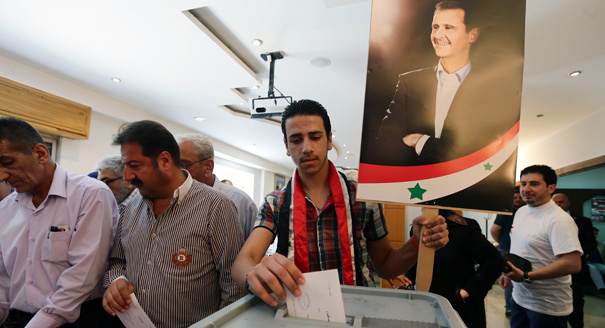
Thousands have flooded the voting booths for the Syrian presidential elections in places like Lebanon and Jordan.
Source: ABC NewsRadio
Host of ABC NewsRadio Tracey Holmes opened up the discussion on the Syrian presidential elections and refugee voting rights with Carnegie’s Yezid Sayigh.
When asked whether he was surprised that Syrian refugees were given the opportunity to vote during the Syrian presidential elections, Sayigh said that the Syrian government has allowed voting for Syrians around the world, adding “any country that has allowed the Syrian embassy to set up a polling both, this is possible for every Syrian. In the case of Syrian refugees, in places like Lebanon or Jordan, they are entitled to the same right. Though the question of course is who actually chooses to exercise this right in what most people understand is not a genuine or credible election.” Sayigh explained that many in Lebanon, for example, are very well connected into Syria. There’s a lot of fear about future consequences, and thus, Syrians “outside of Syria will still behave as if they were at risk from regime retribution or punishment,” said Sayigh.“Right now it looks horrific,” said Sayigh in response to the kind of future Syria may face. “This is a picture of a country that is not going to be able to pick itself up again for many years to come, and that’s assuming that the war stops, and right now it doesn’t look like it’s going to stop for awhile yet.”

Senior Fellow, Malcolm H. Kerr Carnegie Middle East Center
Yezid Sayigh is a senior fellow at the Malcolm H. Kerr Carnegie Middle East Center in Beirut, where he leads the program on Civil-Military Relations in Arab States (CMRAS). His work focuses on the comparative political and economic roles of Arab armed forces, the impact of war on states and societies, the politics of postconflict reconstruction and security sector transformation in Arab transitions, and authoritarian resurgence.
Recent Work
Yezid Sayigh
Yezid Sayigh
Carnegie does not take institutional positions on public policy issues; the views represented herein are those of the author(s) and do not necessarily reflect the views of Carnegie, its staff, or its trustees.
As the U.S.-led Coalition withdraws, the Kurds’ reliance on Baghdad, and on themselves, will only increase.
Wladimir van Wilgenburg

Sergei Kiriyenko used Russia’s parliamentary vote to further hone his strategy of corporate mobilization that is designed to maximize votes for United Russia.

Andrey Pertsev

Before the next wave of EU enlargement takes place, the union needs to grapple with thorny questions of how power is distributed among its members.


Emil Sondaj Hansen, Ditte Brasso Sørensen

The Horn of Africa countries are among those facing a new security calculus.


Andrew Leber, Lesley Anne Warner

The European far right might fail to steer EU policy in the direction Russia wants, but they will create enough chaos inside Europe to benefit the Kremlin.

Dimitar Bechev