

Commentary
Alexey Malashenko
{
  "authors": [
    "Alexey Malashenko"
  ],
  "type": "commentary",
  "centerAffiliationAll": "",
  "centers": [
    "Carnegie Endowment for International Peace",
    "Carnegie Russia Eurasia Center"
  ],
  "collections": [],
  "englishNewsletterAll": "",
  "nonEnglishNewsletterAll": "",
  "primaryCenter": "Carnegie Russia Eurasia Center",
  "programAffiliation": "",
  "programs": [],
  "projects": [],
  "regions": [
    "Caucasus",
    "Russia",
    "Azerbaijan",
    "Armenia"
  ],
  "topics": [
    "Security",
    "Military",
    "Foreign Policy"
  ]
}
Source: Getty
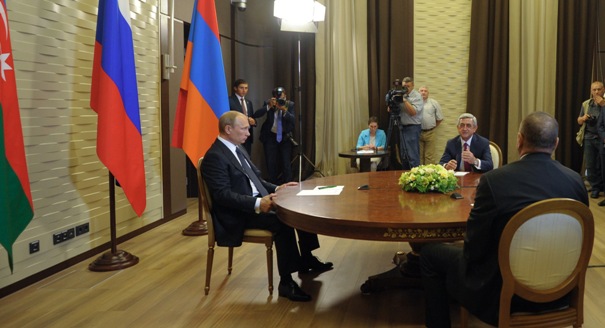
The Sochi meeting between Russia’s, Armenia’s, and Azerbaijan’s presidents is but one episode in the series of Russia’s protracted peacemaking efforts. Rather, the Armenia-Azerbaijan conflict serves as a great pretext for Russia’s presence in the South Caucasus.
It is unlikely that the August 10 Sochi meeting between Russia’s, Armenia’s, and Azerbaijan’s presidents will become a turning point in the Nagorno-Karabakh conflict. This is but one episode in the series of Russia’s protracted peacemaking efforts. Rather, the Armenia-Azerbaijan conflict serves as a great pretext for Russia’s presence in the South Caucasus. As long as the conflict continues, and no one knows how long it will last, Russia will maintain its presence in the region. If the conflict is somehow miraculously resolved, Moscow’s sway over both Azerbaijan and Armenia will diminish.
However, in Nagorno-Karabakh, we are dealing with a perennial conflict, which will remain fundamentally unchanged unless some global political upheavals are to occur.
So how is this trilateral summit different from other meetings of similar format?
Second, the success of Russia’s peacemaking efforts would be quite useful to Moscow at this time. The Ukrainian crisis devalues Russia’s peacemaking efforts; fewer and fewer people still believe it is willing and able to resolve conflicts in the post-Soviet space. Interestingly enough, the smiling Armenian President Serzh Sargsyan asked Putin to keep him informed of the steps Russia takes in Ukraine, promising to do the same vis-à-vis the events in the Caucasus region.
In other words, if Russia is able to succeed in its peacemaking efforts now, it might somewhat restore its dented international reputation.
Third, Russia is seeking to strengthen its position in the post-Soviet space more than ever before. In this context, it is interested in maintaining good working relations with both Armenia and Azerbaijan. It is especially true in light of the fact that Armenia is Russia’s strategic partner; it is a member of the Collective Security Treaty Organization and also intends to join the Customs Union and possibly the Eurasian Union. For its part, Azerbaijan, which has always considered Russia one of its major international partners, will have to overcome the temptation to supply Europe with gas under the so-called Southern Gas Corridor initiative, thus taking Russia out of the energy equation. So it is getting increasingly more difficult for Russia to preserve balance in its relations with both countries.
Fourth, it is possible that Russia may take some unconventional steps to validate its status of a peacemaker. For instance, it may offer to send its peacekeepers into the region (such rumors had been circulating before the start of the summit). Such an event seems unlikely, but if it indeed takes place, it may create a precedent for more Russian peacekeeping engagements in some other regions, such as the southeast of Ukraine.
In any event, the August trilateral summit goes beyond the actual Nagorno-Karabakh conflict, while the conflict itself remains unresolved.
Former Scholar in Residence, Religion, Society, and Security Program
Malashenko is a former chair of the Carnegie Moscow Center’s Religion, Society, and Security Program.
Recent Work
Alexey Malashenko
Alexey Malashenko
Carnegie does not take institutional positions on public policy issues; the views represented herein are those of the author(s) and do not necessarily reflect the views of Carnegie, its staff, or its trustees.

The real test may come after the leaders leave the room.



Sheena Chestnut Greitens, Oriana Skylar Mastro, Yukon Huang, …

The Horn of Africa countries are among those facing a new security calculus.


Andrew Leber, Lesley Anne Warner

The European far right might fail to steer EU policy in the direction Russia wants, but they will create enough chaos inside Europe to benefit the Kremlin.

Dimitar Bechev

The new U.S.–Denmark–Greenland agreement will help Washington exert political, economic, and financial dominance under the guise of security. Yet, it acknowledged Copenhagen’s and Nuuk’s sovereignty on the island.

Marc Pierini
Washington needs to recognize that influence in the Western Hemisphere comes from presence, delivery, and reliability. It also must recognize that while the United States remains the key external actor, it no longer operates in a permissive environment and cannot presume deference from regional players who have other options, namely China.
Juan S. Gonzalez