• Research
  • Emissary
  • About
  • Experts
Carnegie Global logoCarnegie lettermark logo
DemocracyIran
  • Donate
{
  "authors": [
    "Sinan Ülgen"
  ],
  "type": "legacyinthemedia",
  "centerAffiliationAll": "dc",
  "centers": [
    "Carnegie Endowment for International Peace",
    "Carnegie Europe",
    "Malcolm H. Kerr Carnegie Middle East Center"
  ],
  "collections": [
    "Turkey’s Transformation",
    "Europe’s Southern Neighborhood"
  ],
  "englishNewsletterAll": "menaTransitions",
  "nonEnglishNewsletterAll": "",
  "primaryCenter": "Carnegie Europe",
  "programAffiliation": "MEP",
  "programs": [
    "Middle East",
    "Europe"
  ],
  "projects": [],
  "regions": [
    "Middle East",
    "Europe",
    "Türkiye",
    "Iran",
    "Syria"
  ],
  "topics": [
    "Security"
  ]
}
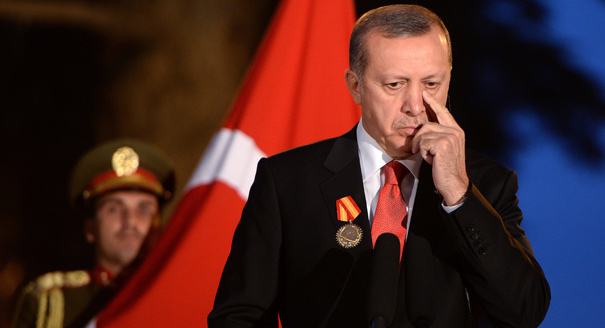
Source: Getty

In The Media
Carnegie Europe

Turkey’s Regime Change Policy for Syria Finds Little Domestic Support

Amid multiple security spillovers from the Syrian crisis, Turkish public opinion is becoming less supportive of Ankara’s ambitious agenda to champion regime change in Syria.

Link Copied
By Sinan Ülgen
Published on Oct 17, 2014
Program mobile hero image

Program

Middle East

The Middle East Program in Washington combines in-depth regional knowledge with incisive comparative analysis to provide deeply informed recommendations. With expertise in the Gulf, North Africa, Iran, and Israel/Palestine, we examine crosscutting themes of political, economic, and social change in both English and Arabic.

Learn More
Program mobile hero image

Program

Europe

The Europe Program in Washington explores the political and security developments within Europe, transatlantic relations, and Europe’s global role. Working in coordination with Carnegie Europe in Brussels, the program brings together U.S. and European policymakers and experts on strategic issues facing Europe.

Learn More

Source: World Politics Review

Turkey recently announced that only Syrian refugees would be allowed to cross the border to fight against the so-called Islamic State (IS) in the besieged town of Kobani. In an email interview, Sinan Ülgen, a visiting scholar at Carnegie Europe, discussed domestic influences on Turkey’s Syria policy.

WPR: How unified is the ruling Justice and Development Party (AKP) on Turkey’s Syria policy, and how does the Turkish opposition view the AKP’s policy?

Sinan Ülgen: The Turkish government’s policy on Syria has never really been popular. There are no dissenting voices within the ruling party given the strong party discipline. But both with regard to the political opposition and public opinion in general, Syria policy remains one of the less popular foreign policy initiatives of the AKP government. The reason is that Turkish public opinion has traditionally been cautious and wary of intervention in other countries’ domestic affairs, which is a long-standing principle of Turkish foreign policy. But the AKP government, following the refusal of Syrian President Bashar al-Assad’s regime in August 2011 to heed to Ankara’s calls for initiating democratic reforms, adopted an aggressive stance and started to champion regime change in Syria. This sudden departure from the established tenets of Turkey’s foreign policy, as justifiable as it may have been, failed to garner much support among the Turkish public. Today, faced with the myriad security spillovers from the Syrian crisis, Turkish public opinion is less supportive of this ambitious agenda.

WPR: What policy has Turkey’s business sector advocated for, in light of lost commercial interests in Syria, and has that changed over the course of the conflict?

Ülgen: The Turkish business community has not really been a factor shaping the government’s Syria policy. In previous years, when the relationship with Damascus was markedly warmer, companies in Turkey’s southeast profited significantly from this rapprochement. Border trade was increasing, and many Syrians were traveling to Turkey for shopping, tourism and even medical care. Now this positive dynamic has ended. Turkey’s overall exports to Syria have fallen by 40 percent. But the severity of the political tension between Ankara and Damascus does not allow the business community to play a role in shaping policy.

WPR: How much leverage do the Kurds currently exercise over the AKP’s policy?

Ülgen: Turkey’s Kurds have recently staged violent street protests to express their dissatisfaction with what they perceive to be the inaction of the Turkish government in the face of IS’s siege of Kobani in Syria. The Peoples’ Democratic Party (HDP), the political representative of Turkey’s Kurds, even threatened to pull out of ongoing peace negotiations with the government. They are intent on using the leverage provided by the negotiations to get the Turkish government to adopt a more interventionist stance on Kobani.

But so far Ankara has resisted this pressure. For Ankara, ensuring U.S. support for the regime change agenda in Syria is more important. That is the reasoning behind calls for setting up safe havens to be backed by a no-fly zone within Syria. Another factor shaping Ankara’s decision-making is the perceived affinity of the Kurdish faction in Syria toward the Assad regime. Ankara wants the Rojava, or Syrian Kurdistan, administration to break away from Assad and take part in the anti-Assad coalition.

This interview was originally published on World Politics Review.

About the Author

Sinan Ülgen

Senior Fellow, Carnegie Europe

Sinan Ülgen is a senior fellow at Carnegie Europe in Brussels, where his research focuses on Turkish foreign policy, transatlantic relations, international trade, economic security, and digital policy.

    Recent Work

  • Research
    Reforming European Security: A Turkish Perspective
      • +5

      Alper Coşkun, Fatih Ceylan, Tacan İldem, …
  • Paper
    From Trade Dependence to Geopolitical Leverage: The EU in an Era of Weaponized Interdependence

      Sinan Ülgen

Sinan Ülgen
Senior Fellow, Carnegie Europe
Sinan Ülgen
SecurityMiddle EastEuropeTürkiyeIranSyria

Carnegie does not take institutional positions on public policy issues; the views represented herein are those of the author(s) and do not necessarily reflect the views of Carnegie, its staff, or its trustees.

More Work from Carnegie Endowment for International Peace

  • Commentary
    Strategic Europe
    Taking the Pulse: Enough with the Annual NATO Summits, Already?

    Over the past ten years, NATO has held almost as many summits as it did during the entirety of the Cold War. Are they still useful, or is it time to stop holding annual meetings?

      • Rym Momtaz

      Rym Momtaz, ed.

  • Europe from Scratch: Visions for a New European Order
    Report
    Europe from Scratch: Visions for a New European Order

    As the EU confronts profound challenges, several leaders have called for fundamental reform to the union’s model—but only modest, superficial changes have resulted. What if Europe really could be reimagined from zero today: What should such a redesigned European order look like?

      Richard Youngs, ed.

  • Commentary
    Carnegie Politika
    What Should We Take From Andrey Melnichenko’s Essay in the Economist?

    Andrey Melnichenko’s essay offers no answer to the fundamental question of how, under any kind of negotiated settlement, Europe can protect itself from the Russian ressentiment that is inevitable in all scenarios except for an outright victory for Putin.

      Leonid Bershidsky

  • Commentary
    Strategic Europe
    European Sycophancy Worked on Trump

    Nearly a year and a half after Europeans leaned into sucking up to Trump, the strategy has produced some benefits when it comes to Ukraine.

      • Rym Momtaz

      Rym Momtaz

  • Romania Bulgaria Turkey Black Sea naval
    Commentary
    How NATO Became Anchored in the Black Sea

    As Russia's war on Ukraine drags on, NATO is expanding its footprint in the Black Sea. Turkey, Romania, and Bulgaria are upgrading their fleets and deepening trilateral cooperation.

      Dimitar Bechev

Get more news and analysis from
Carnegie Endowment for International Peace
Carnegie global logo, stacked
1779 Massachusetts Avenue NWWashington, DC, 20036-2103Phone: 202 483 7600
  • Research
  • Emissary
  • About
  • Experts
  • Donate
  • Programs
  • Events
  • Blogs
  • Podcasts
  • Contact
  • Annual Reports
  • Careers
  • Privacy
  • For Media
  • Government Resources
Get more news and analysis from
Carnegie Endowment for International Peace
© 2026 Carnegie Endowment for International Peace. All rights reserved.