

Commentary
It signals a new era of tech diffusion and warfare.
Steve Feldstein
{
  "authors": [
    "Ulrich Speck"
  ],
  "type": "legacyinthemedia",
  "centerAffiliationAll": "dc",
  "centers": [
    "Carnegie Endowment for International Peace",
    "Carnegie Europe"
  ],
  "collections": [
    "Europe’s Eastern Neighborhood"
  ],
  "englishNewsletterAll": "ctw",
  "nonEnglishNewsletterAll": "",
  "primaryCenter": "Carnegie Europe",
  "programAffiliation": "EP",
  "programs": [
    "Europe"
  ],
  "projects": [],
  "regions": [
    "Russia",
    "Europe",
    "Eastern Europe",
    "Ukraine",
    "Western Europe",
    "Iran"
  ],
  "topics": [
    "Foreign Policy"
  ]
}
Source: Getty
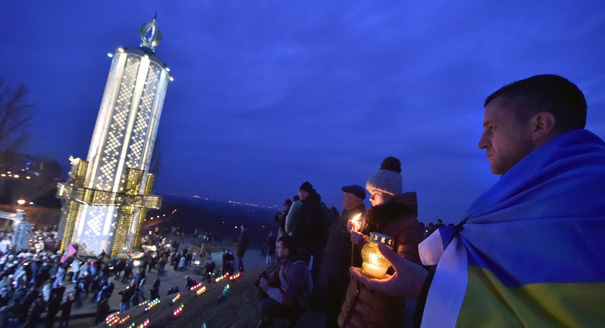
For years, the EU was extremely cautious not to provoke Russia. But with Moscow’s aggression against Ukraine, the EU now has to accept that the situation has changed.
Source: The Moscow Times
For Russia, relations with the European Union have become competitive and acrimonious. Ukraine cannot be part of both worlds anymore; it is either in the EU or the Russian-led Eurasian Union. The space in between has disappeared. Moscow's goal is to regain control over Ukraine and other countries in the region that are turning westward.
But Russia was not always opposed to closer ties between Eastern Europe and the EU. In 2004, President Vladimir Putin welcomed the idea of EU integration for Ukraine, saying it would be beneficial for Russia too. The view in the EU was that Russia was against NATO in its neighborhood, but not against the EU.
But of course there were signs of the things to come. In 2011, Moscow set up its own integration project, formally modeled on the EU, the Eurasian Economic Union. Until last summer, however, there was no sign that Russia would risk an open conflict with the West. A Russian reaction to Ukraine moving closer to Europe was expected, but not an act of open military aggression.How did the EU get into this conflict? The Eastern Partnership, the framework from which the association agreements emerged, was a Polish initiative. Poland wants a safe neighborhood in Eastern Europe. Warsaw saw EU association as a first step on the way to stabilizing Ukraine and other countries in the region.
The Eastern Partnership was a weak policy because strong members like Germany and France did not fully back it. They left the steering of this policy to EU officials in Brussels. Berlin, the key power for EU relations with the East, did not take responsibility for that policy.
The Eastern Partnership was poorly funded, and it did not include membership in the EU. Most EU capitals were happy with the Russia policy they had pursued for two decades, and they didn't want any tensions with Russia over Ukraine. And they did not expect the association agreement with Ukraine to change much. The truth is that the EU didn't care much about its eastern neighbors, and the Eastern Partnership was just a polite way to express this disinterest.
The #EaP was a weak policy because strong members like Germany and France did not fully back it.Tweet This
For two decades the West had implicitly granted Russia a sphere of influence in the post-Soviet space. It was all about Russia; nobody cared much about Central Asia, the South Caucasus, and countries like Belarus, Ukraine and Moldova. When Armenia suddenly canceled EU association last year and decided to join the Eurasian Economic Union, there was almost a sigh of relief in European capitals.
In the EU mainstream, there was no ambition to change anything in the post-Soviet space. Stability meant not interfering with the Moscow-led order in the post-Soviet space even if this meant limited sovereignty for other post-Soviet countries.
It was not the EU that was pushing for change in the region; it was people in the region who were fed up with Moscow-backed, highly corrupt and incompetent autocratic systems. It was people-power that led to tensions between these countries and Moscow, and it was people-power that forced the EU to become more active in the region.
Ukraine is a case in point. When Ukraine's then-President Viktor Yanukovych declared that he would not sign the association agreement and that Ukraine would develop its ties with Moscow, most EU capitals weren't exactly unhappy with that decision. But then Euromaidan happened. People appeared on Kiev's main square weaving EU flags. For them, closer ties with the EU were the only hope to escape from a corrupt Moscow-backed regime.
With #Crimea, there was a war of aggression on European soil, and the EU had to do something.Tweet This
It was the Euromaidan, not geopolitical ambition, that forced the EU to get back into the game in Ukraine. Suddenly the EU was in a conflict with Russia that it did not seek, for a country in which it wasn't very interested. It was Russia's decision to annex Crimea and covertly attack eastern Ukraine militarily that forced the EU to take sides, under German leadership.
There was a war of aggression on European soil, and the EU had to do something. Suddenly the EU and Russia were in a conflict about core principles of international order.
The popular narrative that the West wanted to break Ukraine away from Russia is simply a myth, spread by the Kremlin's propaganda machine. For years, the EU was extremely cautious not to provoke Russia. Germany was always taking Russian positions into account: Former German leaders Helmut Kohl and Gerhard Schröder were sympathetic to Russian interests, and current German Chancellor Angela Merkel's previously close relationship with Putin is well-known.
The EU is a party to a conflict. It must play geopolitics at least in a minimalist way.Tweet This
But with Russia's aggression against Ukraine, the EU now has to accept that the situation has changed. The EU is a party to a conflict. It must play geopolitics at least in a minimalist way — keep the playing field open against a Russia that wants to regain control over Ukraine.
The whole point of the European system that was built after World War II was to ensure that Europe would never return to the era of war and territorial conquest that we saw in the years between 1914 and 1945. The EU now must defend and reassert that order: to clearly communicate to Moscow that annexation and territorial aggression are not acceptable in Europe anymore. This is as much a conflict about principles as it is a conflict about Ukraine.
Ulrich Speck
Former Visiting Scholar, Carnegie Europe
Speck was a visiting scholar at Carnegie Europe in Brussels, where his research focuses on the European Union’s foreign policy and Europe’s strategic role in a changing global environment.
Carnegie does not take institutional positions on public policy issues; the views represented herein are those of the author(s) and do not necessarily reflect the views of Carnegie, its staff, or its trustees.
It signals a new era of tech diffusion and warfare.

Steve Feldstein

With its public finances in shambles, the far right polling at 35 percent ahead of the 2027 presidential election, and a growing protest movement, is France’s crisis a threat to the EU’s geopolitical awakening?

Rym Momtaz, ed.

Putin’s conservative staffing policies and search for ever greater control have cemented parliament’s transformation into a bureaucratic appendage of the executive branch.

Andrey Pertsev

Russia’s AI-driven propaganda campaigns operate in a fragmented, chaotic, and often illogical manner. That’s not necessarily a problem for the Kremlin, though: It’s much easier to mimic genuine public debate that way.

Ilya Klishin

Ahead of a tough winter for Ukraine, Donald Trump’s swing back toward Russia bodes ill. But instead of panicking, Kyiv’s European allies are focusing on action.
Rym Momtaz