

Commentary
Alexey Malashenko
{
  "authors": [
    "Alexey Malashenko"
  ],
  "type": "commentary",
  "centerAffiliationAll": "",
  "centers": [
    "Carnegie Endowment for International Peace",
    "Carnegie Russia Eurasia Center"
  ],
  "collections": [],
  "englishNewsletterAll": "",
  "nonEnglishNewsletterAll": "",
  "primaryCenter": "Carnegie Russia Eurasia Center",
  "programAffiliation": "",
  "programs": [],
  "projects": [],
  "regions": [
    "Russia"
  ],
  "topics": [
    "Political Reform",
    "Religion",
    "Economy"
  ]
}
Source: Getty
The ethno-religious tensions in Russia have subsided a bit in 2014, because the Ukrainian conflict has shifted the xenophobic sentiments from an internal to an external adversary. However, this shift does not eliminate xenophobia altogether—on the contrary, overall aggressiveness is on the rise.
Inter-ethnic and inter-religious tensions are a constant factor in Russia’s social and political life. Over the last two decades they have generally increased, despite periods of waxing and waning. These tensions are fueled by migration—both external (mostly from Central Asia) and internal (from the North Caucasus). The lack of adequate government policy on migration and corruption among those responsible for migration flows contributes to the continued tensions.
According to a recent study of interethnic tensions prepared by the Center of Research on the National Conflicts and the Club of Regions and symbolically titled “The Grapes of Wrath,” only thirty Russian regions face no or few ethnic tensions. But even these “successful” regions, which incidentally include Ingushetia, Chechnya, Nizhny Novgorod, and Perm, occasionally experience conflicts and even terrorist attacks.
Only thirty Russian regions face no or few ethnic tensions.Tweet This
In recent years, Russia has seen a proliferation of new ethno-cultural zones created by migrants, most of who cannot assimilate into a culture they consider alien. They therefore form their own settlements, sometimes even with their own infrastructure, where they can live according to their own norms. Some specialists believe that certain neighborhoods on the outskirts of Moscow are turning into ghettos, which seemed impossible just ten years ago.
Muslim migrants increasingly identify with their religion and become more religiously observant. Some Islamic radicals enter the country along with mainstream Muslim migrants, giving rise to greater Islamophobia.
The ethno-religious tensions have subsided a bit in 2014. The number of ethnic conflicts has declined by 35 percent for the first three quarters. If no serious upheavals occur before January, 2014 may go down as a relatively calm year in this regard. The drop resulted from the Ukrainian conflict which has shifted the generally xenophobic sentiments among the Russian public from an internal to an external adversary—the West and primarily the United States, as well as Ukraine, which is persistently branded as fascist by official propaganda.
Ukrainian conflict has shifted the generally xenophobic sentiments among the Russian public from an internal to an external adversary.Tweet This
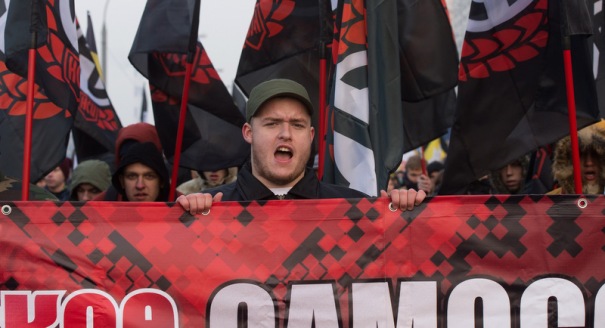
The shift in the object of xenophobia does not however eliminate it altogether. On the contrary, overall aggressiveness is on the rise, and it will still be directed toward visitors from neighboring states and the North Caucasus, whom the nationalistically-driven public encounters much more frequently than the “enemies” from the West. At the November 4 “Russian march,” the Nationalist Party head Dmitry Dyomushkin reiterated that the nationalists are not about to end their struggle against migration from Central Asia.
Former Scholar in Residence, Religion, Society, and Security Program
Malashenko is a former chair of the Carnegie Moscow Center’s Religion, Society, and Security Program.
Recent Work
Alexey Malashenko
Alexey Malashenko
Carnegie does not take institutional positions on public policy issues; the views represented herein are those of the author(s) and do not necessarily reflect the views of Carnegie, its staff, or its trustees.

China’s political future will be shaped between now and next October. As the Communist Party enters its intense “campaign season” to prepare for a major political transition in 2027, reading Beijing's actions and responses may become more difficult as domestic politics weigh on its behavior more than usual.

Damien Ma
The EU can impose sanctions but struggles to enforce them without the United States. With Washington increasingly disinterested in backing European interests, the bloc must now fend for itself.
Nicu Popescu, Tiago Antunes
Rubio’s recent visit brought welcome attention, but more capital requires governance changes that may be a hard sell for regional governments.

Jennifer B. Murtazashvili
Japan’s long-term security policy is driven by concerns about China, and there is little appetite for (or interest in) pursuing a confrontation with Moscow.

James D.J. Brown
Russia is testing the waters of NATO’s mutual defense clause. What do strikes in Romanian territorial waters mean for the alliance’s posture toward Moscow?

Dimitar Bechev