

Commentary
Despite public disputes over trade and immigration, the strategic partnership’s foundations remain sturdy.
Sameer Lalwani
{
  "authors": [
    "Richard Sokolsky",
    "Jeremy Shapiro"
  ],
  "type": "legacyinthemedia",
  "centerAffiliationAll": "dc",
  "centers": [
    "Carnegie Endowment for International Peace"
  ],
  "collections": [],
  "englishNewsletterAll": "ctw",
  "nonEnglishNewsletterAll": "",
  "primaryCenter": "Carnegie Endowment for International Peace",
  "programAffiliation": "russia",
  "programs": [
    "Russia and Eurasia"
  ],
  "projects": [],
  "regions": [
    "North America",
    "United States",
    "East Asia",
    "Western Europe"
  ],
  "topics": [
    "Security",
    "Foreign Policy"
  ]
}
Source: Getty
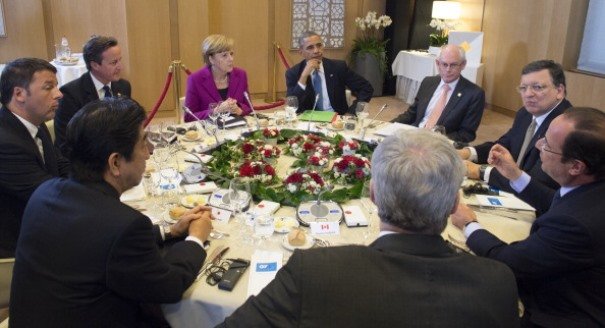
U.S. allies around the world seem increasingly less willing and less capable of contributing to common goals. What went wrong?
Source: Brookings Institution
Allies have long been central to U.S. national security strategy and particularly so in the Obama administration. “[W]e must,” President Obama declared in May 2014, “mobilize allies and partners to take collective action. ... [W]e have to work with others because collective action in these circumstances is more likely to succeed, more likely to be sustained, [and] less likely to lead to costly mistakes.”
This focus on allies in a world in which power is diffusing and crises are multiplying is both good politics and good sense. Allies lessen the military and financial burdens of U.S. engagement and confer greater legitimacy on U.S. efforts. Further, the United States does not always know best—allies and partners often have better ideas for how to deal with a crisis and a comparative advantage in implementing them, especially when it comes to understanding local dynamics.
For these reasons, the Obama administration, like previous administrations, has expended much diplomatic capital nurturing formal and informal alliances and spent billions of dollars, in the Pentagon’s argot, in “building partner capacity.”But it doesn’t seem to be working so well. U.S. allies around the world seem increasingly less willing and less capable of contributing to common goals. Most European allies are retreating inward and slashing defense spending, even as Russia becomes more aggressive. Asian allies seem more focused on criticizing the inadequacy of the administration’s rebalance to the Asia-Pacific region than on forming regional security institutions that might effectively respond to China’s rise. Worst of all, U.S. allies in the Middle East are mostly a motley collection of chronically co-dependent petro-states and corrupt basket cases teetering on the edge of chaos. So what went wrong? Why has the effort to empower U.S. allies borne so little fruit?
Paradoxically, U.S. capacity-building efforts infantilized rather than empowered our allies, especially the European and Arab states, creating a level of dependency that, at least until very recently, stifled independence. The Obama administration, like its predecessors, urged these countries to develop capacity but simultaneously signaled to them that America would ultimately defend them when they got into trouble.
The U.S. government often compounded this problem by demanding little accountability and results for actually developing combat effectiveness. Instead of linking U.S. military assistance to Arab states meeting certain benchmarks on readiness, inter-operability, logistics, and command and control improvements, the United States squandered leverage by treating these sales largely as commercial transactions. And by not offering incentives or imposing disincentives for poor performance, the United States violated the cardinal rule of how to stop free riding. Finally, the U.S. government often had overly ambitious goals and neglected a simple lesson: In dealing with corrupt and repressive governments and fragmented societies, all the money, training, and equipment in the world cannot buy the will to fight, military professionalism, leadership, and morale.
The Obama administration has, since at least 2011, been involved in fairly discreet efforts to change these dynamics. In Libya, Mali, and Yemen, it has sought to take away the safety net and to encourage, even force, U.S. allies to take on greater responsibility. For many critics of the Obama administration this amounts to a failure of American leadership or even abandonment of erstwhile partners to their regional foes.
And after many years in which military capabilities have atrophied or failed to develop, allied burden sharing has often not been a pretty picture. Particularly on the military front, U.S. allies clearly do not perform as well as the United States would have if it had simply taken charge itself. In Iraq, U.S efforts to pass on responsibility have clearly failed and forced a re-engagement in that conflict that the administration would certainly have preferred to avoid.
These setbacks and risks are real. But, overall, the administration’s approach is sound. It represents a sophisticated understanding of how America should exercise its leadership in a more multipolar world of diffused power. It also reflects a recognition that many of the security challenges the United States faces stem from poor governance, and that the resulting pathologies—especially ethnic, sectarian, and tribal conflicts—are not as amenable to American solutions as the more traditional Cold War threats of inter-state aggression. Lastly, the administration’s concept of leadership is more appropriate for a public that, according to almost all public surveys, is more sympathetic to George McGovern’s 1972 message of “come home America” than to John Kennedy’s appeal in his 1961 Inaugural Address to “pay any price, bear any burden…to assure the survival and the success of liberty.”
Most importantly, limited resources and capacities in a world of rising competitors means the United States has little choice but to run these risks. In most of the crises and conflicts the United States confronts in the greater Middle East, doing nothing is often not a politically viable option. At the same time, large-scale U.S. military intervention is neither politically feasible nor morally defensible and risks escalating the violence. But however expensive it is for the United States to train and equip foreign partners, it would be far more expensive to engage American forces directly. And the costs to America’s reputation, credibility, and prestige are greater when U.S. forces fail to achieve their mission than is the case when foreign partners fail.
The United States should not always expect allies to do well or exactly what it wants. But taking such risks is necessary for building true capacity. American frustration with free riders is not a new problem. In fact, it’s hard to remember a time when a U.S. administration was not complaining about freeloading allies. The Obama administration is, rightly, less tolerant of these inadequate efforts and less willing to bail these countries out, because it recognizes that the problem of weak and unreliable partners has become much more severe. In the end, America has a large margin of security and can afford to take these risks in the short-term. For its long-term security, it must take these risks because, as experience amply demonstrates, no one will really build capacity if there is a safety net.
This article was originally published by the Brookings Institution.

Nonresident Senior Fellow, Russia and Eurasia Program
Richard Sokolsky is a nonresident senior fellow in Carnegie’s Russia and Eurasia Program. His work focuses on U.S. policy toward Russia in the wake of the Ukraine crisis.

Jeremy Shapiro
Brookings Institution
Jeremy Shapiro is the research director and U.S. program director of ECFR. His areas of focus include U.S. foreign policy and transatlantic relations. Shapiro was previously a fellow with the Project on International Order and Strategy and the Center on the United States and Europe at Brookings, where he edited the Foreign Policy program’s blog Order from Chaos. Prior to Brookings, he was a member of the U.S. State Department’s policy planning staff, where he advised the secretary of state on U.S. policy in North Africa and the Levant. He was also the senior adviser to then assistant secretary of state for European and Eurasian affairs Philip Gordon, providing strategic guidance on a wide variety of U.S.-European foreign policy issues.
Carnegie does not take institutional positions on public policy issues; the views represented herein are those of the author(s) and do not necessarily reflect the views of Carnegie, its staff, or its trustees.

Despite public disputes over trade and immigration, the strategic partnership’s foundations remain sturdy.

Sameer Lalwani
It signals a new era of tech diffusion and warfare.

Steve Feldstein

With its public finances in shambles, the far right polling at 35 percent ahead of the 2027 presidential election, and a growing protest movement, is France’s crisis a threat to the EU’s geopolitical awakening?

Rym Momtaz, ed.

Russia’s AI-driven propaganda campaigns operate in a fragmented, chaotic, and often illogical manner. That’s not necessarily a problem for the Kremlin, though: It’s much easier to mimic genuine public debate that way.

Ilya Klishin

Ahead of a tough winter for Ukraine, Donald Trump’s swing back toward Russia bodes ill. But instead of panicking, Kyiv’s European allies are focusing on action.
Rym Momtaz