

Report
- +3
James M. Acton, Alexey Arbatov, Vladimir Dvorkin, …
{
  "authors": [
    "Petr Topychkanov"
  ],
  "type": "legacyinthemedia",
  "centerAffiliationAll": "",
  "centers": [
    "Carnegie Endowment for International Peace",
    "Carnegie Russia Eurasia Center"
  ],
  "collections": [],
  "englishNewsletterAll": "",
  "nonEnglishNewsletterAll": "",
  "primaryCenter": "Carnegie Russia Eurasia Center",
  "programAffiliation": "",
  "programs": [],
  "projects": [],
  "regions": [
    "South Asia",
    "India",
    "Russia"
  ],
  "topics": [
    "Economy",
    "Security",
    "Military",
    "Foreign Policy"
  ]
}
Source: Getty
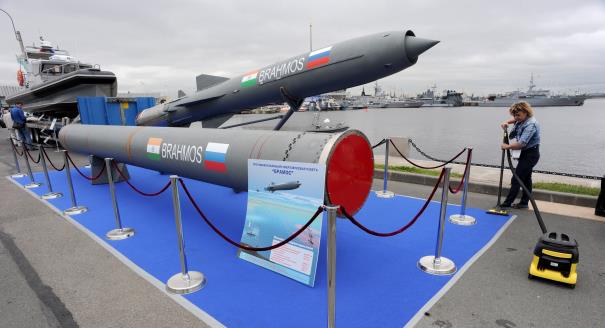
The joint India-Russia missile project BrahMos has been the single most successful joint military-technical collaboration between the two countries, and it appears the prospects for its usage are just beginning. Both countries need to increase this kind of strategic collaboration.
Source: Russia & India Report
Russia and India have a well-developed system for military-technical relations.
In recent years, there have been a number of great successes in their cooperation in these spheres.
The BrahMos project, in particular, is one of the most significant accomplishments of military-technical cooperation between India and Russia.
The creation of the BrahMos supersonic cruise missile however, remains the sole example of Russian-Indian cooperation in military technology which resulted in the creation of a product which is greatly superior to similar products produced in developed countries.On 12 February 1998, Russia and India signed an Agreement between the two governments on the ‘Joint Development and Production of Missile Complexes with the Anti-Ship Missile (BrahMos).’
Based on these documents, a joint enterprise BrahMos Airspace Ltd. was established, with a registered capital of $250 million dollars. The share in the joint venture was divided as: 49.5% to Russia and 50.5% to India. The first flight tests for the BrahMos (named after the rivers Brahmaputra and Moskva) took place in 2001.
In 2004, the Indian government proposed that the country’s Armed Forces adopt the missiles into service.
The Indian Navy initiated the process of adopting the missiles in 2005, the Army, in 2007.
According to this year’s data, the Indian Army has two regiments armed with BrahMos missiles, while a third regiment is being equipped. The decision about a fourth regiment has been made, and missiles for the fifth and sixth regiments may be ordered by the end of this year. (Each regiment, armed with four launchers and ninety missiles, costs an estimated at $300 million dollars).
According to official data from 2013, the Indian Navy has eight ships equipped with launchers for BrahMos missiles. In fact, however, India only has six ships with the BrahMos: Rajput, Ranveer, and Ranvijay destroyers (according to domestic classification, these are the Project 61ME anti-submarine ships) and Teg, Tarkash, and Trikand frigates (Project 11356 patrol ships).
New versions of the BrahMos missiles are being developed for submarine and aircraft carriers. On March 20th 2013 the first test launch of the missile from an underwater platform took place. In 2015 preparations for the test launch of the BrahMos from the Su-30MKI fighter jet were announced.
But, despite being half a tonne lighter and half a metre shorter, the BrahMos rocket was too heavy for the aircraft. The fighter could take off, but landing was difficult if the missile wasn’t launched, forcing the Indian Air Force to abandon plans to equip the Su-30MKIs with three missiles. The two airplanes prepared for test launches of the BrahMos, can only carry one missile.
In line with plans to equip submarines and fighters with this missile, a decision was taken in 2014 to build the mini-BrahMos. A smaller missile will make it possible to launch them on submarine torpedoes and equip not only Su-30MKI but also MiG-29K and MiG-29KUB, based on the Vikramaditya aircraft carriers, with them.
It is in both Moscow and Delhi’s interests to initiate new strategic projects like the BrahMos. This would help Russia strengthen its position in India’s arms market, as it is a country cooperating in such critical areas where other countries are not ready to share and develop military technology jointly with India.
The joint efforts of Moscow and India could create components or whole systems for strategically important weapons. In modern conditions, such cooperation would undoubtedly serve Russia’s interests.
After the deterioration in relations with several countries because of the Ukraine crisis, obstacles have arisen for Russia to obtain several components used in manufacturing Russian military products. The sanctions imposed on Russia by these countries after the annexation of Crimea “has somewhat slowed down the pace of our work,” said A.P. Isaikin, Rosoboronexport’s General Director.
Until the current crisis, Russian arms manufacturers worked with about 100 companies from 28 countries. It does not appear an unsolvable task to replace the foreign countries that decline to continue supplying components for armaments and military hardware of Russian manufacture. The re-orientation towards such states as the BRICS members and, above all, India will help resolve the problem.
India can be distinguished from the remaining BRICS states in that it has the richest and most varied experience cooperating with Russia in the field of high technology.
In the case of China, when taking into account its active copying of military technologies, including acquiring them through technological espionage, and pursuit of arms markets traditional for Russia, it becomes clear why a project similar to that of the BrahMos has not come about with Russian-Chinese military-technical cooperation.
Former Fellow, Nonproliferation Program, Moscow Center
Topychkanov was a fellow in the Carnegie Moscow Center’s Nonproliferation Program.
Recent Work

James M. Acton, Alexey Arbatov, Vladimir Dvorkin, …
Petr Topychkanov
Carnegie does not take institutional positions on public policy issues; the views represented herein are those of the author(s) and do not necessarily reflect the views of Carnegie, its staff, or its trustees.

Despite unhappiness on the ground, Moscow is determined to use both carrot and stick to ensure there is record support for United Russia in occupied Ukraine.

Konstantin Skorkin

The armed forces champion a form of capitalism that is generating revenue, but its reliance on rent faces diminishing returns, leaving the country with massive sunk costs and deferred returns, deepening dependency on external borrowing.

Yezid Sayigh
Despite Morocco’s hopes that its film industry would reap rewards, the blockbuster’s success will be tainted by controversy surrounding filming in occupied Western Sahara.

Sarah Yerkes
Helping to stabilize Haiti is in the United States’ national interest and can be done by making wise use of various foreign policy tools in addition to supporting international security forces.

Christopher Shell

Networks—from international payments platforms to key economic sectors—underlie many aspects of U.S. power. But they are suffering under an extractive approach to foreign policy.
Daniel W. Drezner