

Research
- +4
Milan Vaishnav, Rahul Verma, Rukmini S., …
{
  "authors": [
    "Christophe Jaffrelot"
  ],
  "type": "legacyinthemedia",
  "centerAffiliationAll": "dc",
  "centers": [
    "Carnegie Endowment for International Peace"
  ],
  "collections": [],
  "englishNewsletterAll": "ctw",
  "nonEnglishNewsletterAll": "",
  "primaryCenter": "Carnegie Endowment for International Peace",
  "programAffiliation": "SAP",
  "programs": [
    "South Asia"
  ],
  "projects": [],
  "regions": [
    "South Asia",
    "India"
  ],
  "topics": [
    "Political Reform",
    "Democracy",
    "Security"
  ]
}
Source: Getty
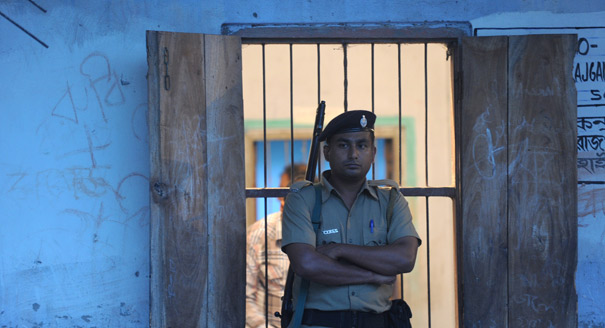
The Bajrang Dal has enlarged its agenda in such a way that the rule of law is at stake in India.
Source: Indian Express
Last week, co-convenor of the Bajrang Dal’s (BD’s) Bantwal cell, Bhuvith Shetty, triggered a controversy by welcoming the assassination of scholar M.M. Kalburgi. Thirty years after its creation, the BD has enlarged its agenda in such a manner that the rule of law is at stake. The BD was founded in 1984 under the auspices of the VHP to increase Hindu mobilisation for the Ayodhya movement.
While the first leader of the BD, Vinay Katiyar, was a former RSS pracharak, the organisation lacked the disciplinary regimen of the RSS. Up until 1993, the BD did not even have a uniform. Bajrang Dalis recognised each other by one sign only: the saffron-coloured headband bearing the word “Ram” that they wore. In 1990, they were among the kar sevaks who stormed the Babri Masjid. On December 6, 1992, they were again at the frontlines, and actively participated in the demolition of the mosque. As a result, the BD was banned by the Narasimha Rao government.However, the ban was revoked the following year. The rest of the Sangh Parivar then wanted to better control the organisation. On July 11, 1993, the BD was provided with a uniform (blue shorts, white shirt and saffron scarf) and a handbook aimed mainly at those in charge of training. In the preface to this little book, Acharya Giriraj Kishore, then second in command of the VHP, paid tribute to the heroes of December 6, 1992: “On that day the force of youth, escaping its leaders, and despite their repeated injunctions, went forward to accomplish its mission — a mission aimed to erase the shameful scar [that was the Babri Masjid].” But this was immediately followed by “Whether it is an individual or a nation, the entire society or an organisation, only one who knows discipline can achieve success, awareness and excellence. Without discipline there can be no success. Discipline comes from training and exercise. And if a disciplined man is also brave, what more can you ask for?”
Kishore’s emphasis on discipline was translated into the establishment of a rigorous new system in the 1990s. For one, the BD adopted the specific RSS technique of sermons (baudhik) delivered by a local official. Second, BD officials were now to meet regularly to coordinate their activities.
At the same time, the BD set up training camps where its militants received rigorous physical conditioning but showed little sign of improved discipline. What does the BD use its strike force for after the Ayodhya issue was put on the back burner by Atal Bihari Vajpayee himself? It first sent activists to J&K to help Hindus, especially in the Poonch, Doda and Rajouri districts. The BD also partly redirected its focus towards Christians. In January 1999, in Odisha, one organisation member, Dara Singh, murdered an Australian missionary, Graham Staines, and his sons by burning them alive in their car. In MP and Gujarat, churches, priests and nuns were attacked. Katiyar justified this hostility towards Christians in these terms: “Christians have become aggressive ever since Sonia Gandhi took over as Congress president. Christians feel they have the perfect protector… to convert Hindus.”
In parallel, the BD developed a cultural-policing agenda. Its primary targets were artists who, it believed, didn’t respect Hindu culture. It first attacked M.F. Husain in 1996. The main cause of their fury was a 1976 painting that depicted the goddess Saraswati far too scantily clad for their taste. In the 2000s, Husain, who had waited for legal protection for years, moved to Qatar.
Hindu artists have also been the targets of BD wrath for their “immoral” treatment of Hindu deities. In January 2004, a gang of militants attacked the Garden Art Gallery in Surat, and destroyed eight canvases not only by Husain, but also by K.H. Ara, N.S. Bendre and Chittrovanu Mazumdar. In May 2007, Bajrang Dalis burst into the fine arts department of MS University (Baroda), and attacked a student, accusing him of painting obscene pictures using religious subjects.
The “blasphemous” nature of certain works of art is not the only motive for the cultural policing that the BD indulged in. Ponga Pandit, a play denouncing the condition of Dalits, was targeted in 2004. Portraying the condition of widows in society is another issue that saw the BD adopt strong-arm tactics, as in the controversies around Deepa Mehta’s film Water, whose set was ransacked by BD activists. One of Mehta’s previous films, Fire, had already ignited the anger of the Hindu nationalists, for it portrayed the homosexual relationship of two women. The same theme was taken up by Girlfriend, a “Bollywood” film that sparked an even more violent BD campaign in 2004.
In Gujarat, a state where the BD is associated with the name of Babu Bajrangi — who was convicted for his role in the 2002 anti-Muslim violence — the organisation has gone on a crusade to “rescue” Hindu girls who had married Muslims, or men from a different caste. One of its 2007 pamphlets explained that love marriages harmed Hindu tradition, and that rescuing a Hindu girl was equal to saving 100 cows. In the space of a few months, over 700 girls were “rescued”. Some husbands have filed criminal cases but to no avail; moreover, the police appeared to be refraining from carrying out an inquiry on Bajrangi. The Supreme Court had to step in. It initiated an inquiry that finally prompted the BD to disown him in early 2007. He said he would remain a member of the organisation.
This is in the very nature of the BD, which is an elusive body that belongs to those who claim they are part of it — and whose actions are secretly orchestrated.
This elusiveness does not make it more innocuous. All the South Asian countries that have let similar phenomena develop have also seen a decline of the already precarious rule of law, including the multiplication of targeted killings.
This article was originally published in the Indian Express.

Former Nonresident Scholar, South Asia Program
Jaffrelot’s core research focuses on theories of nationalism and democracy, mobilization of the lower castes and Dalits (ex-untouchables) in India, the Hindu nationalist movement, and ethnic conflicts in Pakistan.
Recent Work

Milan Vaishnav, Rahul Verma, Rukmini S., …
Christophe Jaffrelot
Carnegie does not take institutional positions on public policy issues; the views represented herein are those of the author(s) and do not necessarily reflect the views of Carnegie, its staff, or its trustees.

Russian strikes are weakening the economy sustaining Ukraine’s war effort. Closing the growing funding gap will require more European support and politically contentious reforms in Kyiv.

Balázs Jarábik

Ex-president Gurbanguly Berdimuhamedov remains interested in politics, but his son Serdar, Turkmenistan’s current president, is becoming increasingly independent and willing to break with his father’s legacy. If their covert rivalry goes too far, both risk losing power.

Galiya Ibragimova

Europe is facing rising populism internally as well as external pressures from Russia, China, Turkey, and the United States.

Dimitar Bechev

A notable degree of participative democracy has firmly arrived in Europe. But to have more far-reaching impact, democratic deliberation needs to move into a radically new phase.

Richard Youngs
Economic recovery has brought Sri Lanka a modicum of stability, but domestic strains and great-power rivalry could test how long it lasts.

Avinash Paliwal