

Commentary
Andrei Kolesnikov
{
  "authors": [
    "Andrei Kolesnikov"
  ],
  "type": "commentary",
  "centerAffiliationAll": "",
  "centers": [
    "Carnegie Endowment for International Peace",
    "Carnegie Russia Eurasia Center"
  ],
  "collections": [],
  "englishNewsletterAll": "",
  "nonEnglishNewsletterAll": "",
  "primaryCenter": "Carnegie Endowment for International Peace",
  "programAffiliation": "",
  "programs": [],
  "projects": [],
  "regions": [
    "Russia"
  ],
  "topics": [
    "Foreign Policy",
    "Global Governance"
  ]
}
Source: Getty
Putin is laying claim to the legacy of the 1945 Yalta conference. But Russia's attempts to rewrite history to justify its current policies are not working.
Source: Vedomosti
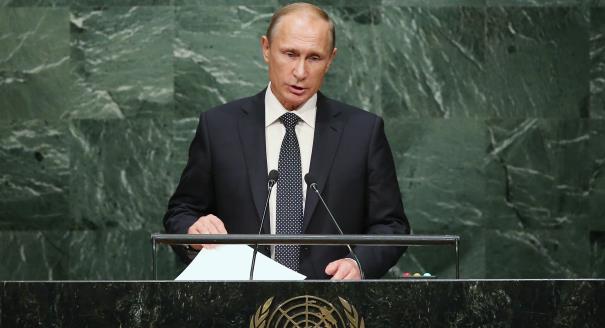
When Russian President Vladimir Putin mentioned Yalta at the beginning of his speech to the United Nations General Assembly, he was invoking history on many levels.
“The decision to establish the UN [was] made in our country, at the Yalta Conference of the leaders of the anti-Hitler coalition,” Putin told the assembly. He made it clear he was speaking as the head of the Russian state, the legal successor of the Soviet Union, and of the men who formulated the principles of the post-World War II global order.
The phrase “our country” was full of meaning. In 2014 Putin deliberately re-drew the map of the world when Russia took over Crimea, including its famous port-city of Yalta. But Yalta was also the place where Joseph Stalin perfected the art of re-shaping international geography in 1945. By Putin’s logic, that makes Russia the birthplace of the UN.
First of all, the three men strongly disagreed. Secondly, Stalin was not ready to talk about UN voting procedures. Third, he argued that the Soviet republics of Ukraine and Belarus should get their own seats—Roosevelt relented on this in order to appease Stalin and guarantee Soviet support in the unfinished war with Japan.
Finally, the Yalta Conference was one of several places where the formation of the UN was discussed. It was first debated at Dumbarton Oaks in 1944 and the full planning for the new organization happened in San Francisco in April 1945.
Putin’s invocation of history was again not quite correct when, declaring that the world’s powers should united against a common foe, he compared the coalition against Islamic terrorists he wants to create in Syria—on his own terms—with the Allies’ World War II coalition against Hitler. Including Syrian President Bashar al-Assad in an anti-ISIS coalition would in fact be more like inviting Franco or Mussolini to join the fight against Hitler.
A harbinger of Putin’s historical discourses in New York came a few days earlier from Warsaw, when the Russian ambassador Sergei Andreev sparked outrage by accusing Poland of being partially to blame for World War II, claiming that the country had blocked the formation of an anti-Hitler coalition. (No doubt it was Poland’s reticence that forced Stalin to make a deal with Hitler).
Andreev’s statement was seen as an insult to the memory of the 22,000 Polish officers massacred by the Soviet regime in the Katyn Forest in 1940. People are asking how a diplomat can work in a country he hates with such passion that he distorts the meaning of a whole historical period. Or is this an example of coercive diplomacy Russian-style?
Russia’s attempts to project “soft power” by using historical analogies are not working. Maybe this is because the current regime maintains its legitimacy not only with the memory of historical victories, but thanks to defeats poorly disguised as victories.
Even Syria has historical associations for the Russian public, as it provides them with a fond reminder of the Soviet Union’s “traditional” spheres of interest. As for the Yalta Conference of 1945, there was also a declared and a hidden message in Putin’s speech. The real result of Yalta was not a “concert of nations,” but the division of the world into spheres of influence. This kind of division is surely the ambition of the man who is the legal successor of everything Soviet, including “our Syria” and “our Yalta.”
This publication originally appeared in Russian in Vedomosti.
Former Senior Fellow, Carnegie Russia Eurasia Center
Kolesnikov was a senior fellow at the Carnegie Russia Eurasia Center.
Recent Work
Andrei Kolesnikov
Andrei Kolesnikov
Carnegie does not take institutional positions on public policy issues; the views represented herein are those of the author(s) and do not necessarily reflect the views of Carnegie, its staff, or its trustees.
In the discussions made possible by the State Duma election campaign, one question is being asked more and more loudly. “What next?”

Andrey Pertsev
While the Nazis rushed ahead in a revolutionary fervor, Russia’s modern crusaders against enemies of the state work methodically, giving their targets time to adjust to restrictions before closing the loopholes.

Leonid Bershidsky
Media coverage suggests Kyiv’s fortunes have changed. That shift may be important, but it only goes so far.

Dara Massicot, Aaron David Miller, Andrew S. Weiss
Lee’s tour shows how Seoul is reorganizing its diplomacy away from Pyongyang and toward industrial networks and the geography of the compute economy.
Darcie Draudt-Véjares
Most migrants may have left Ceuta, but the effects may linger.


Alejandro Martin Rodriguez, Sarah Yerkes