

Article
Wang Tao
{
  "authors": [
    "Wang Tao"
  ],
  "type": "legacyinthemedia",
  "centerAffiliationAll": "",
  "centers": [
    "Carnegie Endowment for International Peace",
    "Carnegie China"
  ],
  "collections": [
    "U.S.-China Relations",
    "China’s Foreign Relations"
  ],
  "englishNewsletterAll": "",
  "nonEnglishNewsletterAll": "",
  "primaryCenter": "Carnegie China",
  "programAffiliation": "",
  "programs": [],
  "projects": [
    "Carnegie Oil Initiative"
  ],
  "regions": [
    "North America",
    "United States",
    "East Asia",
    "China"
  ],
  "topics": [
    "Climate Change",
    "Economy"
  ]
}
Source: Getty
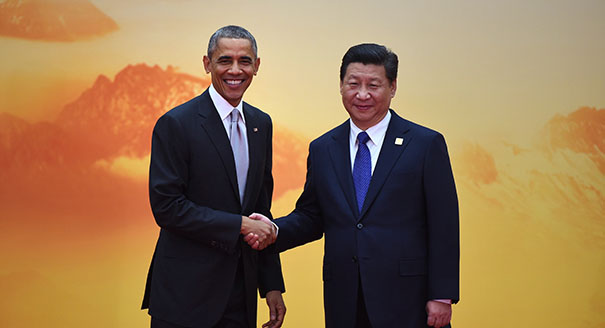
If Obama and Xi can enhance coordination of U.S. and Chinese economic and energy policies, it could help bolster market confidence and improve the prospects of the Paris Climate Change Conference.
Source: China-US Focus
Less than twenty days after celebrating, in different ways, their 70th anniversaries of victory in WWII, President Xi will meet President Obama in Washington for his first state visit to the United States as Chinese president. Unlike 70 years ago, the common enemy the two countries face this time is no longer Japanese militarism, but instead, economic uncertainty and climate change.
This is the third formal meeting between Xi and Obama, and is likely to be the last. The first one was in June 2013, the “private” meeting held in Sunnylands, California. The two reached agreement to build a “Sino-U.S. new type of major power relationship,” and together with the development of their personal relationships, provided impetus to build mutual trust and set a clear strategic direction for Sino-U.S. relations. The second was in November 2014 during the Beijing APEC summit, when President Obama made a state visit to China. The outcome was very successful, including the “Sino-U.S. Joint Declaration on Climate Change,” a landmark moment after years of international climate change negotiations, bringing a bright prospect to the UN Climate Change Conference in Paris at the end of 2015. For the third meeting between President Xi and Obama, both countries and the international community have good reason to have high expectations.
However, this meeting is also taking place at a time with more difficulties and complications. Since 2015, Sino-U.S. differences on a range of issues have deteriorated. Although some progress was still made in June during the seventh round of the Strategic and Economic Dialogue (S&ED), inevitably hot-button issues negatively affected bilateral relations.Yet a series of recent fluctuations in the Chinese and the world economies reminded everyone of the necessity for the two countries to cooperate. The Shanghai A-share index has fallen about 40% from its high point in June. Prices of mass commodities, including crude oil, experienced another sharp fall after an unexpected devaluation of the Chinese renminbi in August, followed by disruption in the European and American stock markets. Weak demand from China also dampened expectations for oil prices, adding a threat to the U.S. shale boom, which it has based its economic recovery upon. The road to transitioning the Chinese economy to a “new normal” is anything but flat, and the expectation that the Fed will raise rates has complicated overall implications for the world economy, especially for emerging economies. Economic decision-making in the world’s two largest economies in the coming months may have a decisive impact on the world economy as 2020 approaches. Reaching a coordinated and common understanding of respective economic policies at the third meeting between Presidents Xi and Obama will have immense importance in stabilizing the world economy.
Climate change negotiations have also reached a most critical time. After Xi’s visit to the United States, there will be less than 10 weeks before the UN climate conference in Paris. Whether Xi and Obama could bring further consensus and cooperation between the two largest emitters is also a question warmly expected by international community.
Ironically, the world now faces a similar economic difficulty as it did before Copenhagen in 2009, only the United States and China have switched positions. Back in 2009, the Chinese economy outperformed the rest of the world under the four trillion dollar stimulus package, while the United States and Europe were struggling in financial turmoil. The 2008 economic crisis was regarded as one of the reasons for the failure in Copenhagen in 2009. Now the Chinese economy is a real concern to many with worrying indicators in industry and energy demand, whereas the U.S. economy is on track for strong recovery partly driven by the shale oil and gas boom, with a employment rate that is better than expected. Could there be a different outcome compared to 2009 due to this role reversal?
The Chinese government needs to make hard choices in the second half of 2015. Is it to go back to the old path of heavy industrialization and investment to stimulate the economy, or insist on restructuring, implementing the long-awaited reform in production factor pricing and state-owned monopoly enterprises? The former means greater environmental risk, possibly making it that early conservation efforts were in vain, while the latter means enduring greater economic pain in the short term. Given the scale of Chinese economic and environmental impacts, either choice would have global implications.
However, environment conversations and economic development are not necessarily an either-or choice. Good investment can also drive good economic transitions.
If the Chinese government could make better use of market mechanisms to control pollution, providing a supportive environment for clean energy and environment technologies, China’s environmental protection efforts and carbon reduction targets could turn into huge economic opportunities. It is estimated that the total environmental investment needed during the “Thirteenth Five Plan” in China is expected to be more than one trillion U.S. dollars, and the Chinese government can only provide 15% of the funds. The United States can use its own experience and technology to help China to achieve this goal, while bringing greater market opportunities for their own business.
Investment and technical cooperation in key areas have been identified and agreed by both governments in the latest S&ED, including heavy-load truck fuel standards, electric vehicles, shale gas, industrial boiler efficiency, and smart grids. The Chinese government hopes to promote public-private partnership (PPP) projects in these areas as primary means of stabilizing economic growth, but inadequacy in protecting private investment and poor coordination in project management between private and public partners are still prevailing barriers. The Chinese government could learn from U.S. experience in effectively utilizing market forces to guide and encourage private investment towards these areas.
China also needs to deepen reforms in the energy sector. Since the Third Plenum of the Eighteenth Party Congress, President Xi has repeatedly pledged to carry out reforms in monopolizing state-owned enterprises, and to let the market be the decisive power in the allocation of resources. Progress was made in the past two years, but only slowly. If China wishes to replicate the shale boom of the United States, it needs to break down the restrictions of access to oil and gas resources and to establish a vibrant oil and gas trading system, while continuing to push for reforms in oil, gas, and power markets. As a cleaner fossil energy, natural gas can make contributions to both environmental protection and economic prosperity, but the main obstacle is not price nor supply, but market and trade restrictions, as well as the distorted pricing of alternative energy. It is evident that with adequate supply and declining prices in the first half of 2015, growth of natural gas demand fell from 8.9% in 2014 to 1.4%. The national carbon trading market that China plans to establish in 2016 would help to partially alleviate this distortion, but the most important thing is promote much-needed reforms in the power sector.
Energy security, especially oil and gas supply security has always been one of the major concerns of the Chinese government. This also to some extent explains the Chinese firm stance on the issue of the South China Sea. With clearer prospects of the United States exporting to the Asia-Pacific market, China and the United States would have common interests in safeguarding oil and gas supply security in this region. Even though oil is not mentioned in the “Sino-U.S. Joint Declaration on Climate Change,” coordinating the two countries oil policies, including the evaluation of greenhouse gas emissions from unconventional oils and management of the consumption of its by-product, petroleum coke, requires institutionalizing cooperation and communication between the United States and China. This would ease Chinese concerns on energy security, contributing to the two countries’ common target on climate change, and encourage China’s participation in international energy governance.
Collaboration on clean technology, energy sector reform, and energy security could provide new impetus to China’s economic transition, but also provide more support for the U.S. economic recovery, and at the same time contribute to the stability of the world’s economy and efforts to tackle climate change.
Professor Yan Xuetong, president of the Management Board of the Carnegie–Tsinghua Center for Global Policy commented in July 2013 that “providing public good to the international community is the foothold for a healthy competition between China and the United States.” 70 years ago, China and the U.S. fought side by side during the anti-fascist war, but confined by different battlegrounds, direct cooperation was limited. 70 years later, facing economic uncertainty and climate change that put the world’s prosperity and sustainability at great peril, the United States and China have to work much closer to provide the much-needed public goods for the world. This should be the essence of “Sino-U.S. new type of major power relationship,” and the most anticipated outcome of the third meeting between Xi and Obama.
A version of this article was originally published by China-US Focus.

Former Nonresident Scholar, Carnegie-Tsinghua Center for Global Policy
Wang Tao was a nonresident scholar in the Energy and Climate Program based at the Carnegie–Tsinghua Center for Global Policy.
Recent Work
Wang Tao
Wang Tao, Yang Yifang
Carnegie does not take institutional positions on public policy issues; the views represented herein are those of the author(s) and do not necessarily reflect the views of Carnegie, its staff, or its trustees.

Ahead of a tough winter for Ukraine, Donald Trump’s swing back toward Russia bodes ill. But instead of panicking, Kyiv’s European allies are focusing on action.

Rym Momtaz

Without a ceasefire with Ukraine on attacking each other’s energy infrastructure—to which the Kremlin is unlikely to agree—the diesel agreement between Putin and Trump is largely for show, rather than representing a genuine increase in the volumes of Russian diesel on the global market.

Sergey Vakulenko

Despite its flop at the box office, the film raises important questions for the climate community to answer.

Leonardo Martinez-Diaz

Russian strikes are weakening the economy sustaining Ukraine’s war effort. Closing the growing funding gap will require more European support and politically contentious reforms in Kyiv.

Balázs Jarábik

In an interview, Rozina Ali discusses her new book on the rise and manifestations of Islamophobia in the United States.

Michael Young