

Commentary
Cornelius Adebahr
{
  "authors": [
    "Cornelius Adebahr"
  ],
  "type": "other",
  "centerAffiliationAll": "dc",
  "centers": [
    "Carnegie Endowment for International Peace",
    "Carnegie Europe"
  ],
  "collections": [
    "Europe’s Southern Neighborhood",
    "Iranian Proliferation"
  ],
  "englishNewsletterAll": "ctw",
  "nonEnglishNewsletterAll": "",
  "primaryCenter": "Carnegie Europe",
  "programAffiliation": "EP",
  "programs": [
    "Europe"
  ],
  "projects": [],
  "regions": [
    "Middle East",
    "Europe",
    "North America",
    "United States",
    "Iran",
    "Western Europe"
  ],
  "topics": [
    "Foreign Policy",
    "Nuclear Policy"
  ]
}
Source: Getty
European actors should take the initiative not only to implement the deal itself but also to help create an environment, both regionally in the Middle East and politically, that supports such implementation.
Source: Washington Quarterly
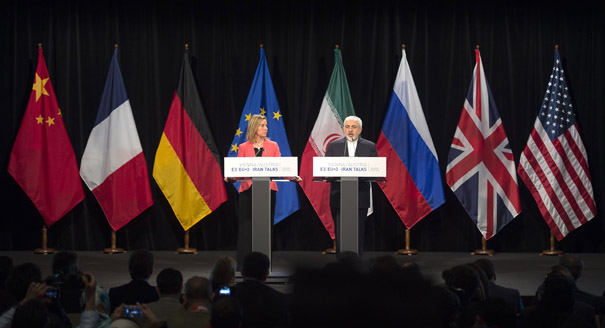
The July 2015 nuclear agreement with Iran is not only a victory for diplomacy, but also very much a transatlantic success. The deal that hides its groundbreaking qualities in the non-descript title “Joint Comprehensive Plan of Action” (JCPOA)1 represents the conclusion—and validation—of a process that three European states began in 2003. As a sign of transatlantic interdependence, U.S. opposition to engage Iran post-9/11 required the Europeans to begin a process that, ultimately, could only conclude with the United States at the table, which joined the talks alongside China and Russia in 2006. Throughout these years, the transatlantic alliance has been critical to driving the negotiation process forward, combining diplomatic and economic pressure with the right incentives to nudge Tehran toward accepting serious limitations on its purportedly civilian nuclear program.2 In other words, only because the United States and Europe worked so closely on this file could they rally the international support that was necessary to first isolate Iran and then successfully conclude the negotiations.
However, transatlantic cooperation is likely to become more difficult going forward. The U.S. government faces continued domestic resistance to even accepting the limited cooperation this agreement stipulates with Iran, a 36-year-long U.S. adversary. In this climate, it is questionable how much Washington can play a proactive role in implementing the JCPOA over the coming years. Europe—referring to the European Union and/or more specifically France, Germany, and the United Kingdom (also known as the E3/EU)—as the initiators of this process, may be less hampered by internal politics. Yet, they are absorbed with crises closer to home including Russia’s war and the resulting instability in Ukraine, continued uncertainty about the viability of the Eurozone, and the recent influx of refugees from the Middle East and North Africa, to name but the most pressing three.Still, Europe has an enormous interest in seeing the deal through for objective security reasons (preventing Iran from getting a nuclear bomb) as much as for its ownership of the JCPOA. At the same time, it lacks the domestic opposition present in the United States that could prevent it from engaging Iran beyond the agreement. This is why Europe can and should take the Iran deal forward, and enlist U.S. support to do so as a natural extension of the close cooperation during the negotiations.
This article looks at how European actors should take the initiative not only to implement the deal itself but also to help create an environment, both regionally in the Middle East and politically, that supports such implementation. It outlines how the European Union should actively seek support from the United States to continue to work together on and beyond the nuclear file. In particular, the transatlantic partners should:
This article was originally published in the Washington Quarterly.
1 Joint Comprehensive Plan of Action, Vienna, July 14, 2015, http://www.eeas.europa.eu/statements-eeas/docs/iran_agreement/iran_joint-comprehensive-plan-of-action_en.pdf.
2 For an early proposal of a transatlantic initiative on the nuclear file when there was not any willingness yet in Washington to talk to Iran, see Robert J. Einhorn, “A Transatlantic Strategy on Iran’s Nuclear Program,” The Washington Quarterly 27, no. 4 (Autumn 2004), pp. 21–32, http://www.tandfonline.com/doi/abs/10.1162/wash.2004.27.4.21.

Former Nonresident Fellow, Carnegie Europe
Cornelius Adebahr was a nonresident fellow at Carnegie Europe. His research focuses on foreign and security policy, in particular regarding Iran and the Persian Gulf, on European and transatlantic affairs, and on citizens’ engagement.
Recent Work
Cornelius Adebahr

Cornelius Adebahr, Barbara Mittelhammer
Carnegie does not take institutional positions on public policy issues; the views represented herein are those of the author(s) and do not necessarily reflect the views of Carnegie, its staff, or its trustees.

Despite its flop at the box office, the film raises important questions for the climate community to answer.

Leonardo Martinez-Diaz

Funding Ukraine remains a priority for European leaders. As Russia’s war of aggression heads into another winter, two feasible options to mobilize support for Kyiv should be fast-tracked.


Vladyslav Rashkovan, Gregory P. Wilson

In an interview, Rozina Ali discusses her new book on the rise and manifestations of Islamophobia in the United States.

Michael Young

While the EU and European governments are embracing the much-lauded middle-power moment, this entails three difficult conundrums.

Richard Youngs
The middle power moment will not be defined by sovereign states alone, and California stands out for its potential contributions to international cooperation.


Ian Klaus, Stewart Patrick