

Research
- +4
Milan Vaishnav, Rahul Verma, Rukmini S., …
{
  "authors": [
    "Christophe Jaffrelot"
  ],
  "type": "legacyinthemedia",
  "centerAffiliationAll": "dc",
  "centers": [
    "Carnegie Endowment for International Peace"
  ],
  "collections": [],
  "englishNewsletterAll": "ctw",
  "nonEnglishNewsletterAll": "",
  "primaryCenter": "Carnegie Endowment for International Peace",
  "programAffiliation": "SAP",
  "programs": [
    "South Asia"
  ],
  "projects": [],
  "regions": [
    "North America",
    "South America",
    "Southern, Eastern, and Western Africa",
    "South Asia",
    "India",
    "Pakistan",
    "Russia"
  ],
  "topics": [
    "Foreign Policy"
  ]
}
Source: Getty
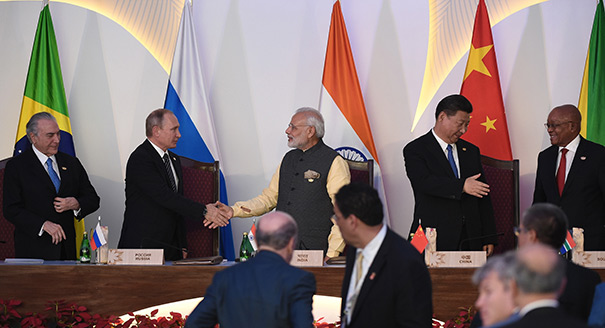
The contradictions between India’s policies vis-à-vis Pakistan and the United States and its membership of the BRICS, a grouping dominated by Russia and China, were visible at the BRICS summit in Goa.
Source: Indian Express
With the benefit of hindsight, one can learn several lessons from the BRICS summit in Goa. Before this event, close observers of India’s foreign policy in general and of BRICS in particular, Samir Saran and Abhijnan Rej, had emphasised the need “for creating new and agile institutions that can help the group”. Such an objective was ambitious and the Goa meeting has allowed BRICS to work in that direction.
In the final declaration, the members countries not only felicitated themselves for “the operationalisation of the New Development Bank (NDB) and of the Contingent Reserve Arrangement (CRA)”, but agreed to set up a credit agency. Here, BRICS are true to their DNA: Basically, this “geo-economic alliance”, to use the words of Saran and Rej, “perceives power concentration in the hands of Bretton Woods institutions as unfair and seeks to promote alternative models of development”. This is why, like in every summit since 2009, BRICS have targeted the governance of the IMF in Goa. Not only have they asked for a new quota formula that would “ensure that the increased voice of the dynamic emerging and developing economies reflects their relative contributions to the world economy”, but they have also called for the European countries to cede two chairs on the Executive Board of the IMF. For years, the targeting of West-dominated institutions has provided BRICS with a common cause.
But is it still sufficient today? The question is particularly relevant from the point of view of India after the acceleration of its rapprochement with the US in several domains, including economic and defence matters. This rapprochement has been resented by two key BRICS players, Russia and China, which have recently made moves bound to be perceived as provocations by India. Russia, which has already agreed to sell attack helicopters to Pakistan, sent troops to this country in September last for first-ever military joint manoeuvres. The Indian ambassador to Moscow had to convey to Russia New Delhi’s views that “military cooperation with Pakistan which is a country that sponsors terrorism as a matter of state policy is a wrong approach.”. Relations with China were even more tense since, over the last six months, China blocked India’s attempt at joining the Nuclear Suppliers Group (NSG), made military incursions in Arunachal Pradesh and vetoed in the UN an India-supported resolution designating Masood Azhar as a terrorist. (Azhar is the chief of Jaish-e-Mohammed, one of the Pakistani groups already on a UN blacklist, which has been held responsible for the Uri attack and the killing of 19 Indian armymen).
The Goa summit was bound to be “a moment of reckoning”, as Harsh Pant pointed out, precisely because of this context. All the more so as it happened at a time when the Indian government had initiated moves to isolate Pakistan on the international stage in the wake of the Uri attack. On that ground, the glass remained half empty. Certainly, the Indian attempt of isolating Pakistan from other South Asian countries — that had resulted in the cancellation of the Islamabad SAARC meeting in October — found another expression in the Outreach Summit of BRICS leaders of BIMSTEC countries, including Bangladesh, Bhutan, Myanmar, Nepal, Sri Lanka and Thailand, a clear signal that, in its region, India will look east even more than before. But the final declaration spared Pakistan.
On the first day of the summit, Modi had targeted Pakistan calling it the “mothership” of terrorism: “Terror modules around the world are linked to this mothership. This country shelters not just terrorists. It nurtures a mindset,” Modi said. However, the final declaration did not mention Pakistan, nor key words like “cross-border terrorism” or “state-sponsored terrorism” and the only terror groups named — ISIS, al Qaeda and Jabhat al-Nusra — were not Pakistani. Russia and China were not on the same wave length so far as this security issue was concerned. This hiatus may be due to Russian and Chinese perceptions that saving the Syrian regime is their priority and that both countries will need Pakistan to fight the Islamist groups listed above if they regroup in Afghanistan after being defeated in the Middle East.
In Goa, China has taken Pakistan’s side more explicitly than Russia, which somewhat bowed to Beijing instead of supporting New Delhi. A day after Modi called Pakistan a “mothership of terrorism”, the Chinese Foreign Ministry declared that their country opposed “linking terrorism with any specific country or religion”. It also said: “China and Pakistan are all-weather friends”.
Such divergences did not prevent India from using the Goa meeting to relate to China bilaterally. For instance, President Xi Jinping and Narendra Modi agreed to hold a dialogue on New Delhi’s bid for membership of the NSG. But China will clearly not help India to isolate Pakistan, as it was already evident from the CPEC project and, more precisely, from the fact that “its” Asian Infrastructure Investment Bank (which is much bigger than the NDB) has recently granted a $300 million loan for extending the hydropower plant of Tarbela, jointly with the World Bank. Incidentally, Xi Jinping also used China’s financial resources to relate more effectively to another neighbour of India, Bangladesh: He stopped over in Dhaka on his way to Goa to sign off loans worth $24 bn, with a country to which India has lent $2 bn last year.
The Goa summit enabled India to re-engage Russia (or vice versa). On the one hand, New Delhi and Moscow signed a $4-5 billion deal on the S-400 defence missile system. On the other, “India recognised Russian side’s effort towards achieving a political and negotiated settlement of the situation in Syria”. This joint statement was issued by Vladimir Putin and Modi at a time when the Obama administration was highly critical of the Russian strikes on Aleppo.
The contradictions between India’s policies vis-à-vis Pakistan and the US and its membership of the BRICS, a grouping dominated by Russia and China, have led observers to think about alternative routes, like the revival of IBSA. In a post BRICS summit article, Samir Saran mentions that IBSA countries have met “on the sidelines” in Goa and that such a grouping (“in many ways more organic than BRICS”) “should engage with both the US and one European power, like Germany, to promote a concert of democracies across continents, bringing advanced economies alongside emerging ones”. More than one European country might support such a move.
Former Nonresident Scholar, South Asia Program
Jaffrelot’s core research focuses on theories of nationalism and democracy, mobilization of the lower castes and Dalits (ex-untouchables) in India, the Hindu nationalist movement, and ethnic conflicts in Pakistan.
Recent Work

Milan Vaishnav, Rahul Verma, Rukmini S., …
Christophe Jaffrelot
Carnegie does not take institutional positions on public policy issues; the views represented herein are those of the author(s) and do not necessarily reflect the views of Carnegie, its staff, or its trustees.
Despite public disputes over trade and immigration, the strategic partnership’s foundations remain sturdy.
Sameer Lalwani

Russia spent years building a “sovereign internet,” concentrating web infrastructure exclusively within Russian territory. Ukrainian drone attacks have shown how vulnerable that approach has left the Russian internet.

Maria Kolomychenko

With its public finances in shambles, the far right polling at 35 percent ahead of the 2027 presidential election, and a growing protest movement, is France’s crisis a threat to the EU’s geopolitical awakening?

Rym Momtaz, ed.

Putin’s conservative staffing policies and search for ever greater control have cemented parliament’s transformation into a bureaucratic appendage of the executive branch.

Andrey Pertsev

Russia’s AI-driven propaganda campaigns operate in a fragmented, chaotic, and often illogical manner. That’s not necessarily a problem for the Kremlin, though: It’s much easier to mimic genuine public debate that way.

Ilya Klishin