

Commentary
Judy Dempsey
{
  "authors": [
    "Judy Dempsey"
  ],
  "type": "legacyinthemedia",
  "centerAffiliationAll": "dc",
  "centers": [
    "Carnegie Endowment for International Peace",
    "Carnegie Europe"
  ],
  "collections": [
    "Transatlantic Cooperation",
    "EU Integration and Enlargement"
  ],
  "englishNewsletterAll": "ctw",
  "nonEnglishNewsletterAll": "",
  "primaryCenter": "Carnegie Europe",
  "programAffiliation": "EP",
  "programs": [
    "Europe"
  ],
  "projects": [],
  "regions": [
    "Europe",
    "North America",
    "United States",
    "Western Europe",
    "Iran"
  ],
  "topics": [
    "EU",
    "Security",
    "Military"
  ]
}
Source: Getty
Given his outspoken statements on NATO, U.S. President-elect Donald Trump has handed a silver platter to Russia’s Vladimir Putin and to populists throughout Europe.
Source: Washington Post
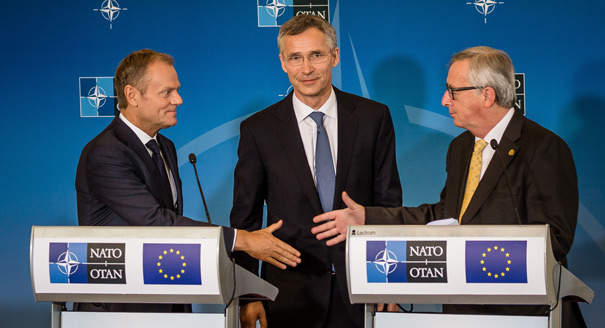
On a cold night in Brussels this past Sunday, Federica Mogherini, the European Union’s foreign policy chief, invited the European bloc’s 28 foreign ministers for an informal brainstorming. She wanted to sound them out about how they should react to the election of Donald Trump as the next president of the United States and what it could mean for European security and defense policy.
As it turned out, the meeting didn’t amount to a needed wake-up call for Europeans to pull together in order to rescue two the great post-1945 achievements: the Euro-Atlantic relationship anchored on NATO and America’s commitment to Europe’s security and values. The election of Donald Trump could be the defining moment for the future of the transatlantic relationship.
Instead, European leaders disagreed over how Europe could defend itself, with or without NATO. They showed an extraordinary reluctance to grasp how the changes in the United States will affect Europe’s security and the durability of the transatlantic relationship.
Two of the E.U.’s most important military countries — Britain and France — didn’t even bother to accept Mogherini’s invitation. Britain’s foreign secretary, Boris Johnson, called the gathering a “collective whinge-o-rama.” France’s Jean-Marc Ayrault wanted to meet the new U.N. secretary general. Hungary’s foreign minister stayed away as well. He said the E.U. was being hysterical.
“Since Trump’s election, the security environment has completely changed,” said Karl-Heinz Kamp, president of the German Federal Academy for Security Policy. “There is a dramatic change in the international foreign policy environment,” Kamp told participants at a security conference he hosted in Berlin on Nov. 14, a day after the Brussels summit. (I was in attendance.) “The president-elect, as a populist, has promised everything and anything. America will be a different partner in NATO, not just because Trump asked us to pay more. Trump is anti-establishment. The anti-establishment doesn’t care about the truth.”
This drift in the E.U. is good news for President Vladimir Putin. Russia has long sought to divide and eventually destroy the transatlantic alliance. Trump, given his statements on NATO, has handed Putin and populists on both sides of the Atlantic a silver platter.
In the United States, three in 10 Republican and Republican-leaning registered voters who backed Trump in the primaries said being a member of NATO was bad for the United States, according to a recent study by Pew Research Center.
In Europe, populist movements mix their Euro-skepticism with anti-Americanism.
Marine Le Pen, leader of France’s far-right wing National Front and a presidential candidate, praised Trump’s victory. At the same time, she opposes U.S. dominance and any further integration of the E.U. That bodes ill both for NATO and for the E.U.’s ambitions to strengthen its foreign and defense policy.
Regardless of the security and terrorist threats facing Europe, the populists’ message is that the nation state, alone, can take back control and look after its own defense. That was also the message of the Brexit campaign. Trump’s victory reinforced that belief.
These movements that are essentially isolationist have implications for the E.U. and NATO.
In Europe, several E.U. leaders, particularly Jean-Claude Juncker, president of the European Commission, the E.U.’s executive, called for the establishment of a E.U. army.
“We have a lot to thank the Americans for … but they won’t look after Europe’s security forever,” Juncker said. “We have to do this ourselves, which is why we need a new approach to building a European security union with the end goal of establishing a European army.”
Guy Verhofstadt, leader of the Liberal grouping in the European Parliament, said Trump’s victory was “a wake-up call for Europe to further unite and take charge of its own destiny.”
That’s going to be a hard sell for other E.U. members.
The Baltic States and Poland know that the E.U. is no substitute for NATO. It doesn’t have the military capabilities, the logistics or intelligence. For these countries, it is the (dwindling) presence of American soldiers in Europe that deters Russia, not European forces. As newly elected Estonian President Kirstil Kaljudaid said recently in Berlin, “NATO is the most important security provider for Estonia.”
Christoph Heusgen, Chancellor Angela Merkel’s foreign policy and security adviser, also put paid to the idea of a European army and that Europe could go it alone.
“NATO is the pillar of German security,” he told the security conference in Berlin. “Yes, we have to develop a European security and defense policy, but always under the headlines of no duplication [with NATO]. ”As for a common E.U. army, “it’s just a buzzword. It would not be supported by Germany. Its not possible.”
NATO officials say the E.U. is in no shape to have its own army. “In NATO, it is five non-E.U. members that make up 80 percent of Alliance spending,” a NATO official said. “What does that say about the European allies willing to look after their own defense,” he added.
“Going it alone is not an option, either for Europe or for the United States,” Jens Stoltenberg, NATO’s secretary general, said. Not yet, but Trump has started the debate.
This article was originally published by the Washington Post.

Nonresident Senior Fellow, Carnegie Europe
Judy Dempsey is a nonresident senior fellow at Carnegie Europe
Recent Work
Judy Dempsey
Judy Dempsey
Carnegie does not take institutional positions on public policy issues; the views represented herein are those of the author(s) and do not necessarily reflect the views of Carnegie, its staff, or its trustees.
Despite the agreement’s uncertainty, it’s still a significant development in regional and nuclear policy.


Andrew Leber, Jane Darby Menton
“AI safety in parallel” is modest and pragmatic but vital.

Matt Sheehan

Trump is distracted and Ukraine wants Europe to step up. The continent’s leaders must find their voice and assert it in talks with Russia.

Alissa de Carbonnel
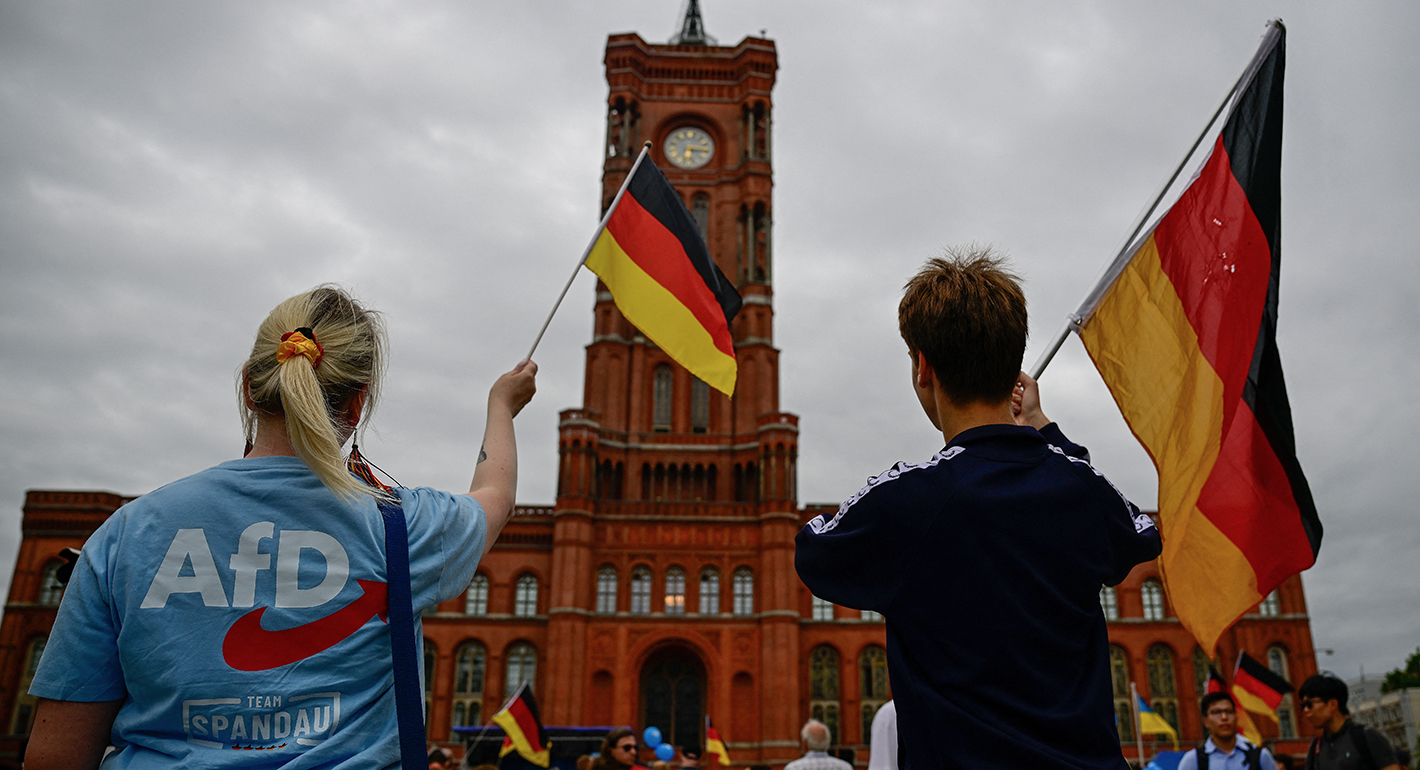
Unresolved tensions within the AfD may ultimately constrain the its potential as a leader among European and global populist forces.
Jeremy Cliffe
There is a deeply rooted assumption in post–Cold War American statecraft that overwhelming military and economic power translates directly into favorable political outcomes. But force alone is rarely enough. To meet the challenges of the mid-21st century, Washington needs a cultural shift toward a mindset that takes negotiation far more seriously.

Cecily Brewer