

Commentary
Sarah Chayes
{
  "authors": [
    "Sarah Chayes"
  ],
  "type": "legacyinthemedia",
  "centerAffiliationAll": "dc",
  "centers": [
    "Carnegie Endowment for International Peace"
  ],
  "collections": [
    "Anti-Corruption",
    "U.S. Democracy in Comparative Perspective"
  ],
  "englishNewsletterAll": "democracy",
  "nonEnglishNewsletterAll": "",
  "primaryCenter": "Carnegie Endowment for International Peace",
  "programAffiliation": "DCG",
  "programs": [
    "Democracy, Conflict, and Governance"
  ],
  "projects": [],
  "regions": [
    "North America",
    "United States"
  ],
  "topics": [
    "Political Reform",
    "Democracy",
    "Foreign Policy"
  ]
}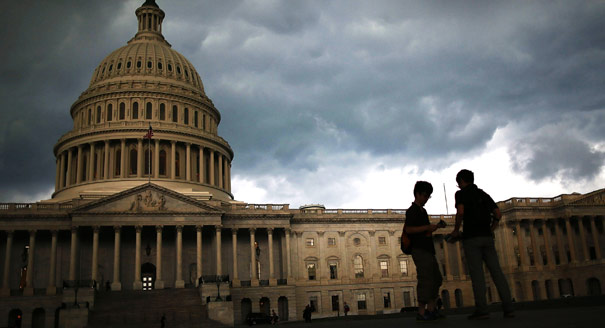
Source: Getty
In a country full of sophisticated lawyers and lobbyists and rationalizers, it is now urgent to ask whether Americans still understand what corruption is. To say it’s what is proscribed by law is to fall into a logical sinkhole.
Source: Foreign Policy
I have an odd perspective on the election of Donald Trump: a warped kind of déjà vu. For the past decade, I’ve worked on the issue of corruption around the world. In particular, I’ve spent a lot of time explaining that people who live in structurally corrupt political and economic systems are sometimes driven to extremes. I have always understood that the analysis was relevant in the United States — just maybe not how relevant.
In the past 10 years, populations have rejected “rigged systems” that had stood for decades. They have risen up in mass protests in Brazil, Guatemala, South Africa, and South Korea. They have overthrown their governments in open insurrections like the Arab Spring and Ukraine’s Maidan. Or they have fallen in behind self-proclaimed Robin Hoods such as Venezuela’s Hugo Chávez. Occasionally, they have joined violent religious movements like the Islamic State or Boko Haram.
With Trump’s election, the United States just joined this list.
It might make his voters uncomfortable to hear that they’ve behaved much as my former neighbors in Kandahar, Afghanistan, who re-embraced the Taliban in their disgust at the corruption of Hamid Karzai’s government. Hillary Clinton voters might be equally upset to consider the degree to which the United States has come to resemble that regime or those of other corrupt countries I have been studying.
We Americans may not be subjected to shakedowns by the police, the judge, or the county clerk. But consider current realities: Networks that weave together public officials and business magnates (think the food or energy industries, pharmaceuticals, or Wall Street) have rewritten our legislation to serve their own interests. Institutions that have retained some independence, such as oversight bodies and courts, have been deliberately disabled — starved of operating funds or left understaffed. Practices that, while perhaps not technically illegal, clearly cross the line to the unethical, the inappropriate, or the objectively corrupt have been defended by those who cast themselves as bulwarks of reason and integrity.
How many of us have said — in any meaningful way — “That’s a red line!”? Who among us refused, in the end, to take the money or make the excuses?
For me, the seminal moment came on June 27, when the Supreme Court overturned former Virginia Gov. Bob McDonnell’s conviction on corruption charges. A businessman had lavished luxury travel, designer clothes, a Rolex watch, and tens of thousands of dollars on McDonnell and his wife, apparently in return for their help persuading public universities to perform clinical trials on his company’s tobacco-based anti-inflammatory supplement.
The Supreme Court’s decision was unanimous. Not one of the eight justices could come up with a reason why such behavior might violate the law. None even thought the matter significant enough to warrant separate comment or a cry to our collective conscience: “Given the wording of the statute, I had to vote this way. But the legal definition of corruption has grown too narrow. These statutes had better change if America as we know it is to survive.”
Subsequent commentary was signally lacking in outrage. On NPR’s The Diane Rehm Show that day, for example, the guests (two legal scholars and a journalist) practically skipped over the McDonnell decision. Rehm had to push them to grapple with it. Their consensus seemed to be that if the standard enshrined in the lower court’s decision to convict McDonnell were to prevail, every politician in Washington would be liable.
Well, exactly.
These are moral issues. And the very laws we depend on to enforce what should be bedrock standards have sometimes undermined them. Do we reject corruption? Of course we do — just as we refuse to countenance torture. But then come the legal definitions. What counts as torture? How bad does it have to hurt? What do you mean by corruption? The head of an Egyptian business association once told me: “That’s part of the brilliance of corruption in Egypt; they make it legal!” The United States is going down the same road: The laws we hold so dear have narrowed the definition of corruption almost to the point of irrelevance.
Two candidates — Bernie Sanders and Donald Trump — made the word “corruption” central to their campaigns. Together they drew easily more than half of votes cast. Yet to use this word to describe America remains almost taboo in polite circles. In the hundreds of pages of post-election commentary, how often has it been emphasized?
One remark from 2013 says a lot about what has befallen America. When then Salon writer Alex Pareene described some of JPMorgan Chase’s practices as corrupt, CNBC host Maria Bartiromo slapped him down. “Should we talk about the financial strength of JPMorgan, at this point?” she wondered. “Even with all of these losses, the company continues to churn out tens of billions of dollars in earnings and hundreds of billions of dollars in revenue. How do you criticize that?”
Indeed. How do you criticize money these days?
In a country full of sophisticated lawyers and lobbyists and rationalizers, it is now urgent to ask whether we still understand what corruption is. To say it’s what is proscribed by law is to fall into a logical sinkhole.
What does corruption mean when a senior public official receives gifts from foreign leaders, via an institution bearing her name, while she is making decisions regarding these same foreign leaders? How should someone like me talk about corruption overseas when five different police departments use force against peoples whose lands were stolen through repeated treaty violations, on behalf of a private company pleading the letter of property laws?
What is the definition of corruption when a bank defrauds millions of customers without losing its license? When 2 million American adults are behind bars for trivial offenses, their lives permanently derailed, while no legal institution has punished any executive for bringing about the collapse of the world economy?
It’s time to see past the rationales and the rhetoric. No matter who won our vote, we must come to grips with these questions.
Whatever our affiliation or walk of life, we must also, each of us, discover and hold on to that dividing line that marks off the reasonable compromises from the unacceptable.
For, like the people of Mosul in Iraq or northern Nigeria, who traded intolerably corrupt regimes for Islamist crusaders who were worse, Americans will wake up in January under a system that is more corrupt than the one that fueled their rebellion. That is the irony of resorting to a wrecking ball to bring down a corrupt regime. Too often, the kleptocratic networks prove resilient, while those who revolted end up with crushed heads.
Already, President-elect Trump’s questionable affiliations and potential conflicts of interest — as genteel vocabulary would have it — are making headlines. The issue is not one of technical legality or poor vetting. His actions and associations are deliberate. While tweeting out distractions to disguise the fact, he will unleash a feeding frenzy. Our laws and institutions will be bent to the purposes of personal enrichment. Industry lobbyists will draft the bills. He will negotiate business deals with foreign counterparts, confusing his personal interests for the good of the nation. Agencies that try to hold the line will see their budgets slashed, their officials belittled in public. Law enforcement will be even more selective than it is today. The labor of human beings, the land, and what’s on it or under it will be converted to cash as efficiently as possible. And what can’t be converted will be bulldozed out of the way.
And what will Americans do in the face of this exacerbation of our own brand of corruption? Will we further relax our standards, shrugging our shoulders and referring to the letter of ever-changing laws? Or will we reach for a definition of corruption that is in line with common sense and rebuild our foundations upon that bedrock?
Our answer to that challenge will determine whether this is a crisis the United States survives and from which it emerges renewed — or whether we lurch into some more violent and damaging cataclysm.
Former Senior Fellow, Democracy, Conflict, and Governance Program
Sarah Chayes is internationally recognized for her innovative thinking on corruption and its implications. Her work explores how severe corruption can help prompt such crises as terrorism, revolutions and their violent aftermaths, and environmental degradation.
Recent Work
Sarah Chayes
Carnegie does not take institutional positions on public policy issues; the views represented herein are those of the author(s) and do not necessarily reflect the views of Carnegie, its staff, or its trustees.
Ultimately, Zelensky sided neither with the reform camp nor with the military establishment as such, but with political control.

Balázs Jarábik
Despite the agreement’s uncertainty, it’s still a significant development in regional and nuclear policy.


Andrew Leber, Jane Darby Menton
“AI safety in parallel” is modest and pragmatic but vital.

Matt Sheehan

Trump is distracted and Ukraine wants Europe to step up. The continent’s leaders must find their voice and assert it in talks with Russia.

Alissa de Carbonnel
Unresolved tensions within the AfD may ultimately constrain the its potential as a leader among European and global populist forces.
Jeremy Cliffe