

Paper
James M. Acton, Ankit Panda
{
  "authors": [
    "James M. Acton"
  ],
  "type": "legacyinthemedia",
  "centerAffiliationAll": "dc",
  "centers": [
    "Carnegie Endowment for International Peace"
  ],
  "collections": [
    "U.S. Nuclear Policy",
    "Korean Peninsula"
  ],
  "englishNewsletterAll": "ctw",
  "nonEnglishNewsletterAll": "",
  "primaryCenter": "Carnegie Endowment for International Peace",
  "programAffiliation": "NPP",
  "programs": [
    "Nuclear Policy"
  ],
  "projects": [],
  "regions": [
    "North America",
    "United States",
    "East Asia",
    "North Korea"
  ],
  "topics": [
    "Foreign Policy",
    "Nuclear Policy",
    "Arms Control"
  ]
}
Source: Getty
President-Elect Donald Trump appears to have drawn a red line against North Korea’s acquiring the capability to threaten the United States with a nuclear-armed ballistic missile. Can he enforce it?
Source: Atlantic
It was only eight years ago that the United States had just one president at a time. Yet those days have felt much more distant over the past two months as the president-elect, Donald Trump, has set about merrily reshaping U.S. policy 140 characters at a time.
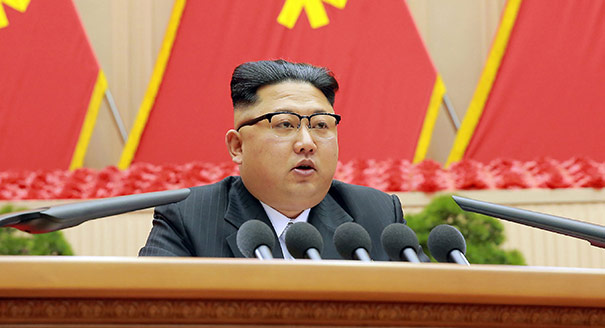
Tuesday evening saw what might turn out to be one of his more consequential Twitter proclamations. In a New Year’s address, North Korea’s supreme leader, Kim Jong Un, had stated that his country had “entered the final stage of preparation for the test launch of intercontinental ballistic missile.” In response, Trump tweeted that “North Korea just stated that it is in the final stages of developing a nuclear weapon capable of reaching parts of the U.S. It won't happen!”
If Trump’s tweet is to be taken literally—and perhaps, as the saying goes, it should be taken seriously but not literally—he appears to have committed to preventing Kim from acquiring the capability to threaten the United States with a nuclear-armed missile, as opposed to necessarily stopping the test that Kim says he is planning. Yet, regardless of Trump’s actual intentions, the tweet could come to be seen as a “red line” and hence set up a potential test of his credibility. Much will depend, of course, on whether Trump subsequently doubles down on his pledge, but now that the tweet is out there, he has only limited influence on how it is viewed by North Korea, U.S. allies, and the American people.
Past U.S. presidents have discovered that red lines against North Korea are easy to set but difficult to enforce. On June 29, 2006, when North Korea was preparing to test another long-range missile, President George W. Bush declared that launching it would be “unacceptable.” Not only did Pyongyang go ahead with the launch anyway, but it did so on July 4.
North Korea crossed other U.S. red lines too that year. In October, Pyongyang conducted its first nuclear test in spite of a warning by Bush, a year earlier, that “a nuclear-armed North Korea will not be tolerated.” The United States has been putting up with the Kim dynasty’s possession of nuclear weapons ever since.
Over the last year, North Korea’s weapon-development efforts have made significant progress due to an unprecedented level of testing. Unless those efforts are somehow checked, there can be little doubt that, even without foreign assistance, they will result in a nuclear-armed intercontinental ballistic missile (ICBM)—though there is some uncertainty about timing.
It is difficult to conceive how Trump could enforce his red line—if that is what he decides to do—without ultimately reaching a negotiated settlement or authorizing large-scale military action. The other policy tools he might try to wield—economic sanctions, pressure from China, military threats, and even limited strikes (such as blowing up a missile on the launch pad)—are not ends in themselves. They might be able to provide the United States with leverage at the negotiating table. If they don’t, they could provide justification for a major attack. By themselves, however, they cannot deny North Korea a nuclear-armed ICBM indefinitely.
Large-scale military action would be fraught with risks, of which two stand out. First, strikes against North Korean long-range missiles and their production infrastructure—the absolute minimum target set required to enforce Trump’s red line—would risk terrible retaliation. Seoul, for example, is within reach of a prodigious quantity of North Korean artillery. U.S. bases in Japan could be hit by medium-range North Korean missiles, some of which may already be nuclear-armed. Broadening the target set to include more North Korean military assets would merely increase Pyongyang’s incentives to employ whatever survived in even less discriminate ways. Second, after a strike, North Korea could—and almost certainly would—attempt to rebuild its missile force. As a result, the United States would either need to occupy the country or else launch periodic strikes to “mow the grass.”
Diplomacy, then, is the better option, though “better” is a relative term. In theory, Trump’s goal could be met if North Korea agreed to suspend nuclear and long-range missile tests in return for some to-be-negotiated concessions from the United States. This approach would stop North Korea from developing a nuclear-armed ICBM through trial and error. And, while it would not stop theoretical and laboratory-scale research, it would severely curtail the reliability of any resulting weapon.
In practice, the challenges to even reaching—let alone enforcing—a deal are manifold. For starters, it is far from clear that North Korea actually wants a deal, at least at any price that the United States and its allies might be willing to pay. Diplomacy would probably be more difficult if North Korea asked—as it might well do—for an end to joint U.S.-South Korean military exercises or a peace treaty to replace the armistice that stopped the Korean War but didn’t formally end it, as opposed to economic aid. In return for such security-related concessions, South Korea might want much more on disarmament from North Korea than just a testing moratorium—though how much Trump would take Seoul’s concern into account is an open question.
Moreover, even if a reasonable quid pro quo can be reached, there is the surprisingly thorny question of how to define a long-range missile. On February 29, 2012, Pyongyang agreed to a moratorium on nuclear and long-range missile tests (among various other measures) in return for food aid from the United States. Only 16 days later, North Korea announced plans for a satellite launch, which the United States argued was an ICBM test in disguise. The deal fell apart shortly thereafter.
Then there is the challenge of negotiating the timetable for the deal’s implementation. To maintain as much leverage over North Korea as possible, the United States is likely to want to provide whatever concessions it agrees to make only after a prolonged period of compliance by Pyongyang. North Korea is likely to argue that it can’t trust Washington to cough up later and that it should be rewarded early.
Yet in spite of these and other challenges, there is really very little reason for the great dealmaker not to try his hand at diplomacy with Pyongyang. In the very best case, he could prevent the emergence of a grave new threat to the United States indefinitely. More plausibly, he could delay it by a few, potentially valuable years. Even in the all-too-probable worst case—that no deal is reach or it falls apart almost immediately—it is hard to see what the United States would lose from trying. Besides, if it all goes wrong and North Korea successfully demonstrates a nuclear-armed ICBM, Trump could always just deny he said it wouldn’t happen.

Jessica T. Mathews Chair, Co-director, Nuclear Policy Program
Acton holds the Jessica T. Mathews Chair and is co-director of the Nuclear Policy Program at the Carnegie Endowment for International Peace.
Recent Work

James M. Acton, Ankit Panda
James M. Acton
Carnegie does not take institutional positions on public policy issues; the views represented herein are those of the author(s) and do not necessarily reflect the views of Carnegie, its staff, or its trustees.

The acknowledgment has sparked fears of a new arms race with China and Russia.

Chris O’Meara

Smaller powers cannot go it alone, but Canadian history shows that integration with the United States will not always be benign.
Paul Samson

The European Commissioner for Trade is headed to China. But after President Xi’s bridge-building visit to Washington, can a more isolated EU overcome Beijing’s stranglehold on critical raw materials? Who will blink first?

Rym Momtaz, ed.
The summit may be remembered as a fatal blunder, when Washington, Beijing, and the AI industry collectively chose ceremony over action.

Jeffrey Prescott

European NATO countries are wrestling with the possibility of U.S. disengagement from the alliance. With the continent’s security increasingly uncertain, governments must restore the credibility of their collective defense.



Hans-Dieter Lucas, Adam Thomson, Pierre Vimont