

The return of war as the organizing factor in Middle Eastern politics has predictable consequences: governments are prioritizing regime stability and becoming averse to political and social reform.
Sarah Yerkes, Amr Hamzawy
{
"authors": [
"Michele Dunne",
"Bechir Blagui",
"Steven A. Cook"
],
"type": "legacyinthemedia",
"centerAffiliationAll": "dc",
"centers": [
"Carnegie Endowment for International Peace",
"Malcolm H. Kerr Carnegie Middle East Center"
],
"collections": [
"Arab Awakening"
],
"englishNewsletterAll": "menaTransitions",
"nonEnglishNewsletterAll": "",
"primaryCenter": "Carnegie Endowment for International Peace",
"programAffiliation": "MEP",
"programs": [
"Middle East"
],
"projects": [],
"regions": [
"Middle East",
"North Africa",
"Egypt",
"Libya",
"Tunisia",
"Syria",
"Yemen",
"Gulf",
"Levant",
"Maghreb"
],
"topics": [
"Political Reform",
"Democracy"
]
}Source: Getty
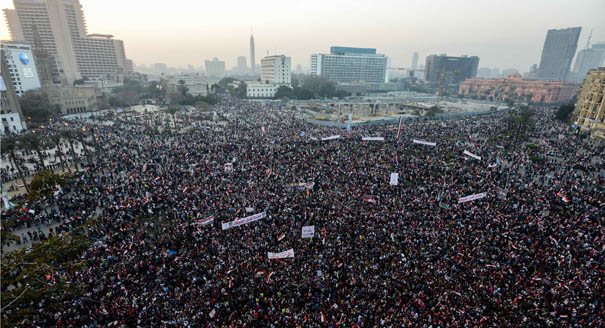
The Arab Spring protests upended the order of the Middle East, but six years later much remains the same.
Source: KPCC's AirTalk
Six years after the start of the Arab Spring, the Middle East still faces a crisis of governance and the post-colonial economic and political model on which much of the region was built has crumbled. Speaking with KPCC’s AirTalk, Carnegie’s Michele Dunne discussed the trajectory of the Middle East and the effects of the 2011 uprisings. She remarked that the most recent wave of uprisings, many of which ended tragically, is one among several coming waves of change in the region.
Former Nonresident Scholar, Middle East Program
Michele Dunne was a nonresident scholar in Carnegie’s Middle East Program, where her research focuses on political and economic change in Arab countries, particularly Egypt, as well as U.S. policy in the Middle East.
Bechir Blagui
Steven A. Cook
Carnegie does not take institutional positions on public policy issues; the views represented herein are those of the author(s) and do not necessarily reflect the views of Carnegie, its staff, or its trustees.
The return of war as the organizing factor in Middle Eastern politics has predictable consequences: governments are prioritizing regime stability and becoming averse to political and social reform.
Sarah Yerkes, Amr Hamzawy
The Africa Technology Policy Tracker reveals policymakers’ priorities for the continent’s digital transformation.
Jane Munga
The future looks bleak for independent media worldwide, but there is a robust infrastructure of knowledge, organizations, and people to build upon.
Daniel Sabet, Susan Abbott
Why the Iran ceasefire isn’t a quick fix to the Strait of Hormuz energy crisis.
Helima Croft, Aaron David Miller
Spot analysis from Carnegie scholars on events relating to the Middle East and North Africa.
Michael Young