

Commentary
Michael Young
{
  "authors": [
    "Michael Young"
  ],
  "type": "legacyinthemedia",
  "centerAffiliationAll": "dc",
  "centers": [
    "Carnegie Endowment for International Peace",
    "Malcolm H. Kerr Carnegie Middle East Center"
  ],
  "collections": [],
  "englishNewsletterAll": "menaTransitions",
  "nonEnglishNewsletterAll": "",
  "primaryCenter": "Malcolm H. Kerr Carnegie Middle East Center",
  "programAffiliation": "MEP",
  "programs": [
    "Middle East"
  ],
  "projects": [],
  "regions": [
    "Levant",
    "Israel",
    "Palestine",
    "North America",
    "United States",
    "Middle East"
  ],
  "topics": [
    "Political Reform"
  ]
}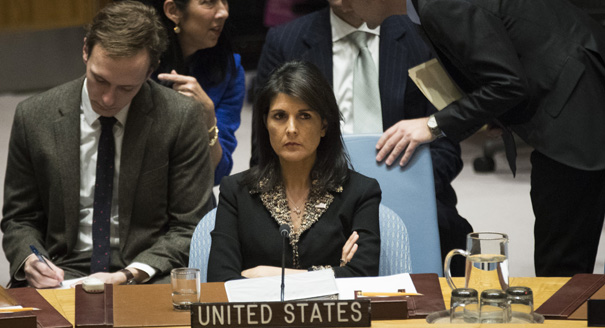
Source: Getty
Trump’s decision on Jerusalem only came after multiple US decisions that redefined Resolution 242, which affirms the “inadmissibility of the acquisition of territory by war”.
Source: The National
When Israel and its supporters have defended US president Donald Trump’s decision to move the US embassy from Tel Aviv to Jerusalem, their main argument has been that Washington only recognised a reality that had long been true – namely that Israel’s governing institutions were located in the latter city.
However, the argument is without merit when it comes to East Jerusalem, which was occupied during the June 1967 Arab-Israeli war. In seeking recognition for a united Jerusalem, the Israeli state has ignored the text of United Nations Security Council Resolution 242, which affirms the “inadmissibility of the acquisition of territory by war”. In failing to clearly distinguish between East and West Jerusalem, the Trump administration made its own position on the resolution consciously vague, further undermining this text of international law.
By way of contrast, the Eisenhower administration took a very different tack after the 1956 Suez Crisis, when Israel occupied the Sinai Peninsula and Gaza. Despite strong Israeli opposition to withdraw from the territories, then president Dwight Eisenhower compelled the Israelis to pull their troops out in March 1957.
As Mr Eisenhower put it at the time: “Should a nation which attacks and occupies foreign territory in the face of United Nations disapproval be allowed to impose conditions on its own withdrawal? If we agreed that armed attack can properly achieve the purposes of the assailant, then I fear we will have turned back the clock of international order.”
That conclusion has been lost on Mr Trump. Today one can apparently acquire land through conquest, then see this legitimised. Yet in many respects, the behaviour of the US administration is more complicated than the decision on Jerusalem would suggest. To say that Mr Trump destroyed the peace process would be inaccurate. The peace process had been dead for years, and Resolution 242, on which it was founded, has been eroded by the US over decades.
Since the early 1970s, the United States has taken positions on Resolution 242 that were designed to qualify its conditions. In July 1970, the Nixon administration, in a letter to then Israeli prime minister Golda Meir, promised that the United States would not insist on Israel accepting the Arab definition of Resolution 242. To the Arabs, as well as to many other countries which endorsed the UN decision, Israel was obligated to withdraw from all of the territories occupied in 1967. Washington’s position potentially gave Israel the latitude to engage in a lesser withdrawal than that demanded by its enemies.
At the time the US position, which had been outlined in the Rogers Plan, proposed by then secretary of state William Rogers, was that because the 1967 borders had been defined by the 1949 armistice agreements, they were not final. Yet while acknowledging that there could be adjustments to final borders because of security needs, the US also emphasised that the new borders should not reflect the results of conquest. The Meir letter did not contradict the Rogers Plan but by questioning the scope of the intended withdrawal, it implicitly expanded Israel’s margin of manoeuvre to redraw borders to accommodate areas acquired through war.
In February 1972, the US also agreed a memorandum of understanding with Israel, in which it affirmed that Israel did not need to agree to a full withdrawal from the occupied territories as part of any interim agreement. Effectively, this meant that Israel could enter into negotiations with the Arab states without committing itself to a complete withdrawal as a final outcome. Again, this gave the Israelis considerable room in any future talks with the Arabs.
A further concession – and a major one – was made when Washington agreed not to undertake any actions to advance Middle Eastern peace without first discussing it with Israel. What this did was to give Israel virtual veto power over any American diplomatic steps that it might find objectionable.
While none of these commitments entirely neutralised Resolution 242, taken together they undeniably watered down, in a bilateral US-Israeli format, a UN decision taken by the more widely representative Security Council. Over the years, the initial US willingness to allow for a limited modification of borders for security purposes expanded to a readiness to accept much more substantial changes, albeit ones where there might be compensatory land swaps.
In other words, Mr Trump’s decision on Jerusalem, no matter how objectionable, only came after multiple US decisions that redefined Resolution 242. Over the decades this gave Israel the leeway to build illegal settlements in the West Bank, change the status of Jerusalem in contravention to UN Security Council Resolution 478 (made in 1980), annex the Golan Heights and effectively turn Resolution 242 into an increasingly empty text, except with regard to the Sinai Peninsula.
This hardly makes Mr Trump less culpable but it does suggest that as the United States has spoken of a two-state solution over the past two and a half decades, it has also laid the groundwork to ensure that such an outcome would become impossible. What the US president did recently was only help dispel a mirage.
It’s not surprising that Palestinians are now speaking of a one-state solution to end their conflict with Israel. Let the Americans try to resolve that conundrum. After all, they made all other alternatives so much more improbable.

Editor, Diwan, Senior Editor, Malcolm H. Kerr Carnegie Middle East Center
Michael Young is the editor of Diwan and a senior editor at the Malcolm H. Kerr Carnegie Middle East Center.
Recent Work
Michael Young
Michael Young
Carnegie does not take institutional positions on public policy issues; the views represented herein are those of the author(s) and do not necessarily reflect the views of Carnegie, its staff, or its trustees.
AI capabilities are moving fast. Most institutions—including governments—can’t keep up.


Anton Leicht, Scott Singer

The Bureau of Industry and Security needs to adjust its focus and practices to maintain its position as the U.S. government’s primary champion of international technological competition.
Geoffrey Irving

European Commission President Ursula von der Leyen is about to give her annual address on the state of the EU. Here’s what she won’t—but should—say.

Rym Momtaz
It is improbable that Israel’s forthcoming elections will alter much in terms of how the country thinks about security.

Nathan J. Brown

Understanding the climatic pain points is necessary for policymakers hoping to minimize the war’s negative environmental consequences.



Alejandro Martin Rodriguez, Joy Arkeh, Sarah Yerkes