

Commentary
- +11
Cornelius Adebahr, Dan Baer, Rosa Balfour, …
{
  "authors": [
    "Erik Brattberg"
  ],
  "type": "legacyinthemedia",
  "centerAffiliationAll": "dc",
  "centers": [
    "Carnegie Endowment for International Peace",
    "Carnegie Europe"
  ],
  "collections": [
    "Transatlantic Cooperation",
    "European Defense in a New Transatlantic Context"
  ],
  "englishNewsletterAll": "ctw",
  "nonEnglishNewsletterAll": "",
  "primaryCenter": "Carnegie Endowment for International Peace",
  "programAffiliation": "EP",
  "programs": [
    "Europe"
  ],
  "projects": [],
  "regions": [
    "North America",
    "United States",
    "Western Europe",
    "Europe",
    "Iran"
  ],
  "topics": [
    "Security",
    "Foreign Policy"
  ]
}
Source: Getty
If the international system is moving toward great-power competition, having a Europe that is more integrated, including on defense issues, and better able to withstand pressure from Russia and China ultimately serves America’s own interest.
Source: American Interest
Considering the slew of negative things Donald Trump has uttered about Europe and NATO both prior to and since his election, the U.S. Administration’s new National Security Strategy (NSS) and National Defense Strategy (NDS) should be welcomed by its European allies and partners. Although starkly different in tone from the Obama Administration’s strategic outlook, both these documents are surprisingly “un-Trumpian” on several matters concerning European security.
The main takeaway of the NSS and NDS is that the global landscape is increasingly marked by strategic competition, especially with China and Russia. The NDS puts it plainly: “Inter-state competition, not terrorism, is now the primary concern in U.S. national security.” European capitals concerned that President Trump still harbors positive views about Russia should be thankful that the Administration now officially considers Russia a revisionist power and a challenge to American interests.
Moreover, both the NSS and NDS offer a clear endorsement of America’s traditional alliances. The NSS acknowledges the importance of allies and partners to advancing “U.S. interests and help[ing] push back against U.S. strategic competitors.” Indeed, the word “allies” is mentioned 78 times throughout the document, far more than in the 2015 Obama version. In a similar fashion, the NDS states that the U.S. “network of alliances and partnerships remain the backbone of global security.” Both documents make a case for active U.S. engagement in Europe, with the NSS noting that “a strong and free Europe is of vital importance to the United States.”
Also notable is that the NSS and the NDS offer unequivocal support for NATO and commit to upholding the alliance’s Article 5, an issue that has visibly plagued the Transatlantic relationship since Donald Trump announced his candidacy. Even the language on defense spending is somewhat milder in tone than what European leaders have been used to hearing from Trump. Both documents make clear that the U.S. “expects” European allies to fulfill their defense spending commitments, but thankfully avoid the mistake of conditioning U.S. support upon said fulfillment.
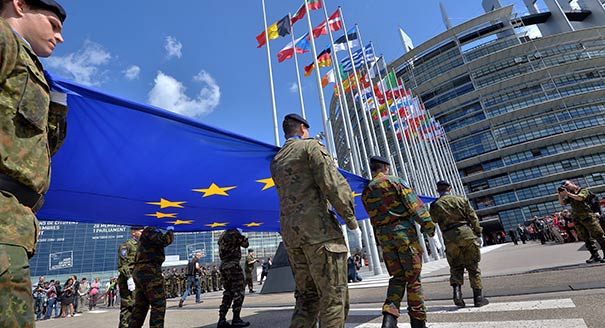
However, a subtle but important shortcoming of both strategic texts is their failure to acknowledge ongoing European efforts not only to spend more on defense but also to give the European Union a greater role in the continent’s defense affairs. While there is a long-standing tendency in Washington to approach EU defense cooperation with disinterest and skepticism, often for good reasons, the Trump Administration seems to go even further by downplaying or even ignoring the role of the European Union altogether. For example, Secretary of State Rex Tillerson’s November speech on the Administration’s policy towards Europe and Transatlantic relations barely mentioned the European Union at all. This is unfortunate. If, as the new strategic documents suggest, the international system is indeed moving toward great-power competition, having a Europe that is more integrated, including on defense issues, and better able to withstand pressure from Russia and China ultimately serves America’s own interest. The United States should therefore support the European Union to help itself.
The fact is that over the past year, European defense collaboration has made significant strides, notably including the creation of Permanent Structured Cooperation (PESCO) and the European Defence Fund (EDF). PESCO encourages smaller constellations of likeminded EU countries to team up on developing capabilities and increasing operational ability. The EDF allocates significant EU Commission funding toward common defense projects and can provide new incentives for cooperation on innovation and defense industrial consolidation. These and other ongoing efforts are part of a comprehensive yet pragmatic approach to the EU defense dimension that seeks to utilize different EU instruments to build national capabilities. The idea is that these capabilities can then be used for deterrence and operations either on behalf of the European Union and NATO or in another format (such as a coalition or a UN-operation).
Crucially, unlike past attempts to deepen European defense, there seems to be both genuine political will and a sense of urgency this time around. While many of the current initiatives pre-date the election of Donald Trump, uncertainty regarding U.S. foreign policy and Trump’s erratic leadership has certainly intensified the demand for alternatives for European security. On top of this, Brexit and the election of the overtly pro-European Emanuel Macron in France have added a new dynamic. The United Kingdom is no longer blocking EU defense initiatives and Macron’s seminal speech at the Sorbonne in September 2017, laying out his vision for Europe, included a clarion call for a more ambitious EU defense.
Even NATO seems to welcome a stronger European pillar. Today, it is widely recognized that both organizations play crucial and complementary roles in providing for European security. Assuming that EU initiatives are correctly implemented and sufficiently integrated with NATO efforts to avoid duplication, this should be precisely what the United States and the Trump Administration are calling for—a Europe that assumes more responsibility for its own security matters.
While it is still too early to tell what real-life impact these EU defense initiatives will have, dismissing them outright would be a mistake. Not only can EU defense collaboration provide a vehicle for greater collaboration between European states on specific projects, it can also justify an increase in defense spending for skeptical governments like Germany’s. Examples of areas where the European Union can make practical contributions to broader Transatlantic security efforts include counterterrorism and addressing hybrid warfare (a new EU Counter-Hybrid Threats Center in Helsinki was set up last year). The European Union is also promoting the concept of “military Schengen” to allow for greater freedom of movement across Europe for NATO reinforcements, a high priority in ensuring credible deterrence against Russia in areas like the Baltic states. Finally, having Europe assume more responsibility, particularly in its own southern neighborhood, should be a welcome development for Washington, allowing it to devote its attention and resources to other problems, such as managing China and Russia.
The post-Cold War Transatlantic security bargain used to be that Europe would help maintain global security in exchange for a continued U.S. commitment to European security. While this is still welcomed by Washington, a stronger European pillar within NATO is now also necessary to keep the United States present and engaged on the continent. A balanced approach that seeks to promote deeper European defense cooperation through practical measures while safeguarding NATO as the bedrock of European security is the right way forward. The failure to encourage such a development in the National Security Strategy and the National Defense Strategy was a missed opportunity. The next NATO summit in Brussels in 2018 provides an excellent forum for the Trump Administration to reverse it.
This article was originally published in the American Interest.

Former Director, Europe Program, Fellow
Erik Brattberg was director of the Europe Program and a fellow at the Carnegie Endowment for International Peace in Washington. He is an expert on European politics and security and transatlantic relations.
Recent Work



Cornelius Adebahr, Dan Baer, Rosa Balfour, …

Erik Brattberg, Philippe Le Corre, Paul Stronski, …
Carnegie does not take institutional positions on public policy issues; the views represented herein are those of the author(s) and do not necessarily reflect the views of Carnegie, its staff, or its trustees.

Japan’s long-term security policy is driven by concerns about China, and there is little appetite for (or interest in) pursuing a confrontation with Moscow.

James D.J. Brown

Russia is testing the waters of NATO’s mutual defense clause. What do strikes in Romanian territorial waters mean for the alliance’s posture toward Moscow?

Dimitar Bechev
Why Pakistan, Saudi Arabia, and Turkey are joining forces on regional security.


Alper Coşkun, Amr Hamzawy

The truth of the strategic situation is that Europe and Russia are extremely unlikely to be able to “turn the page” on their confrontation within the next two decades.

Arkady Moshes

Protests in Iran follow a similar pattern: Economic grievances turn into political protests that spread nationwide. But increased state repression has begun to shift the arrangement.

Eric Lob