

Report
- +2
George Perkovich, Jessica Tuchman Mathews, Joseph Cirincione, …
{
  "authors": [
    "Jon Wolfsthal"
  ],
  "type": "legacyinthemedia",
  "centerAffiliationAll": "dc",
  "centers": [
    "Carnegie Endowment for International Peace"
  ],
  "collections": [
    "Iranian Proliferation"
  ],
  "englishNewsletterAll": "ctw",
  "nonEnglishNewsletterAll": "",
  "primaryCenter": "Carnegie Endowment for International Peace",
  "programAffiliation": "NPP",
  "programs": [
    "Nuclear Policy"
  ],
  "projects": [],
  "regions": [
    "Middle East",
    "Iran"
  ],
  "topics": [
    "Foreign Policy",
    "Nuclear Policy"
  ]
}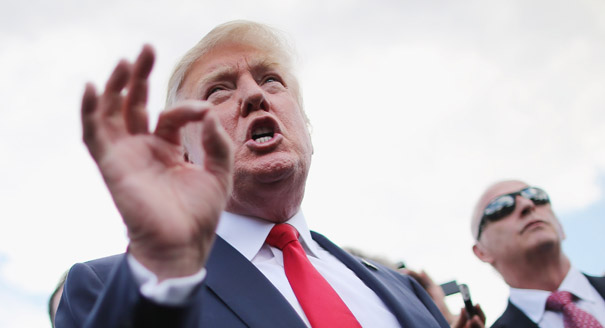
Source: Getty
The U.S. violation of the Joint Comprehensive Plan of Action (JCPOA) gives Iran more nuclear options, and the West less control. Here is what President Trump is throwing away by scrapping the Iran nuclear deal.
Source: New Republic
I am biased. I worked for President Obama, supporting the negotiations that produced the Iran deal President Trump now plans to scrap. On the other hand, laboring on nuclear arms control for three decades, including as an inspector in North Korea and as an observer at Iranian nuclear facilities, also gives you a perspective that people who don’t read nuclear manuals at home (a solid mental health choice) sometimes lack.
For those that have never read the actual text of the Joint Comprehensive Plan of Action (JCPOA) or are less familiar with nuclear inspections, here’s what President Trump is throwing away.
Before the JCPOA came into force, Iran had close to 20,000 uranium enrichment machines, called centrifuges, in operation. Most of these were primitive, but some were more advanced models and the pace of advancement was accelerating. Under the JCPOA, Iran cannot have more than 5,060 centrifuges operating and cannot use more advanced models until 2025, and then would have had to slowly introduce them and explain why they were doing so. Iran was also required to let IAEA inspectors track and monitor centrifuge production and storage of parts. That all goes away after today. Iran is within its right to reject any restrictions now that the U.S. is openly violating the deal.
Before the JCPOA entered into force, Iran had enriched some uranium up to 19 percent of uranium-235 content, i.e. where 19 percent of the uranium sample consists of the particular isotope that can be easily split (uranium-235). Natural uranium has less than 1 percent U-235, while producing weapons requires uranium enriched above 90 percent U-235. Iran also possessed large amounts of uranium gas, many times more than needed to make one nuclear weapon. Under the JCPOA, Iran is barred from enriching any uranium above 3.67 percent and from possessing more than 300 kg of uranium gas, less than the amount needed for even one bomb. Both of these restrictions were to last until 2030. Now, Iran can enrich to whatever level it wants, for any reason, and posses as much uranium gas for enrichment as they choose. This will leave Iran weeks if not days from a bomb once they restore their infrastructure.
Before the JCPOA entered into force, International Atomic Energy Agency inspectors could only visit some Iranian sites every few weeks, some every few months. Under the JCPOA, IAEA inspectors have permanent access at key sites and have installed remote sensing equipment that provides real-time data to ensure that Iran is not enriching uranium to a level higher than allowed under the deal—technology no other state maintaining nuclear facilities has ever allowed international monitors to install. Now, all of this goes away. IAEA access will be greatly reduced and the IAEA can only realistically hope to gain access to suspect or military sites if it can gain the backing of the IAEA Board of Governors and the UN Security Council. These seem unlikely and any such request could ignite a political and even military standoff.
Could Iran have sat back under these restrictions for 15 or 20 or 25 years and then just built a bomb? This was the scenario the deal’s critics focused on. But it wouldn’t have been that simple: The JCPOA bans Iran from doing any research on specific technologies needed to produce nuclear weapons. So while it is possible they could have built up stocks of uranium and a large enrichment capability, without the mechanical devices needed to produce a bomb, such work would have been somewhat useless without the auxiliary research. And any moves to do such research would have been obvious, since Iran was required under the JCPOA to adopt something known as the IAEA Additional Protocol—the gold standard in inspection rights and access that ensure the IAEA can get into facilities, interview people, and gain access to information upon request. These weapon restrictions and inspection rights, too, now go away.
These are just a few example of where Iran was before the deal, what restrictions they accepted under with the 156 pages of the JCPOA, and what they are now free to reverse at any time now that President Trump has announced the United States will violate the terms of the deal by refusing to waive sanctions. The nuclear expert in me has trouble understanding either how this state of affairs is better than what existed under the JCPOA, or how President Trump—who has defied the advice of key European allies—expects to gain broad international support for a new, tougher deal, given what will certainly be less effective sanctions and lower support from our allies than what the U.S. had leading up to the JCPOA. And for all Russia’s general hostility to NATO and misuse of the UN to protect Syria’s president Assad, we should remember that Russia supported UN sanctions against Iran and blocked the sale of advanced air defense missiles to the state. These air defense missiles have now been delivered, making U.S. military action riskier for our troops and airmen.
U.S. violation of the JCPOA gives Iran more nuclear options, and us less control and insight. Iran can be expected slowly, carefully but persistently to remove the restrictions it is now under and work toward being able to produce a nuclear weapon at a time of its choosing. This will not happen all at once, but it will happen. Europe may try to provide Iran with incentives to go slow, but in the end the death of the JCPOA leaves the United States with only two ways to stop an Iranian nuclear weapons capability—negotiate a new, better deal with less leverage (unlikely) or prepare for regular military strikes that may or may not prove able to keep Iran from the nuclear bomb.
Former Nonresident Scholar, Nuclear Policy Program
Jon Wolfsthal was a nonresident scholar with the Nuclear Policy Program.
Recent Work


George Perkovich, Jessica Tuchman Mathews, Joseph Cirincione, …
Jon Wolfsthal
Carnegie does not take institutional positions on public policy issues; the views represented herein are those of the author(s) and do not necessarily reflect the views of Carnegie, its staff, or its trustees.
Despite the agreement’s uncertainty, it’s still a significant development in regional and nuclear policy.


Andrew Leber, Jane Darby Menton
“AI safety in parallel” is modest and pragmatic but vital.

Matt Sheehan

Trump is distracted and Ukraine wants Europe to step up. The continent’s leaders must find their voice and assert it in talks with Russia.

Alissa de Carbonnel
Unresolved tensions within the AfD may ultimately constrain the its potential as a leader among European and global populist forces.
Jeremy Cliffe
There is a deeply rooted assumption in post–Cold War American statecraft that overwhelming military and economic power translates directly into favorable political outcomes. But force alone is rarely enough. To meet the challenges of the mid-21st century, Washington needs a cultural shift toward a mindset that takes negotiation far more seriously.

Cecily Brewer