• Research
  • Emissary
  • About
  • Experts
Carnegie Global logoCarnegie lettermark logo
DemocracyIran
  • Donate
{
  "authors": [
    "Julia Gurganus"
  ],
  "type": "legacyinthemedia",
  "centerAffiliationAll": "dc",
  "centers": [
    "Carnegie Endowment for International Peace"
  ],
  "collections": [],
  "englishNewsletterAll": "ctw",
  "nonEnglishNewsletterAll": "",
  "primaryCenter": "Carnegie Endowment for International Peace",
  "programAffiliation": "russia",
  "programs": [
    "Russia and Eurasia"
  ],
  "projects": [
    "The Return of Global Russia: A Reassessment of the Kremlin’s International Agenda"
  ],
  "regions": [
    "North America",
    "United States",
    "South America",
    "Russia"
  ],
  "topics": [
    "Economy",
    "Foreign Policy"
  ]
}
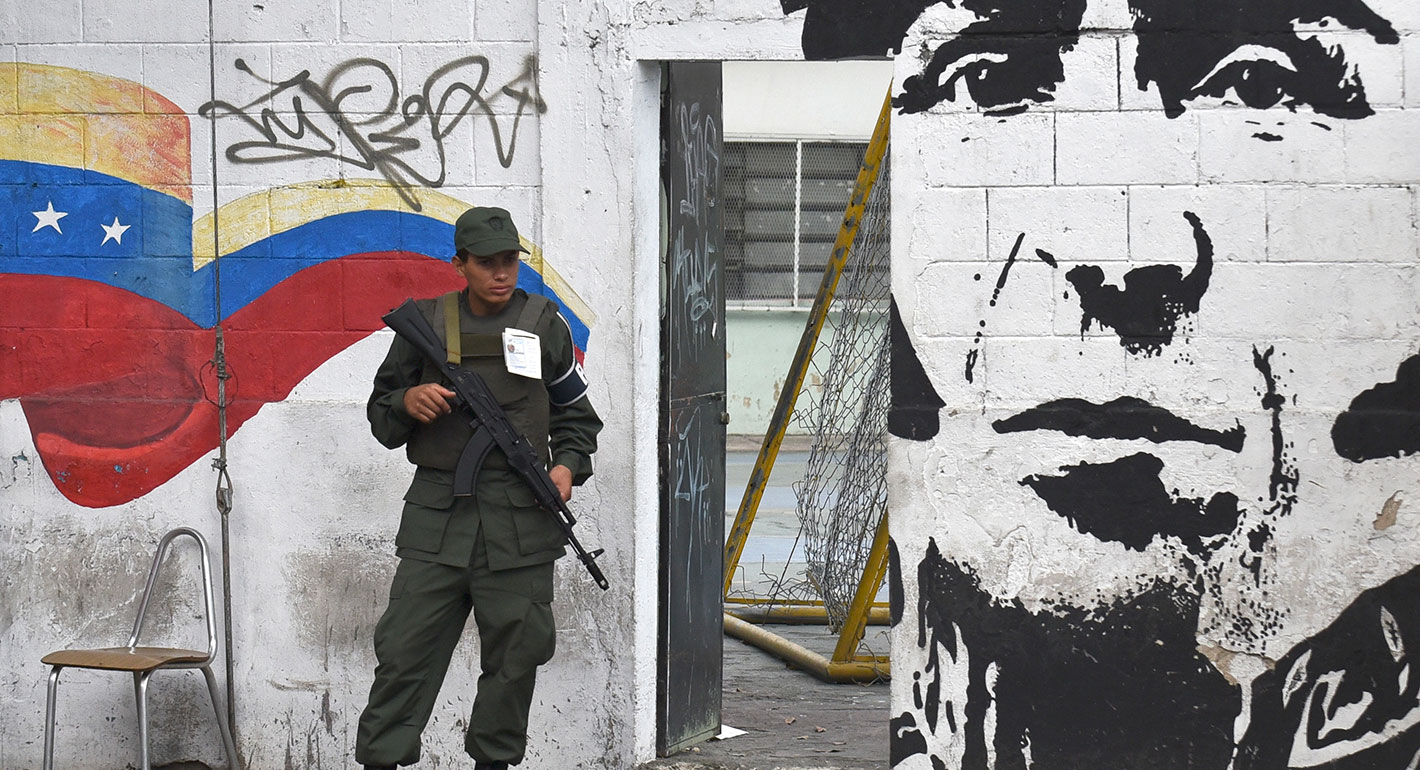
Source: Getty

In The Media

Venezuela: A New U.S.–Russia Battleground

Putin is less interested in President Nicolás Maduro and his regime than in using him as a thorn in Washington’s side. Venezuela’s crisis provides Putin with a like-minded collaborator eager to denounce the United States.

Link Copied
By Julia Gurganus
Published on May 22, 2018
Program mobile hero image

Program

Russia and Eurasia

The Russia and Eurasia Program continues Carnegie’s long tradition of independent research on major political, societal, and security trends in and U.S. policy toward a region that has been upended by Russia’s war against Ukraine.  Leaders regularly turn to our work for clear-eyed, relevant analyses on the region to inform their policy decisions.

Learn More
Project hero Image

Project

The Return of Global Russia: A Reassessment of the Kremlin’s International Agenda

The Kremlin’s activist foreign policy is expanding Russian global influence at a time when the United States and other Western countries are increasingly divided or consumed by domestic problems.  The Return of Global Russia project will examine the Kremlin’s ambitions to become a player in far-flung parts of the world where its influence has long been written off, the tools it is relying upon to challenge the liberal international order, and practical Western policy options for how and when to respond to this new challenge.

Learn More

Source: Axios

The Kremlin, buoyed by its success in helping the Assad regime stave off collapse, is trying to pull off a similar trick in a troubled part of America’s backyard: Venezuela. The Trump White House is having none of it, but a new stage is being set for U.S.–Russia confrontation.

The big picture: Putin is less interested in President Nicolás Maduro and his regime than in using him as a thorn in Washington’s side. Venezuela’s crisis provides Putin with a like-minded collaborator eager to denounce the U.S.


Vice President Pence had called for a delay ahead of Venezuela’s election this past Sunday on grounds of expected fraud. The Trump administration has used a combination of diplomatic pressure, together with other Latin American governments and Europe, and tough sanctions to isolate and push Maduro into compromising with his opponents.

Moscow responded with a full-throated embrace of Maduro and over-the-top accusations of Washington-engineered regime change. So, why does Moscow choose to back Maduro, even as Venezuela teeters on the brink of collapse? On several issues, there is a clear alignment of interests and world view:

  1. Sanctions: Moscow has long opposed sanctions as a foreign policy tool, especially from the U.S., which has recently levied several waves of individual, corporate and sectoral sanctions against Russia. The U.S. stepped up pressure on Maduro this week, announcing new sanctions that prohibit the purchase of Venezuelan government debt.
  2. Multipolarity: Moscow chafes at U.S. global leadership, and Maduro presides over a ruined economy while looking for a financial lifeline that circumvents Western institutions and sanctions. Together, the two countries look to build alternatives, such as this year’s lackluster launch of the Petro, Venezuela’s digital currency.
  3. Authoritarianism: Moscow and Caracas share an aversion to genuine democratic governance, ruling by sidelining opposition candidates, enriching their inner circles at the expense of the public good and running sham elections.
  4. Anti-U.S. stance: In recent months, Maduro and Putin have flaunted their mutual support in the face of U.S. pressure, blaming U.S. sanctions for their economic problems and using them to whip up domestic support.
  5. Money: Russia’s state oil company Rosneft has been making loans to Maduro in exchange for stakes in Venezuela’s oil. As long as Maduro is in power, Rosneft’s investment looks good.

Why it matters: If Moscow is successful in bailing out the Maduro regime, it will secure its foothold in the region.

This article was originally published by Axios.

About the Author

Julia Gurganus

Former Nonresident Scholar, Russia and Eurasia Program

Julia Gurganus was a nonresident scholar with the Russia and Eurasia Program at the Carnegie Endowment for International Peace. Her research focus is on trends in Russian foreign policy and Russia-U.S. relations.

    Recent Work
  • Paper
    Russia’s Global Ambitions in Perspective
      • Eugene Rumer

      Julia Gurganus, Eugene Rumer

  • Article
    Russia: Playing a Geopolitical Game in Latin America

      Julia Gurganus

Julia Gurganus
Former Nonresident Scholar, Russia and Eurasia Program
EconomyForeign PolicyNorth AmericaUnited StatesSouth AmericaRussia

Carnegie does not take institutional positions on public policy issues; the views represented herein are those of the author(s) and do not necessarily reflect the views of Carnegie, its staff, or its trustees.

More Work from Carnegie Endowment for International Peace

  • Commentary
    Emissary
    Russia Will Be More Dangerous After the War with Ukraine

    Putin’s blunder has created new and enduring security challenges for Russia and Europe.

      • Eugene Rumer

      Eugene Rumer

  • Ukraine's President Volodymyr Zelensky (R) and Poland's Prime Minister Donald Tusk attend a press conference at the Mariinskyi Palace in Kyiv on February 5, 2026, amid the Russian invasion of Ukraine.
    Article
    Kindred Nations, Uneasy Neighbors: Polish-Ukrainian Relations in the Crucible of Russia’s War

    The full-scale invasion cemented Ukraine’s determination to sever its ties with Russia; reimagining the Poland-Ukraine partnership can accelerate Kyiv’s westward alignment and improve the security of both countries.

      Eric Green

  • President of Argentina Javier Milei walks among supporters during his arrival to a closing campaign rally ahead the mid-term election on October 23, 2025 in Rosario, Argentina.
    Paper
    Right-Wing Populism and Strategic Realignment: Argentina’s Milei Experiment

    Argentina’s president blends libertarian populism with leader-centric diplomacy, transnational right-wing networks, and selective disengagement from multilateral institutions.

      Federico Merke

  • The tops of people's heads. Raised above their heads are "No Kings" signs, an upside-down American flag, and a rainbow flag.
    Commentary
    Emissary
    Protests Like No Kings Can Only Go So Far to Stem Authoritarianism

    Lessons from other backsliding democracies show that mass mobilization needs to feed into an electoral strategy. 

      Saskia Brechenmacher, Shreya Joshi

  • Commentary
    Southeast Asia’s Agency Amid the New Oil Crisis

    There is no better time for the countries of Southeast Asia to reconsider their energy security than during this latest crisis.

      Gita Wirjawan

Get more news and analysis from
Carnegie Endowment for International Peace
Carnegie global logo, stacked
1779 Massachusetts Avenue NWWashington, DC, 20036-2103Phone: 202 483 7600Fax: 202 483 1840
  • Research
  • Emissary
  • About
  • Experts
  • Donate
  • Programs
  • Events
  • Blogs
  • Podcasts
  • Contact
  • Annual Reports
  • Careers
  • Privacy
  • For Media
  • Government Resources
Get more news and analysis from
Carnegie Endowment for International Peace
© 2026 Carnegie Endowment for International Peace. All rights reserved.