

Article
C. Raja Mohan, Darshana M. Baruah
{
  "authors": [
    "C. Raja Mohan"
  ],
  "type": "legacyinthemedia",
  "centerAffiliationAll": "dc",
  "centers": [
    "Carnegie Endowment for International Peace",
    "Carnegie India"
  ],
  "collections": [],
  "englishNewsletterAll": "ctw",
  "nonEnglishNewsletterAll": "",
  "primaryCenter": "Carnegie India",
  "programAffiliation": "SAP",
  "programs": [
    "South Asia"
  ],
  "projects": [],
  "regions": [
    "Asia",
    "India",
    "South Asia",
    "East Asia",
    "China",
    "Russia"
  ],
  "topics": [
    "Foreign Policy",
    "Global Governance"
  ]
}
Source: Getty
With New Delhi must looking for stronger ties with both the maritime and continental powers does not mean the nature and scope of these possibilities is symmetric.
Source: Indian Express
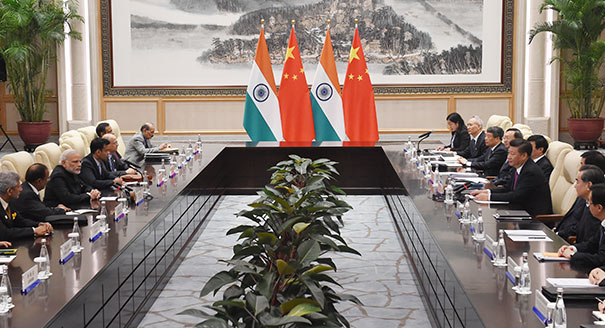
If last week was all about the Indo-Pacific, Delhi’s diplomatic focus this week is on Eurasia. In his keynote address to the Shangri La Dialogue (SLD) in Singapore, Prime Minister Narendra Modi had articulated India’s geopolitical conception of the Indo-Pacific. As India becomes a full member of the Shanghai Cooperation Organisation (SCO), the PM will have an opportunity to expand on India’s idea of Eurasia at the annual summit of the organisation in Qingdao, China.
Much like the PM’s address to the SLD, the his presentation at the SCO and the joint declaration issued there will be subject to intense scrutiny. Differences in political emphasis and diplomatic nuance in the PM’s two presentations will draw considerable attention. There is no question that India’s balancing act between the growing strategic partnership with the US on the one hand, and its renewed effort at holding onto Russia and advancing the complex relationship with China is a riveting one.
That there is structural tension between these multiple imperatives should not come as a surprise. Great power relations have entered a turbulent phase in recent years. For nearly two and a half decades after the end of the Cold War, America, Europe, Russia, China and Japan all sought to deepen economic cooperation and expand political cooperation with each other.
The Trump Administration has now called its relations with China and Russia “competitive”. Russia is at odds with Europe and China’s relations with Japan have been under stress for a while. To make matters even more complicated, Trump is quarreling — on economic and security issues — with his Western partners in G-7 and NATO.
This is a very different world than what we have known. Delhi needs to be quite nimble- footed in coping with the new dynamic among the major powers. It must also deal with the competing geopolitical frameworks in play. If the Indo-Pacific is a maritime conception, Eurasia is a continental one.
Like the two ideas — Indo-Pacific and Eurasia — the SLD and SCO are quite different. The SLD is a forum that brings together the Asian defence establishments and the strategic community. It is increasingly preoccupied with the sharpening maritime conflicts in the Indo-Pacific. The SCO is an effort by China and Russia to consolidate a continental coalition in the heart of Asia.
India is one of the few powers straddling the maritime and continental coalitions. Barely a day before PM Modi travels to the SCO summit, senior Indian officials met with their counterparts from the US, Japan and Australia in Singapore to offer a ringing endorsement of the Indo-Pacific conception. The Quad, apparently, is not quite dead. And certainly not buried.
The obsession of the commentariat with the Quad and its presumed symbolism misses the fact that India’s engagement with the US and Japan (the triad) has steadily advanced through this decade. Meanwhile, India continues to sit with the Russians and Chinese in a trilateral forum as well as the BRICS with Brazil and South Africa.
It is only those who think India must stick to one side or the other who have a problem with India’s engagement in all directions. India is not the only one that embarks on partnerships that appear contradictory. All countries do it. Pakistan, for example, has done it with some aplomb. Think of the early Cold War period when Pakistan became part of the US military alliances, but opened up a close engagement with Communist China, which was locked in a confrontation with America.
By the early 1970s, Pakistan provided the initial diplomatic bridge between America and China as they sought to normalise relations. Even today, Rawalpindi is a “major non-NATO ally” of the US. At the same time, it has a relationship with China that is “higher than the Himalayas, deeper than the Indian Ocean and sweeter than honey”. One has never heard the Chinese complaining about Pakistan’s partnership with America.
The major powers, despite the new competition between them, have not stopped finding compromises where possible. The White House National Security Strategy might talk about the competitive relationships with Moscow and Beijing, but Trump has not given up on doing deals with Russia and China.
The principal question for Indian foreign policy is not whether India should engage both sides. It is about how best it can maximise the gains in both directions. That Delhi must look for stronger ties with both the maritime and continental powers does not mean the nature and scope of these possibilities is symmetric.
Most of India’s trade, investment, technology and cultural ties are currently with the maritime powers. It is in the Western world, especially in the Anglo-Saxon states, that the Indian diaspora has flourished. The US and the European powers are also increasingly important security partners for India. When you combine this with India’s natural maritime advantages, the Indo-Pacific comes into bold relief.
The continental construct, in contrast, is about managing India’s intractable problems. Unresolved territorial disputes with China and Pakistan have resulted in the militarisation of its northern borders and blocked India’s access to the inner Asian space. Those problems are not going to disappear any time soon.
The SCO opens possibilities for limiting the conflict with China through greater regional cooperation on countering terrorism, religious extremism and pacifying conflict zones in Afghanistan and Pakistan. We are not there yet, but it is a goal we must not abandon. Meanwhile, the SCO offers a platform to construct sustained high-level engagement with Central Asia and strengthen the traditional collaboration with Russia in inner Asia.
But what about the inevitable contradictions that arise from the dual engagement? Diplomacy, in the end, is about managing contradictions. Sometimes you finesse them; on some occasions, they might simply sort themselves out. Recall that just a few months ago, the US was pressing India to cut links with the “rogue regime” of North Korea. Next week, President Trump will be sitting down with “Chairman Kim” in Singapore for what promises to be a historic encounter.
This article was originally published in the Indian Express.
Former Nonresident Senior Fellow, Carnegie India
A leading analyst of India’s foreign policy, Mohan is also an expert on South Asian security, great-power relations in Asia, and arms control.
Recent Work

C. Raja Mohan, Darshana M. Baruah


Alexander Gabuev, Paul Haenle, C. Raja Mohan, …
Carnegie does not take institutional positions on public policy issues; the views represented herein are those of the author(s) and do not necessarily reflect the views of Carnegie, its staff, or its trustees.

In an interview, Ian Lustick and Eli Clifton discuss their new book on why a prominent ally has so much influence in America.

Michael Young

Germany, India, and other middle powers can’t build frontier AI alone, and they risk being cut off if they depend on the United States or China. The way through is to build the capacity for a frontier sprint while hoping never to use it.


Anton Leicht, Sam Winter-Levy

Sergei Kiriyenko used Russia’s parliamentary vote to further hone his strategy of corporate mobilization that is designed to maximize votes for United Russia.

Andrey Pertsev

The Plaza Accord was not an externally imposed punishment of Japan but part of a broader restructuring that Japanese economists and policymakers themselves recognized was necessary. Its effects were undermined, however, when Tokyo responded to the resulting slowdown with policies that exacerbated investment, credit expansion, and the very imbalances the adjustment was intended to resolve.

Michael Pettis

Trump has promised Belarus a massive potash deal. But Minsk is seeking something greater: restored Western transit and greater room for maneuver from Russia.

Balázs Jarábik